

I once read the story of Osceola McCarty, an 87-year-old woman who worked 12-hour days doing other people’s laundry for a livelihood. People were amazed when she generously donated 150,000 dollars to establish a scholarship fund at a major university.
Even more impressive is that her gift represented only 60% of her life savings. When asked how she did it, she said she lived modestly, saved regularly, and gave generously.
She saved a quarter of a million dollars over her lifetime by deciding to live a specific way. She structured her wants and needs to reach a particular goal, and because she did, she could be generous beyond anyone’s expectations.
Ms. McCarty’s gift was impressive, but not when compared to the woman in our text today. Ms. McCarty gave away a considerable sum but still had $100,000 in the bank. This woman in Luke had only two coins and gave them to God. After her gift, she didn’t have thousands or hundreds of dollars left over; she didn’t even have a dollar left… she had nothing. The actions of this widow tell us what was truly important to her, and the stark contrast between her act of generosity and the giving of the rich reveals the profound impact of true worship.
Before I read the Scripture, here is the context. These are the final days of Jesus’ earthly life. The Pharisees, Herodians, Sadducees, and scribes have all tried to trap Him with questions. Jesus silenced them all and, turning the tables, asked them a question they couldn’t answer. Immediately after this, He warned people about their hypocrisy.
So, I turn to a portion of the Holy Scripture in Mark 12:38-44. The title of my teaching is “Whom Do You Worship?”
In this text, Jesus contrasts the actions of the Pharisees with those of a widow to answer the question, “Whom Do You Worship?” Those actions reveal two kinds of worship.
Evidence of Self-worship
Most professing Christ-followers would emphatically deny self-worship. I would! Jesus said to His disciples in the hearing of the whole crowd, “Beware of the scholars of the Law!” These scholars, the religious leaders of the day, would’ve said they held God’s Law in the highest esteem. They were scrupulous about applying God’s commands to the most minor details of life. Why would Jesus warn the crowd to “watch out” for them? Because their zeal for the Law caused them to become proud rather than obedient!
Jesus’ statements about the scholars in our text plainly show who they worshipped. I fear you and I may find ourselves in some of His descriptions, so brace yourself.
First, these men lived a life of ostentation. Ostentation is an unnecessary display of wealth, knowledge, or ability to attract attention, gain admiration, or create envy.
Jesus said these men liked walking around in long robes. Long robes were the clothing of kings and dignitaries, a mark of wealth. These robes most likely had tassels on the bottom that would’ve marked these men as teachers of the Law. In their position, they thought they deserved special respect from the ordinary people.
“Is there any ostentation in your life, in the church’s life today, any unnecessary display of wealth or knowledge to attract attention or admiration?” This could be extravagant church buildings, lavish pastors’ salaries, or focusing on material prosperity rather than spiritual growth. After visiting one congregation, a young couple said, “We won’t go back there; it just seemed like a fashion show.” They felt their income level would not allow them to “fit in” in that congregation.
For many years, Heralds of Hope was a member of a large Christian organization. Periodically, we attended their conventions. There, we saw a lot of ostentation in the world of Christian entertainment, the music industry, and even in Gospel preaching/teaching ministries. This is the world’s way, not the Cross’s. It’s self-worship, not the worship of God.
Another aspect of self-worship is reputation. Jesus said these men love to be greeted as “Rabbi,” or teacher, in the marketplace. This was the honorary greeting of an inferior to a superior. Inferior and superior shouldn’t be terms we use in describing the family of God. Jesus and the apostle James warned about insisting on being called by a particular title.
We should indeed strive to have a good reputation. Solomon said, “A good name is rather to be chosen than great riches.” But to what end? According to First Peter 2:15, God may be glorified, and evil men may be silenced.
God’s reputation is so much more important than mine. If I insist that people recognize my accomplishments, education, or position, it puts the focus on me and takes it away from God. I usurp some of the worship that is due to Him alone. This is why humility is a crucial aspect of true worship, as it redirects the focus from ourselves to God’s glory.
And then there’s elevation. When these men attended the synagogue, they wanted to be in front so everyone could see them. In social settings, they wanted the best seats at the table.
Mealtime had great significance in the ancient world. Guests were seated at the table according to their social status. In Luke 14, Jesus was in the home of Simon the Pharisee. He warned those in attendance about their desire for the best seats. He counseled them to take the lower seats first and wait for the host to invite them to a better position.
Do you ever have the temptation of wanting to be noticed? I do. Maybe that’s because of the role God has allowed me to fill. I often remind myself that my position doesn’t make me more valuable than others. I want God’s name elevated, not mine.
Some years ago, I came up the steps from the basement storeroom at our offices with bathroom tissue for the men’s room. One of the other staff members saw me and said, “I don’t think the CEO should replenish the bathroom tissue.” I didn’t want to be disrespectful, so I said nothing, but I thought, “This task is not beneath me.” True worship leads to service.
The next aspect of self-worship is exploitation – “they devour widows’ houses.” These men may have been mismanaging the estates of widows for whom they had been appointed guardians. They made decisions that would benefit them financially instead of looking out for the widow’s best interests. These women were among the most vulnerable people in that society, and the genuinely pious were supposed to serve them. Whatever the case, Jesus accused the scribes of exploiting the situation for their gain.
You and I may never do something like that, but there are many ways to exploit someone besides finances. What about exploiting another person’s emotions or a weakness they have for our benefit? What about threatening to reveal some secret of a person’s past if they don’t do what we ask? Jesus condemns this kind of behavior as pointing to the worship of self.
And then Jesus says they show off by making long prayers; that’s affectation. They appear to be something they are not. We sometimes call it “putting on airs.” This one hits pretty close to home. Maybe you and I don’t make long prayers, but do we do things to make others think we’re more spiritual than we are?
What about our homes? Charles Spurgeon said, “What a man is at home is the real man.” Do you and I say and do things in the privacy of our homes that we wouldn’t want our fellow Believers to know about? Isn’t that projecting an image that’s not accurate? Isn’t it an attempt to look better in the eyes of others than what we are? That’s affectation.
Jesus pronounces harsh judgment on this hypocrisy! In the parallel passage in Matthew’s gospel, Jesus spends a whole chapter denouncing the Pharisees for this. He says that self-worship under the cover of false piety will receive an extremely severe punishment.
Whatever you and I have, be it possessions, ability, position, or reputation, God has given it to us. If Jesus is truly Lord of our lives, if we truly worship Him, then there is no place for personal pride and boasting. In 1 Corinthians 1:31, the apostle Paul reminds us, “He who glories, let him glory in the Lord.” We need to boast about God and His goodness to us.
Someone has said, “The more special we make ourselves, the less special God becomes.” Those are sobering words for you and me to ponder.
Evidence of God-worship
After His lengthy confrontation with the religious leaders in the Temple, Jesus was most likely tired and ready for rest. So, He sits on the steps leading to the Court of the Women. In this court were 13 trumpet-shaped boxes, or chests, placed to receive the offerings of worshippers. According to Alfred Edersheim, each of the 13 boxes was labeled with a designation for the contribution. There were chests for wood, incense, and other things needed for the Temple worship. Others were marked for payment for sacrifices or to make up for past neglect. Watching people come and place their gifts in the various receptacles must have been very interesting.
As Jesus sat with His disciples, they observed the rich casting their gifts into the treasury. Based on what we just discussed and Jesus’ warnings in Matthew 6:2, the rich also tended toward ostentation in their giving. Why else would Jesus warn us against “sounding a trumpet” before placing our offering in the box?
In the history of Heralds of Hope, we’ve had a few people who wanted special recognition for a large donation. We’ve had to say, “I’m sorry, that’s not how we do things.” On the flip side, we’ve had some very generous donors tell us, “Please keep my gift confidential.” That attitude more closely reflects Jesus’ teaching.
We also have donors similar to this poor widow. Some live on fixed incomes, yet their gifts show up in the mail as regularly as the turning of the calendar page. Not only do they give, but they pray, too. Those gifts are precious to us and to the Lord.
So, imagine watching these people come with their gifts. Some puffed up with self-righteousness, lifting the coins high and letting them clang noisily into the box to draw maximum attention. Some may have come grudgingly; they were fulfilling an obligation. Others came cheerfully, eager to give to the Lord to support His work.
And then here comes an unnamed, poor widow who dropped two small coins into one of the boxes. Do you get the picture? This widow was possibly one of the very ones whom the scribes had devoured her living. You’d think she would’ve understood how the system was rigged against her and decided to keep her money. But, no, she comes with her gift to the Lord.
Her clothing and condition most likely identified her as a poor widow. Jesus and His disciples must have been watching closely, or they would’ve missed this small offering. The text doesn’t mention it, but we can be sure she didn’t make a big show of her giving. How could her tiny gift compare with the gifts of the wealthy? I imagine her shyly dropping her coins in the box and stepping quickly and quietly away.
But look at what Jesus said. “Listen up; there’s something I want you to understand. This poor widow has put more into the offering than all the others.” How could Jesus say that? Alfred Edersheim says that during the time of the Roman leaders Pompey and Crassus, the Temple Treasury contained nearly half a million dollars. That was after lavishly defraying every possible expenditure! The vessels used in the service of the Temple were valued at about 2 million pounds sterling; that’s between 4 and 5 million dollars today. What possible difference could her two coins make in that kind of economy?
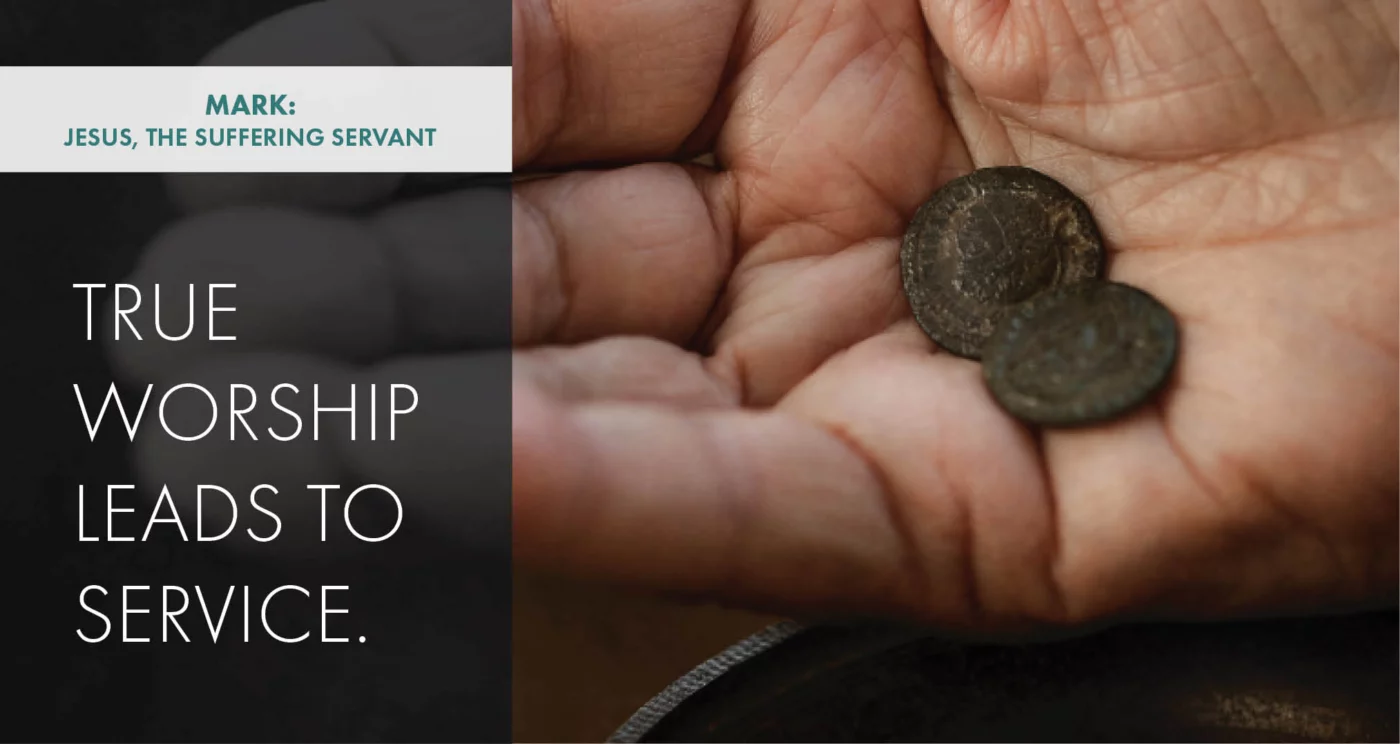
The two coins this poor widow put in were called lepta. Together, they were worth only about 1/64th of a denarius. As you may recall, a denarius was the standard wage given to a day laborer then, and those who earned it certainly couldn’t be considered wealthy. The adjective, poor, used to describe this widow means she worked for a living; she didn’t rely on charity. With her tiny gift, she wasn’t looking for man’s approval; she just wanted to serve her God humbly.
A pastor named John Broadus once planned to preach on this text. But before the sermon, he left the pulpit and joined the ushers as they received the offering. He watched closely as people put their money in the plate. As you can imagine, some people were upset, even angry. Some were confused, some shamefaced, others filled with amazement. All were surprised.
When the collection was over, Pastor Broadus went back to the pulpit. He said, “My people, if you take to heart that I have seen your offerings this day and know just what sacrifices you have made and what sacrifices you have not made, remember that the Son of God, your Savior, goes about the aisles with every usher and sees with his sleepless eye every cent put into the collection by His people.” Yes, God sees not only the amount but also our motives.
Have you ever felt like the little bit you have to give can’t possibly make much difference? According to what Jesus says here, that’s not true!
So, what makes her tiny, 1/64th of a denarius worth more than the enormous gifts of the wealthy? It’s certainly not the amount. No, Jesus said they gave out of their abundance, but this woman, out of poverty, put in everything she had. Those who gave much would barely miss what they put in. But this poor widow put in ALL she had. And she didn’t have to do it; it was voluntary. God saw her heart and her motives, not so much the amount of her gift.
Is this not what God asks us to do — give Him our all? There’s another lesson here we mustn’t miss. No one is too poor to give! Giving draws us closer to God and our fellow men.
I heard the story of a little orphan girl who, years ago, came to a mission school in Africa from an interior village. In the school, she quickly learned of the gentleness and pity of the friends of Jesus. Her greatest joy came when she was given a dress, a comb, a brush, and an enamel plate for her food. She had never owned anything before, and all these were wonderful. But she loved the plate more than anything else for its roundness, its smoothness, and its lovely color.
On the first Sunday, the little girl went to the mission church and heard many new and wonderful things. She learned that Jesus had sent these people to help her. Listening carefully, she learned more about this wonderful person, Jesus. She heard of his goodness, gentleness, and love. She learned so much that her lips quivered, and tears came. Then she saw the people go to a table at the front and lay things on it. She asked in a whisper what this meant and was told it was being done as a thank-you for the love of Him who loves us all. The little girl was heartbroken.
She said, “I love Him so much that I must find something for Him, too. Do you think he would like to have my plate?” The girl beside her, old enough to be both wise and kind, looked into her eager little face and answered softly. “Yes, he will be delighted to have your plate.”
After that, everyone in that little church saw the little girl very shyly yet eagerly walk up the aisle to the table and lay the most precious gift she had on the table.
What about you? Whom do you truly worship? I’ve been convicted as I have meditated on this text. I’ve never known want. I’ve never gone to bed hungry because no food was available. I’ve never lacked adequate clothing or shelter. I have more than I need. I’ve given out of my abundance. I want to think my motives are better than scribes and Pharisees, but I’m unsure. I must be reminded regularly that God sees my heart; He knows my motives for giving.
Yes, whom do I worship?
