
In this episode, we dig into Revelation 7:9-17 to answer a question brought by one of the elders, “Who are these?” As we answer this question, we uncover the identity of the great innumerable multitude standing before God’s throne, explore their doxology of praise, and discover the rewards awaiting those who remain faithful through the Great Tribulation.
Transcript
In Matthew 24, Jesus was teaching His disciples about the end of the age. In verses 37-39, He told them, “But as the days of Noah were, so also will the coming of the Son of Man be. For as in the days before the flood, they were eating and drinking, marrying and giving in marriage, until the day that Noah entered the ark, and did not know until the flood came and took them all away, so also will the coming of the Son of Man be.”
I take several things from Jesus’ words. First, as we approach that time, the coming of the Son of Man, life will continue in a predictable pattern. Eating, drinking, and marriage are all part of our normal human experience. However, it could also mean that these things have become the focus of life, and humans are living solely for their own pleasure. Further, Genesis 6:5 gives this description: “Then the Lord saw that the wickedness of man was great in the earth, and that every intent of the thoughts of his heart was only evil continually.”
As I read the headlines each day, my mind often turns to this verse. The inhumane treatment of human beings by other humans is inexplicable apart from the acceptance of our depravity. The violence against women and children, even infants, in human trafficking is almost unbelievable, yet it is thoroughly documented. Abortion, infanticide, and assisted suicide continue, and in some areas, are growing.
As I prepare this teaching, war between Iran and the West seems imminent, border conflicts continue between India and Pakistan, and between Cambodia and Thailand. China threatens Taiwan and its neighbors. North Korea tests longer-range ballistic missiles, and the list goes on. Amid all this, it is easy to become discouraged and fearful. If we succumb to that temptation, Satan will have us right where he wants us.
So, we must take courage and renew our hope in the promises of God and in the prophecies He’s given us in His Word. That is the goal of our study from the book of Revelation. And that was Jesus’ purpose in revealing these things to John so he could share them with the persecuted Believers of his day. We should be very grateful for this last book of the Bible!
Our text this time is Revelation 7:9-17, and we will examine it in the light of the question one of the elders asked John, “Who are These?” In our previous episode, we looked at the sealing of the 144,000 from the twelve tribes of Israel. That is the background for our text today. Now, listen as I read.
9 After these things I looked, and behold, a great multitude which no one could number, of all nations, tribes, peoples, and tongues, standing before the throne and before the Lamb, clothed with white robes, with palm branches in their hands,
10 and crying out with a loud voice, saying, “Salvation belongs to our God who sits on the throne, and to the Lamb!”
11 All the angels stood around the throne and the elders and the four living creatures, and fell on their faces before the throne and worshiped God,
12 saying: “Amen! Blessing and glory and wisdom,
Thanksgiving and honor and power and might,
Be to our God forever and ever.
Amen.”
13 Then one of the elders answered, saying to me, “Who are these arrayed in white robes, and where did they come from?”
14 And I said to him, “Sir, you know.” So he said to me, “These are the ones who come out of the great tribulation, and washed their robes and made them white in the blood of the Lamb.
15 Therefore they are before the throne of God, and serve Him day and night in His temple. And He who sits on the throne will dwell among them.
16 They shall neither hunger anymore nor thirst anymore; the sun shall not strike them, nor any heat;
17 for the Lamb who is in the midst of the throne will shepherd them and lead them to living fountains of waters. And God will wipe away every tear from their eyes.”
Our text gives us several specific ANSWERS to the question, “Who are These?”
The First Answer is,
The Great Multitude
Our text begins with words that have become familiar to us in our study: “After these things…” The things John is referring to are the events of the first eight verses of the chapter. In the case of the sealing of the 144,000, John says, “I heard the number of those who were sealed.” In contrast, he now sees a great multitude that no one can number.
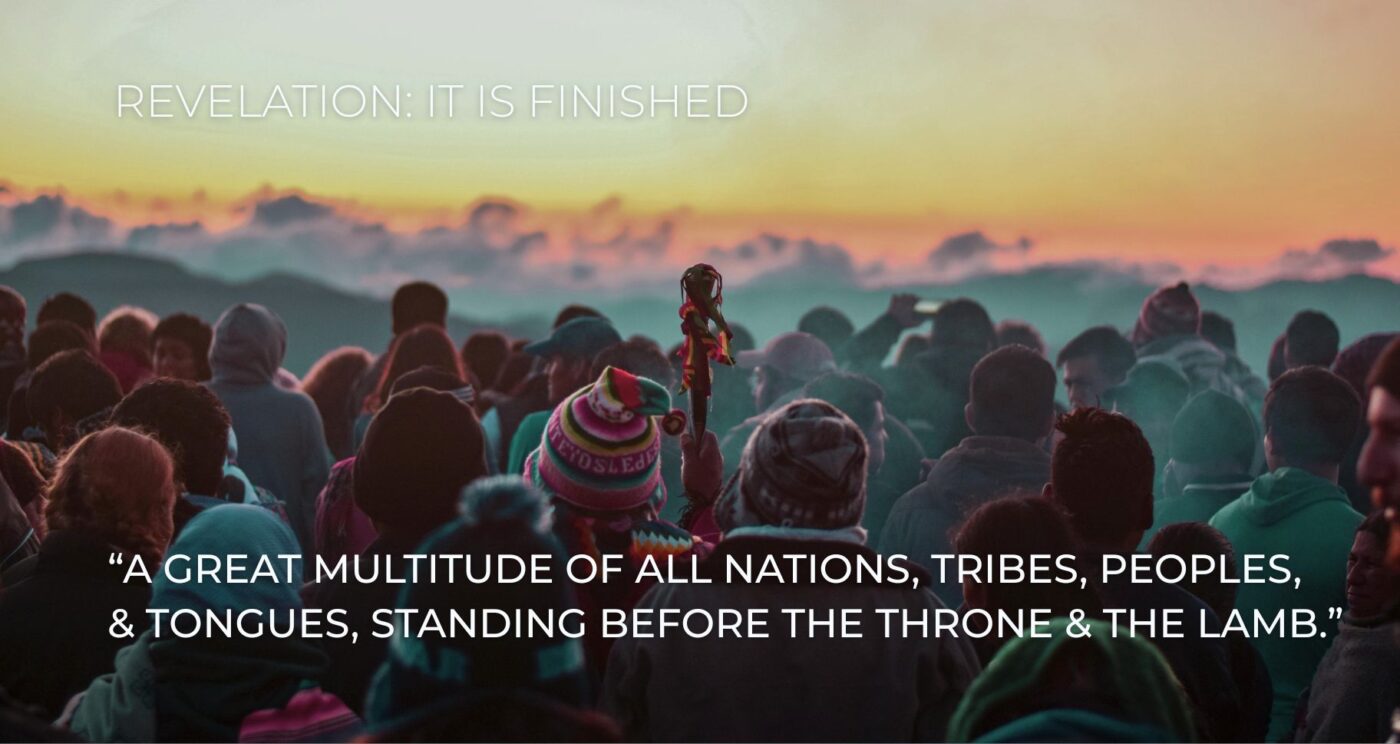
This innumerable multitude is made up of people from all nations, tribes, peoples, and languages. They are a worldwide group, not a single-ethnic group! I believe they are the fruits of Jesus’ promise in Matthew 24:14: “And this gospel of the kingdom will be preached in all the world as a witness to all the nations, and then the end will come.” This multitude may be some of the fruits of the 144,000 Jewish evangelists and the two witnesses of Revelation chapter eleven. These redeemed ones are standing before the throne of God and the Lamb.
Further, they are dressed in white robes and hold palm branches. Both white robes and palm branches symbolize victory and joy. There may be a connection here to the Feast of Tabernacles, commemorating God’s protection and provision for Israel during their wanderings.
This multitude is crying out with a loud voice, “Salvation to our God who sits on the throne and to the Lamb.” Normally, we think of Christ as the source of salvation, but these worshippers have support for their twofold praise in the pastoral epistles. In 1 Timothy 2:3, Paul refers to “God our Savior.” There is unity in the Godhead.
Salvation here is regarded as an accomplished act on the part of these worshippers, and they praise God and the Lamb for it. Notice, they are not part of the 24 elders, whom I said in an earlier episode, represent the church, the Bride of Christ. We will learn shortly where this group comes from.
The Next Answer (to the question, who are these) is,
The Great Affirmation
As this innumerable host proclaims its praise, all the angels, who stand in a circle around the throne, the elders, and the four living creatures, fall on their faces before the throne in reverential awe. I found it interesting that their worship is bracketed by the word “Amen.”
Amen always refers back to something previously said. Here’s an example from Matthew 5:17-18. “Do not think that I came to destroy the Law or the Prophets. I did not come to destroy but to fulfill. For assuredly (Amen), I say to you, till heaven and earth pass away, one jot or one tittle will by no means pass from the law till all is fulfilled.” Where our English translations use words like verily, truly, or assuredly, the word in the original is “Amen.”
So, this first amen of the angels is in response to the praises of the multitude for the gift of salvation in verse 10. Even though angels cannot experience salvation, they are very interested in it and have a desire to understand it (1 Peter 1:12). The second amen is a signal to that crowd to respond by affirming the angels’ own words of praise.
This doxology is almost identical to Revelation 5:12. The arrangement of the items differs slightly, with wealth replaced by thanksgiving, but overall it’s very similar. In chapter 5, it is the Lamb who is worshipped; here, it is God.
They first ascribe blessing to God. In Scripture, blessing is the pronouncement of good, the exaltation of character, and the acknowledgement of generosity. They actively praise, thank, and exalt Him for who He is and for His works, rather than asking Him for something.
Glory is the next item of praise. It is magnificence, splendor, exaltation, praise, and renown. We have seen this in John’s descriptions of the eternal throne room. In the New Testament, it is always a pleasant opinion concerning a person that results in praise and honor.
Wisdom is part of their praise. It is superior knowledge and enlightenment. In His omniscience, the Lamb never needs to guess; He never needs multiple plans in case one doesn’t work out. As Paul says in 1 Corinthians, “the foolishness of God is wiser than men…”
Next is thanksgiving. This is one of the new items compared to Chapter 5. Thanksgiving is a lifestyle marked by the gentle cheerfulness of a grateful heart, rather than by unseemly mirth or hilarity. The importance of thankfulness cannot be overestimated, as evidenced by passages such as Romans 1:21.
And then, honor. The original word is time (teem-ay). It has a variety of meanings, such as price, sum, or proceeds from a sale. It conveys the idea that honor comes from assigning value to something or someone. That value is demonstrated through obedience, respect, and service. A considerable part of the honor we should have for Christ is the price He paid for our redemption!
Next is power; this is inherent power residing in a person or thing by virtue of its nature. It is that which a person exerts or puts forth. It has a range of meanings from authority to omnipotence. The writer of Hebrews tells us, “[God] has in these last days spoken to us by His Son…who being the brightness of His glory and the express image of His person, and upholding all things by the word of His power…”
Finally, the choir praises the Lamb for His strength. Are strength and power the same thing? They are closely related, but in human terms, strength refers to the body’s ability to overcome resistance. Power refers to the speed of that ability. A biblical example is in Ephesians 6:10, “Finally, grow strong in the Lord and in the strength of his power.”
This doxology recognizes the infinite, immeasurable, and intrinsic power that Christ eternally possesses within Himself. This list is also very similar to the one in Daniel 7:14, showing us, once again, the connection between the prophetic Scriptures.
The Last Answer is,
The Great Tribulation
At the conclusion of this amazing doxology, one of the 24 elders approaches John with a question, even though John has not spoken. The elder asks, “These who are arrayed in the white robes, who are they and where do they come from?” The question is emphatic and reflects the natural order of the one asking it.
In response to the question, John says, “My lord, you know who they are.” This was a confession of his ignorance and an appeal for more information. If this group were identical to the church, John would have recognized them from having seen them in chapter 4. Further, the elder would not have asked him, “Who are these people?”
The elder responded, “These are they who have come out of tribulation, ‘the great one,’ and have washed their robes and made them white in the blood of the Lamb.” This metaphor, of making robes white in blood, only gains power when taken literally: those who did not capitulate under persecution have become clean and are regarded by God as sinless because they have remained faithful to Jesus, who shed his blood for them.
So, here is a second group of redeemed ones in heaven during the tribulation period. In verse 15, they point to the merits of the blood of the Lamb as the reason for their joy. In this way, they are like the representatives of the church, the elders of chapters 4 and 5, who attribute their heavenly glory to their redemption in Jesus.
However, as I mentioned briefly earlier, they are distinct from the church for several reasons. First, according to Revelation 3:10, the church is kept out of the Great Tribulation; this group came through that time of severe trial. The representatives of the church sit on thrones (Revelation 4:4); these stand before the throne. The first group wears crowns; these do not. The first group holds harps and censers; this multitude has palm branches in their hands.
If we contrast this group with the 144,000, we see clear distinctions. The 144,000 are all from the nation of Israel. This group comprises people from all nations and peoples. A specific number identifies the former group, while this group is innumerable. The text strongly implies that the first group is still on earth, not yet being glorified. The second group is in a state of glory in the presence of God and the Lamb. Is it possible that this group we’re looking at, and the group on Revelation 6:9-11 (souls under the altar) are the same? At the very least, those who were “slain for the Word of God and for the testimony which they held” are included in this multitude.
As a result of their faithfulness, the Tribulation saints are rewarded in several ways. First, because of this washing, these are before the throne of God, and they serve Him day and night in His Temple. That there is a temple in heaven shouldn’t surprise us. Hebrews 8:4-5 tells us, “For if He [Jesus] were on earth, He would not be a priest, since there are priests who offer the gifts according to the law; who serve the copy and shadow of the heavenly things, as Moses was divinely instructed when he was about to make the tabernacle.”
Furthermore, they will neither hunger nor thirst anymore. These lines are taken directly from Isaiah 49:10. Two strong human appetites will be fully satisfied in the presence of the Lamb, emphasizing the spirituality of our future life. They will no longer be exposed (in any way, shape, or form) to the burning heat of the sun (Psalm 121:6).
The One who sits on the throne “shall spread His tabernacle over them.” A picture of sacred fellowship, and the further idea of God’s Presence as a protection from all fear of evil, like the overshadowing of Israel by the Shekinah, and a possible allusion also to the tents of the feast of tabernacles and to the tent of meeting where God met Moses.
All these blessings are a result of the Lamb, who is in the midst of them, shepherding them, and guiding them to “life’s water springs” (Psalm 23:2 and Revelation 21:6). In the original language, the words of life stand first as emphatic! Shepherding is much more than feeding. It includes all the care a shepherd gives his flock, as beautifully spelled out in Isaiah 40:11.
Last, but not least, is this promise: “And God will wipe away every tear from their eyes.” This expression is one of exquisite tenderness and beauty. The poet Robert Burns said he could never read this without being so affected that he had to weep. This concept of ‘wiping away’ is used of the erasure of a name from the Book of Life in Revelation 3:5.
This comfort is a picture of what God promised through the prophet Isaiah. “For thus says the Lord: “Behold, I will extend peace to her like a river, and the glory of the nations like an overflowing stream; and you shall be nursed, you shall be carried upon her hip, and bounced upon her knees. As one whom his mother comforts, so that I will comfort you; you shall be comforted in Jerusalem,” Isaiah 66:12-13 ESV). Imagine how John’s readers, who were suffering for their faith, would have been comforted by this promise!
Today, we as followers of Jesus also take comfort in these promises. Life is hard, disappointments are many, and suffering abounds. Yet we, too, are confident that the Lamb who redeemed us continues to shepherd us and lead us to the fountains of living water. With the apostle Paul, we can say, “For I consider that the sufferings of this present time are not worth comparing with the glory that is to be revealed to us. For the creation waits with eager longing for the revealing of the sons of God,” Romans 8:18-19.
What about you? Do you have the assurance that your sins have been atoned for and you stand before God clothed in the righteousness of Christ? If not, today is the day of salvation. Don’t put it off, tomorrow may be too late!
