

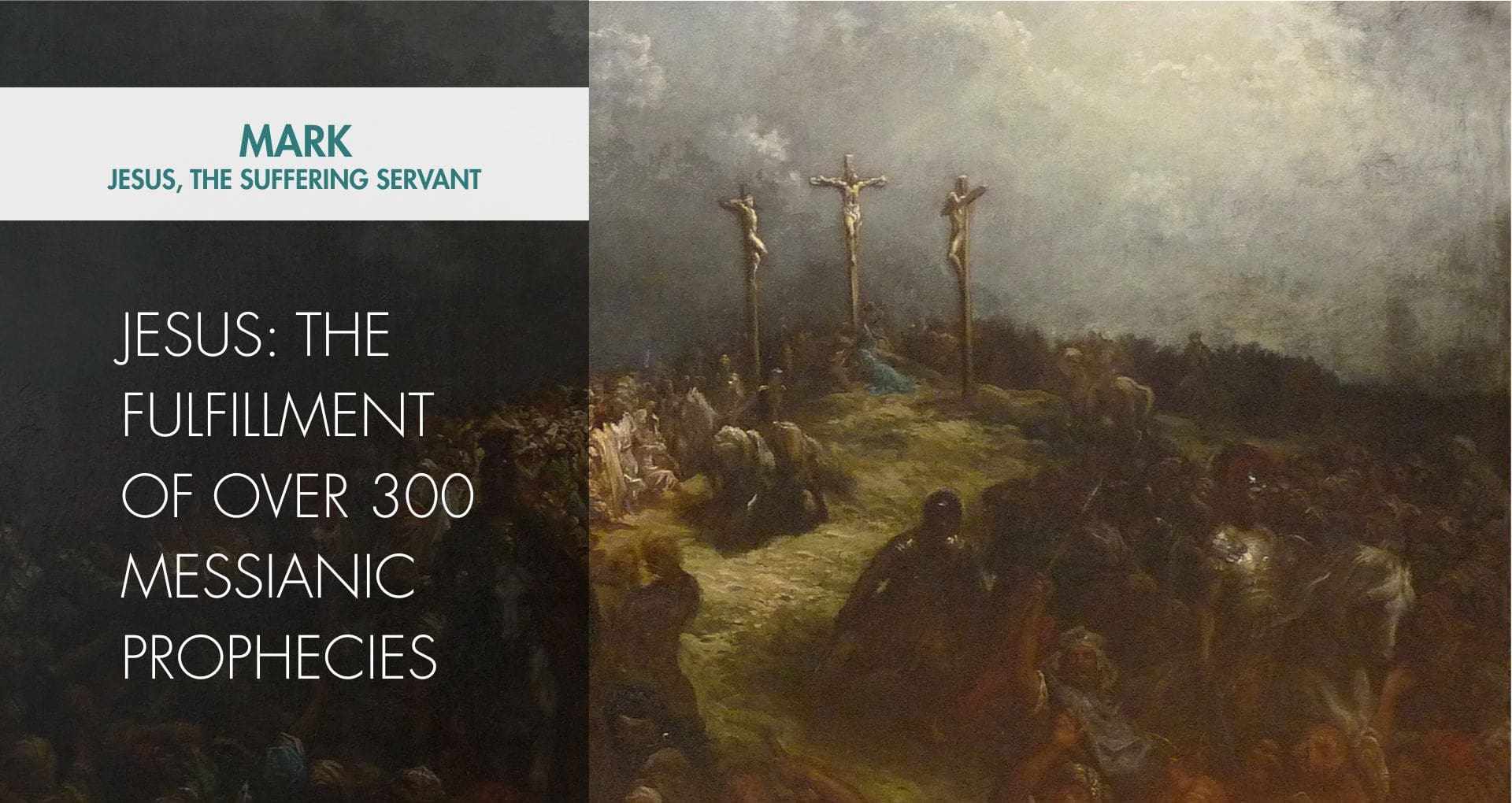
Do you know how many Messianic prophecies Jesus fulfilled during His earthly ministry? Mathematician Peter Stoner counted the probability of one person fulfilling “just” 48 of the prophecies found in the Tanakh (Old Testament) would be one in (10 followed by 157 zeros)! Yet, Jesus (Yeshua) fulfilled not just the 48 specifically Messianic prophecies. He fulfilled more than 300 individual prophecies that related to the Messiah! The first calculation was impressive enough. So, the probability of one man fulfilling 300+ prophecies must be a number beyond comprehension for anyone!
This is more than a matter of random interest. The Messiah has been prophesied in Scripture with great specificity, although sometimes these prophecies are hidden, allegorical, or poetic. And they begin with Genesis 3:15.
Applying the modern science of probability to just eight of these prophecies led Peter Stoner to conclude that the chance of the prophesied Messiah fulfilling all eight is one in one hundred quadrillion – 1 followed by 17 zeroes.
To comprehend this staggering probability, Stoner illustrates:
“…take (100 quadrillion) silver dollars and lay them evenly across the face of Texas. They will cover the state two feet deep. Now mark one of these silver dollars and stir the whole mass thoroughly. Blindfold a man and tell him that he must pick up one silver dollar and say that this is the right one. What chance would he have of getting the right one?”
“Just the same chance that the prophets would have had of writing just eight prophecies and having them all come true in any one man, from their day to the present time, providing they wrote in their wisdom… This means that the fulfillment of just eight prophecies alone proves that God inspired the writing of those [eight] prophecies to a definiteness which lacks only one chance in 100 quadrillions of being absolute.”
I don’t know about you, but I don’t need that kind of information to validate my faith in God or His Word. However, the reality of Jesus’ earthly life and ministry is amply attested to in Scripture and secular history. Those who refuse to believe in Jesus cannot cite a lack of evidence; instead, they lack the will to believe.
In this teaching episode, “When They Crucified Him,” we turn to Mark 15:16-32. This text records the events that followed Pilate’s scourging of Jesus and delivering Him to the Jews to be crucified. Listen as I read the inspired words of Holy Scripture.
Reflecting on the prophecies fulfilled in Jesus’ death should strengthen our faith, deepen our love, and increase our allegiance to the Savior. I’ve chosen several prophecies specifically from Psalm 22 and Isaiah 53.
The First Prophecy is,
A Reproach Among Men
That wonderful Messianic Psalm, Psalm 22:6, says, “But I am a worm, and no man;
a reproach of men, and despised by the people.” Isaiah 53:3 adds, “He is despised and rejected by men, a Man of sorrows and acquainted with grief.”
After Pilate released Barabbas to the crowd, he delivered the beaten, bleeding Savior into the hands of the soldiers to be crucified. Mark says, “They called together the whole garrison.” That would be one-tenth of a Roman legion, or to be specific, six hundred soldiers. The mockery that follows was not done by one or two people but by an entire cohort of Roman soldiers. Six hundred of them had their fun with Jesus.
I mentioned in the previous episode that the Roman scourging was extremely brutal. Those who were scourged were tied to an upright post, their backs were bared, and a guard used a leather-braided whip containing pieces of bone and metal to lash the prisoner until his skin came off his body and his bones and entrails were exposed. Many victims did not survive it.
Now, imagine Jesus, in such a state of physical and mental suffering, having a purple or scarlet robe mockingly draped over His battered shoulders, further irritating the raw flesh. Purple and scarlet were the colors of royalty. In addition, some of the soldiers gathered thorny vines, twisted them into a crown of sorts, and forced it roughly onto His head. Head wounds bleed profusely, and the blood from His scalp flowed down over His face and dripped onto His robe.
Then, they mockingly addressed Him, “Hail, King of the Jews.” The word, hail, means “rejoice, have joy, health!” Not yet tired of their perverse pleasures, they kept striking Him on the head with a staff, each blow driving the thorns deeper into His scalp and continually spitting on Him. Their cruelty knew no bounds! Falling to their knees, they mockingly worshiped Him.
After everyone had had their opportunity and they were tired of their sport, they stripped off the robe they had put on Him. During the time that the robe was on Him, the blood and serum seeping out of His wounds would’ve caused it to adhere to His flesh. Ripping that robe from His back and shoulders sent fresh paroxysms of pain through His tortured body. After all that, they put His clothes back on Him and led Him away to His crucifixion.
In His weakened condition, it is no wonder He could not carry His cross. Imagine the rough wood of that heavy crossbeam rubbing on His bleeding shoulders with their exposed and traumatized nerve endings. The loss of blood, dehydration from the loss of fluids, and the shock-trauma would all contribute to His weakness.
So, they compelled Simon, a native of Cyrene, a city in Libya, to carry His cross. He most likely was in Jerusalem for the Passover. He was coming into the city as this procession was heading out and was “drafted” to carry the cross. Ironically, Jesus told His disciples that if they were to be His disciples, they would have to take up His cross and follow him. The first person in human history to do so was Simon of Cyrene, who carried Jesus’ cross for him.
The text says, “They brought Him to the place called Golgotha.” The word “brought” could mean either carrying/supporting or leading. It is inconclusive. However, it is not too far-fetched to think Jesus needed assistance after His scourging, etc. Expositor’s Bible Commentary notes that “It would appear that Jesus was so weak through the strain of the last few days, and the scourging, that He was unable to walk, not to speak of carrying His cross. He had to be carried as the sick were carried to Him.”
Finally, arriving at the place of crucifixion, they offered Him a sedative, which He refused. He endured the cross in full consciousness, despising the shame, and is now seated at the right hand of the throne of God, Hebrews 12:2.
Now, we understand more clearly the sentiments of the Psalmist, “But I am a worm, and no man; a reproach of men and despised by the people.” Jesus endured all this to purchase our redemption. Why did Jesus do this? Isaiah 53:11 says, “He shall see the labor of His soul, and be satisfied. By His knowledge, My righteous Servant shall justify many, for He shall bear their iniquities.” All this indignity, all this reproach was borne by Him for our justification. What incredible and amazing love!
Another Prophecy is,
Numbered with the Transgressors
Mark tells us it was the third hour of the day, 9 am, when Jesus was crucified. He had been taken before Pilate around 6 am. He had endured hours of questioning, ridicule, abuse, torture, and humiliation. He most likely had received no food or drink since His final meal with the disciples many hours before. Then, in His extreme weakness and pain, He was nailed to the cross.
Mark’s statement about those crucified with Jesus is terse. He skips over the initial blasphemy of the two robbers and the ultimate repentance of the one. “With Him, they also crucified two robbers, one on either side. So, the Scripture was fulfilled, which says, “And He was numbered with the transgressors.” That’s a reference to Isaiah 53:12, which concludes with these words, “And He bore the sin of many, and made intercession for the transgressors.”
You may ask, “Isn’t transgression just another term for sin or iniquity?” All three words have distinct shades of meaning. Transgression is a conscious, willful act of rebellion against something or someone. The word originates from an ancient Canaanite term meaning ‘being terrified’. To transgress against God is to face a terrifying situation, and rather than trust God, trust in your own devices or plans built out of fear, and try to get others to follow your plan. That describes unconverted humanity to a tee.
Why was it necessary for Jesus to be numbered with the transgressors? First, to fulfill prophecy. But more importantly, “so that we who are miserable transgressors by both nature and practice may be reckoned innocent for Christ’s sake. It was done that we, who are worthy of nothing but condemnation, may be counted worthy to escape God’s judgment and be pronounced forgiven before the assembled world.”1
In a Roman crucifixion, it was also customary to include a placard that contained the transgressions of the condemned person. It was usually carried before the criminal or hung around his neck and later put on the cross. The placard above Jesus said, “Jesus of Nazareth – The King of the Jews.” John tells us the chief priests attempted to persuade Pilate to modify the wording on the sign. He refused. Even in this, we see Pilate mocking the Jewish leaders. Later, we’ll see how the taunts of the chief priests modified the words on the placard to suit their ends.
It was also customary for the soldiers to take the spoils of war, so to speak. They had the distasteful job of carrying out the execution and keeping the unruly crowds at bay. Part of their reward was the clothing of the victim or victims. They, too, were among the transgressors.
John’s record tells us, “Then the soldiers, when they had crucified Jesus, took His garments and made four parts, to each soldier a part, and also the tunic. The tunic was seamless, woven from top to bottom in one piece. They said, therefore, among themselves, “Let us not tear it, but cast lots for it, whose it shall be,” that the Scripture (Psalm 22:18) might be fulfilled which says: “They divided My garments among them, and for My clothing they cast lots.”
Another Prophecy is,
The Object of Ridicule
Psalm 22 is quite graphic in its prediction of the ridicule that Jesus would face. “But I am a worm, and no man; a reproach of men and despised by the people. All those who see Me ridicule Me; they shoot out their lip, they shake their head, saying, “He trusted in the Lord, let Him rescue Him; let Him deliver Him, since He delights in Him!”
Mark tells us, “And those who passed by blasphemed Him, wagging their heads and saying, ‘Aha! You who destroy the temple and build it in three days, save Yourself, and come down from the cross!” This ridicule was more brutal to endure because it acknowledged a consciousness of power held back only by the self-restraint of a sacrificed will. These scoffers didn’t realize that Jesus easily could have come down from the cross, but He stayed there in fulfillment of His Father’s will and the plan of salvation for mankind.
However, it was not just the passersby who mocked Him. “Likewise, the chief priests also, mocking among themselves with the scribes, said, ‘He saved others; Himself He cannot save. Let the Christ, the King of Israel, descend now from the cross, that we may see and believe.” This ridicule was not just stated once, but repeated multiple times.
Did you notice how the chief priests’ taunts changed what Pilate had written on the placard? Pilate had written, “Jesus of Nazareth – The King of the Jews.” They put their spin on it, substituting ’Israel’ for the Jews, and explaining ’the King’ as ‘The Christ.’ “Let the Christ, the King of Israel, come down…”
The members of the Sanhedrin lowered themselves to share the savage sport of the populace; members of the priestly aristocracy were seen in company with scribes and elders deriding the Sufferer, not indeed directly addressing Him, or mingling with the crowd, but remarking to one another on His inability to save Himself. Even in the act of mocking, they bore witness to the truth of His miraculous powers. They confessed that He had saved many people. Like the mocking passersby, they failed to realize that He could have come down from the cross.
Do you think the religious leaders would’ve believed in Jesus if He had come down? I don’t. No, they were too deeply invested in securing their position at the cost of His destruction. They remind me of the account of the rich man and Lazarus. When the rich man asked for someone to be sent to his family to warn them of their impending doom, Abraham said, “If they do not hear Moses and the prophets, neither will they be persuaded though one rise from the dead.” These religious men knew what the Scriptures said, but they refused to accept and obey them. How tragic that there are many like them, even today.
What is your response to the crucifixion of Jesus? You can’t logically deny it; it is a historically documented fact. Is that all it is to you, a historical fact? Do you treat it with familiarity, ambivalence, or as “no big deal”? Or do you realize it for what it is?
As I conclude, I offer these thoughts for your consideration.
Jesus was condemned so we can be pardoned and viewed as faultless (by the Father).
Jesus was insulted so that we can be commended.
Jesus was stripped of His clothing so that we can be clothed in righteousness.
Jesus suffered a most degrading form of death so we can have glorious, eternal life.
Jesus was counted as a sinner so that we can be counted as innocent.
Jesus, in His final moments, was mocked as an impostor that we, hypocritical sinners, might be made genuine articles of His grace.
Our sins were imputed to Jesus so His righteousness could be imputed to us.
May the Holy Spirit impress upon us the value of Jesus’ sacrifice.
