

Our culture has a love-hate relationship with future things. On the one hand, the popularity of horoscopes, astrology, and other ways of foretelling the future is very high. People have always had a hankering to peer into the future.
On the other hand, descriptions of divine judgment are met with scorn. Many people accept Jesus as a wise teacher, but reject the notion of Him as the supreme Judge. They say, “God is a god of love; He wouldn’t send anyone to Hell.” Those are both factual statements. But God’s love has provided a way by which every human being can escape eternal punishment. They will choose that path if they end up in Hell; no one will send them there.
As noted in our previous study, “The Coming of the Son of Man,” Jesus provided clear indicators of the coming judgment and the end of the age. In the verses of our text today, Mark 13:28 to 37, He gives further instruction relating to this crucial point in human history.
In the earlier verses of Mark 13, Jesus’ prophetic words pivot back and forth from the near future (the destruction of Jerusalem in 70 AD) to the distant future (the return of Christ at the end of the age). In our text, He seems to be zeroing in on conditions existing at the climax of human history. The immediate context is verses 24 to 27, which deal with supernatural disturbances in the heavens and on the earth immediately following the Great Tribulation. These will culminate with the Son of Man coming in power and great glory.
Jesus’s reminder to His hearers to be alert to the times they were living in is not a casual suggestion. His words are just as important to us today as they were when He uttered them. They are urgent, as we are nearly 2000 years closer to that promised Day of Judgment!
And what was the primary purpose of Jesus’ words in our text? It was to show us how to prepare so that these events do not catch us unaware. So, I’ve titled this message “Watch and Pray.” Let’s turn now to the text, Mark 13:28-37.
In this text, Jesus gives several necessary COMMANDS. Obeying these commands will enable us to remain vigilant as we await the return of Christ. The First COMMAND is,
Be Observant
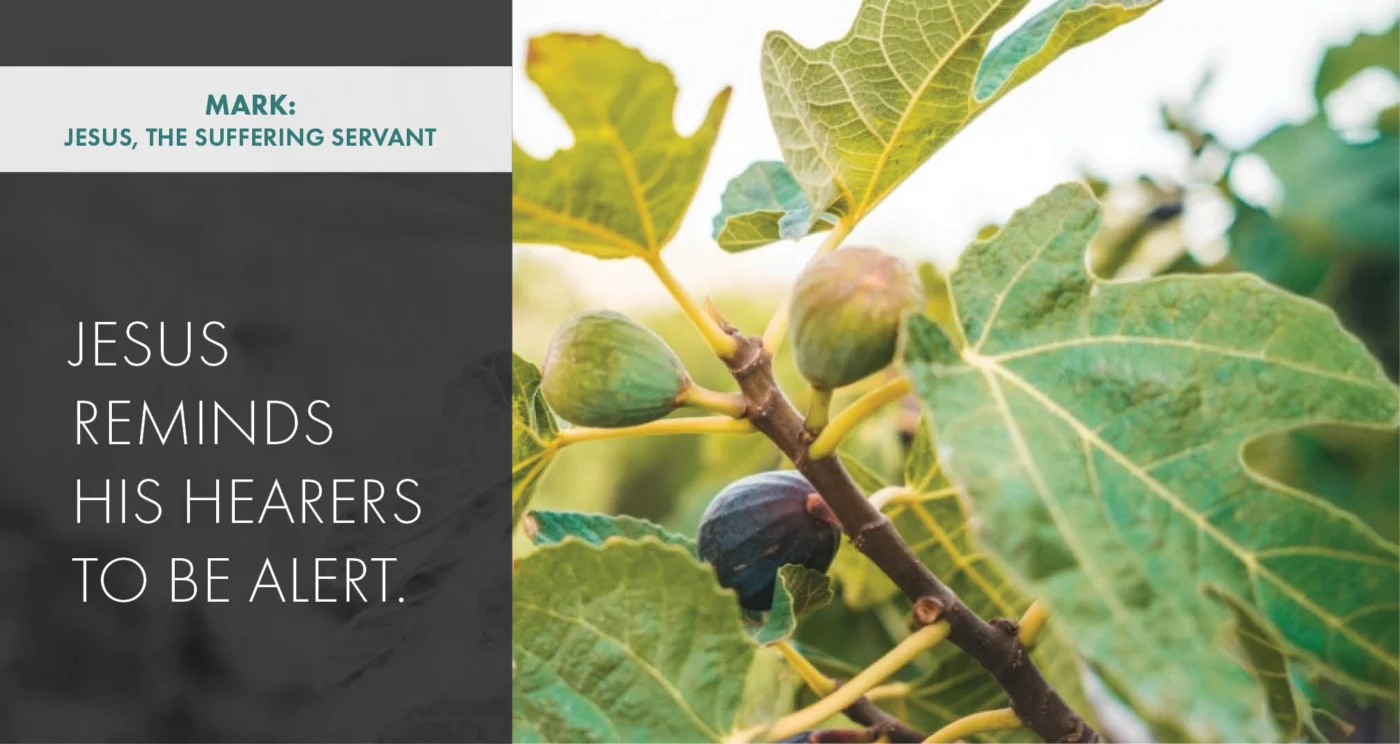
In this text, Jesus uses several words to call attention to the seriousness of our task as we await the Lord’s coming. He uses the words “take heed, behold,” and “watch.” In the opening verse, He says, “Learn a parable of the fig tree…” In other words, take a careful look! Just a glance isn’t enough; you’ll miss important details.
There’s some debate about Jesus’ reference to the fig tree. Some see it as a simple reference to a physical tree, a common sight in Bible lands. Others see it as a reference to Israel as a nation. It’s true; many Scriptures compare the nation of Israel to a vine or fig tree. Just a few are Jeremiah chapter 24, Hosea 9:10, Joel 1:7. Some Bible teachers believe that the “fig tree” budded in May 1948 when Israel once again became a nation. Maybe that’s a valid conclusion, but it’s not readily apparent in this text.
When the fig tree begins to push out blossoms and leaves, you know summer is not far behind. In the same way, Jesus said, when you see the events I’ve told you about coming to pass, you should realize that the coming of the Son of Man is very near. Even young children can follow Jesus’ reasoning.
Remember how Jesus rebuked the Pharisees and scribes for their failure to read the signs of their time? He said, “You can discern the weather by the color of the sky or the direction of the wind, but you’re oblivious to the times you’re living in. You don’t recognize me as the fulfillment of the prophecies you’ve studied for years.” You should be paying attention!
“Just like the fig tree blooming signals the nearness of summer, when the events I’ve told you about (in this chapter) are happening (present tense), then you know the kingdom of God is very near. And you need to take appropriate action.” In the earlier verses, in Jesus’ specific predictions about the destruction of Jerusalem, He gave them warnings particular to that time. In the same way, He warns us about the Day of Judgment that’s coming and how we should prepare ourselves for it.
Oh, but people scoff. “There have been wars and rumors of wars ever since Cain killed Abel. There have been earthquakes, famine, and disease for as long as the world has existed. How can you say these things point to the coming of Christ?” Well, I didn’t say it, Jesus did! If you don’t accept what He said, that’s between you and Him; although, I would add, that will be detrimental to your future. Your rejection of truth doesn’t change the truth!
Others may say, “Well, we only think there are more of these calamities because we have much better communication than previous generations.” I don’t debate the last part of that statement. But I also know that our day was/is not unseen by Jesus. He sees all time as NOW!
Then Jesus makes a statement that scholars have wrestled with for a long time. “Assuredly I say to you, this generation shall (absolutely) not pass away until all that is predicted is fulfilled.”
Let’s start with the obvious. Jesus couldn’t have been referring to those in the audience because they are all dead. Some say this chapter speaks only of the destruction of Jerusalem, but clearly, there are things predicted here by Jesus that didn’t happen in that event. In addition, few who heard Jesus say this were alive in AD 70.
So, what did He mean? Notice that right after Jesus makes this statement, He follows it up with verse 33. “Heaven and earth shall pass away: but my words shall not pass away.” What Jesus said will come to pass!
Some have suggested that Jesus is referring to the human race; that it will continue until all the things predicted will come to pass. That’s undoubtedly true, but not how the word generation is used. Others suggest the unbelieving Jews were present at that time, and today, the Jews as a people group still do not believe in Jesus as Messiah. Some individuals have embraced Him as Messiah, but not the nation. So that seems like a possibility, but again, not the usual way the word generation is used.
The understanding I believe makes the most sense is that the generation that begins to see the signs mentioned in verses 25 and 26 will be the same generation to see the end of human history as we know it. The emphasis is on the certainty of the end, rather than on a specific date. People expected the end of human history; we know that from the disciples’ question at the beginning of this chapter. So, Jesus stated a particular kind of end and the signs accompanying it.
Jesus urges us to be observant of our times; the New Testament Epistle writers echo that counsel repeatedly. Let’s keep our eyes open because our redemption is drawing near!
The Next COMMAND is,
Be Vigilant
Jesus clearly stated that God the Father is the only one who knows when these final events will unfold. “But of that day and hour no one knows, not even the angels in heaven, nor the Son, but only the Father.” Jesus must be speaking of the Second Coming, because he made predictions about the coming destruction of Jerusalem shortly. Anyone who claims to know the particular time of the Second Coming of Christ is a deceiver.
Here, we have a positive command, among the last words of teaching that Jesus gave before going to the Cross. Because the Day of the Lord will come unexpectedly upon those who dwell on the earth, we must be alert and WATCH! Jesus’ command means to be sleepless, constantly alert. It is imperative to keep on watching and being alert. And why must we watch? It is so easy to be overcome by life’s daily obligations and the pursuits of wealth and pleasure. These things gratify our physical senses but dull our spiritual ones.
A sentry on his post must be vigilant. If he fails in his duty, he will pay for it with his life, and many others may lose their lives too. If you and I fail to be vigilant, others may suffer from our lack of vigilance. Ezekiel 33:1-11 provides us with a graphic warning about those who, as God’s messengers, fail to watch and warn those under their care.
And then Jesus gives another present imperative: “keep on earnestly praying.” Paul echoes this command in First Thessalonians 5:13: “Pray without ceasing.” Why? So, you may be strong enough to prevail and escape all these terrible judgments that are coming. This prayer isn’t “now I lay me down to sleep…” This is prayer like Elijah’s: earnest and fervent. And according to James 5:16, it is effective prayer; prayer that makes a difference. Remember, Jesus’ disciples were given this warning in the Garden of Gethsemane and failed their Master miserably.
As I read verse 33, I was reminded of the words of the apostle Paul in Second Corinthians 11. In a brief catalog of some of the things he suffered for the cause of Christ he listed these in verses 27 and 28: “…in weariness and toil, in sleeplessness often, in hunger and thirst, in fasting often, in cold and nakedness; besides the other things, what comes upon me daily: my deep concern for all the churches.” We know Paul’s deep concern for the church was the subject of many prayers. What an example Paul is for us! He was vigilant.
What about you and me; are we vigilant? Are we watching and praying? Or are we like those Jesus described in Luke 21:34, having our “hearts be weighed down with carousing, drunkenness, and cares of this life…” We don’t do those things. Really? What about the emphasis among many professing Christians on pleasure and leisure time? During these summer months, some churches are half-empty because so many parishioners are at the beach, in the mountains, or off on some other pursuit of pleasure.
What about working so much that our families suffer, or we do not have time to fellowship with God’s people, or gather with them for seasons of prayer? We’re working hard to make life easier for our children or heaping up treasures we’ll leave behind when our time on earth is over. The Scriptures remind us that as we see the end of the age approaching, we need more times of fellowship and connectedness, not less.
The apostle Peter warns, “Be sober; be vigilant; because your adversary the devil walks about like a roaring lion, seeking whom he may devour. Resist him, steadfast in the faith, knowing that the same sufferings are experienced by your brotherhood in the world. But may the God of all grace, who called us to His eternal glory by Christ Jesus, after you have suffered a while, perfect, establish, strengthen, and settle you.To Him be the glory and the dominion forever and ever.”
There is a reason why Jesus repeats His command to “watch” so often in these few verses.
The Final COMMAND is,
Be Busy
Jesus said His return will be “like a man going to a far country, who left his house and gave authority to his servants, and each his work, and commanded the doorkeeper to watch.” This reminds me of the parable of the minas in Luke 19.
“He spoke another parable, because He was near Jerusalem and because they thought the kingdom of God would appear immediately. Therefore, He said: “A certain nobleman went into a far country to receive for himself a kingdom and to return. So, he called ten of his servants, delivered to them ten minas, and said to them, ‘Do business till I come.’” We should not sit around twiddling our thumbs waiting for these things to happen. We are to work while we wait.
Did you notice that Jesus gave authority to His servants and a specific work for each to perform? One of those positions of responsibility was to guard the door. Like the parable of the minas, the servants understood that their master would ultimately return. What they didn’t know was the specific time he would come.
Jesus told numerous parables to reinforce this truth. One of them is in Luke 12. “And the Lord said, “Who then is that faithful and wise steward, whom his master will make ruler over his household, to give them their portion of food in due season? Blessed is that servant his master will find so doing when he comes. Truly, I tell you that he will make him ruler over all he has. But if that servant says in his heart, ‘My master is delaying his coming,’ and begins to beat the male and female servants, and to eat and drink and be drunk, the master of that servant will come on a day when he is not looking for him, and at an hour when he is not aware, and will cut him in two and appoint him his portion with the unbelievers.
This unfaithful steward was busy. However, his business was centered on himself, what he wanted, not what his master wanted. And that is our tendency, too. We’re busy, alright, but too often we’re busy with the wrong things.
What is the focus of your labor? The Psalmist said, “Unless the Lord builds the house, they labor in vain who build it; unless the Lord guards the city, the watchman stays awake in vain.” Let’s not be like the prosperous farmer Jesus told about in Luke 12. Jesus didn’t condemn him for his success or his work. He condemned him because “he laid up treasure for himself, and was not rich toward God.”
Jesus closes this section of teaching with a final admonition to watch. In it, he lists the four, 3-hour watches of the night: 6 to 9 pm, 9 pm to midnight, midnight to 3 am, and 3 to 6 am. The application is, we must be ready at all times for His coming!
Are you watching and praying? Our text reveals the importance of obeying these commands. Be observant; pay attention to where we are on God’s clock. Be vigilant; always be on your guard and pray in every life situation. Be busy, doing the work God has called you to do with laser-like focus on His kingdom. If you watch and pray, the coming of the Lord will NOT take you by surprise.
