
Have you ever considered the remarkable gift bestowed upon us by God in our human voice? It is one of the likenesses of being made in His image. We use our voices to speak or to sing. With the same voice, we can both bless God and curse men, as James 3:9 reminds us.
Our human voice is a unique characteristic that each of us possesses. It provides insight into our condition or personality. It changes throughout our lifespan and in response to external stimuli, or due to misuse. Our voice is a complex and not fully understood process. It involves several functions that must work in cooperation, including breathing, swallowing, laughing, whispering, crying, coughing, and speaking, with brain function overlapping in these various activities. Basic emotions of voice are universally recognized across all cultures and languages.
This remarkable gift from God enables us to communicate with Him and with one another. The power of voice first appears in the Creation account. After describing the pre-creation state of the earth, the text says, “Then God said…” Except for humans, all created things came into existence by the power of God’s spoken word.
The Hebrew writer expands on this truth. “God, who at various times and in various ways spoke in time past to the fathers by the prophets, has in these last days spoken to us by His Son, whom He has appointed heir of all things, through whom also He made the worlds…” John introduces Jesus as the Logos, the eternal, living Word.
For the past several episodes of The Voice of Hope, we’ve been studying Jesus’ crucifixion. Think about how voices played a prominent part in these proceedings. The singing of a hymn after the Last Supper. Agonizing prayers of the Savior in the Garden, followed by a hypocritical greeting by Judas. The religious leaders set forth the accusations and false witnesses. The angry, insistent voices of the crowd, “Crucify Him!” The mocking jeers of the crowd, the criminals, and the soldiers. All these voices communicated a variety of desires, feelings, and aspirations.
In Mark 15:33-41, we take special note of “Voices from Calvary.” As I read the text, take note of the voices that are heard, the words spoken, and the impact of those words.
This text makes several significant STATEMENTS that enhance our understanding of the meaning and implications of Jesus’ death.
The First STATEMENT is,
An Exclamation of Pain
Our text begins by describing the supernatural darkness that covered the land from noon to 3 pm. I take that to mean that the whole portion of the Earth that was experiencing daylight suddenly went dark. Why? Because the sun was darkened. This was not an eclipse because Passover was celebrated at the time of the full moon. It was the supernatural power of God. According to Psalm 19, nature speaks, even though it has no audible words.
Darkness is always a symbol of judgment, and Jesus, the sinless Son of God, was bearing the punishment, the judgment for the sins of all humanity. No wonder the sun refused to shine!
At 3 pm, the voice of Jesus rang out loudly, “My God, My God, why have you forsaken Me?” The word, forsaken, carries the idea of deserting someone in circumstances that are against them. The fact that Jesus cried with a loud voice is supernatural. One of the torments of crucifixion was suffocation. The position of the victim on the cross made it difficult to exhale, resulting in a gradual buildup of carbon dioxide in the blood and a corresponding lack of oxygen. Lack of breath affects the volume and tone of the voice.
However, let’s focus on Jesus’ exclamation of pain. As humans, we experience pain at various levels. Here, Jesus was dealing with severe emotional pain; the feeling of being abandoned by His Father. If you’ve been abandoned by someone you love in the moment of your greatest trial, you have some understanding of this pain.
One question that came to me as I studied and meditated on this text was: Did God truly forsake Jesus when He was on the cross? You might say, “Pastor J. Mark, isn’t that what the text says?” Yes, but where did these words that Jesus spoke come from? They are recorded in Psalm 22, a portion of Scripture that I drew excerpts from in my previous message.
Psalm 22, which Jesus quotes on the cross, begins with a profound lament expressing distress and a sense of abandonment. However, the psalm does not end in despair; on the contrary, as we progress through the verses, there is a change in tone.
In Psalm 22:24, we read, “For he has not despised or abhorred the affliction of the afflicted, and he has not hidden his face from him, but has heard, when he cried to him.” This powerful statement highlights God’s faithfulness in responding to the cries of the afflicted. The context of the final verses of Psalm 22 is one of trust in God, acknowledging His sovereignty and providence.
Considering Jesus’ quotation of Psalm 22 on the cross, we can interpret it as Him expressing the deep agony of feeling separated from God amid suffering. In His complete unity with the Father, He had never experienced anything like this before! However, the full understanding of Psalm 22 emphasizes that God did not forsake the afflicted, and the situation eventually turns into praise and trust in divine faithfulness.
Further, the New Testament provides additional insights. In John 16:32, Jesus speaks to the disciples about the impending hour of the cross, stating, “Behold, the hour is coming, indeed it has come, when you will be scattered, each to his own home, and will leave me alone. Yet I am not alone, for the Father is with me.” This statement highlights God’s constant presence even in the most challenging moments of Jesus’ life.
This is in no way an attempt to minimize the tremendous pain Jesus felt, not so much physically, although that was great, but emotionally and spiritually. We have never been like Him, “completely free from sin and one with the Father,” therefore, we cannot fathom the feelings Jesus experienced as our sin-bearer.
Add to that pain the continued mocking of the bystanders. Based on Jesus’ cry, some bystanders mistakenly thought He was calling for Elijah. Alfred Edersheim says no Jew would make this mistake and attributes it to the faulty understanding of Hebrew by the provincial Roman soldiers. Others suggest the misunderstanding is affected, that is, those mocking Him knew what He said but pretended not to.
Whatever the case, one of them ran and filled a sponge with wine, put it on a hyssop stalk, and gave Him a drink. This scoffer scornfully cried, “Let Him alone, let’s see if Elijah will come to take Him down.”
Jesus’ exclamation of pain came from the depths of His being. May we bow in awe and worship that He endured such pain, carrying the weight of our sins on the cross.
The Next STATEMENT is,
An Exclamation of Triumph
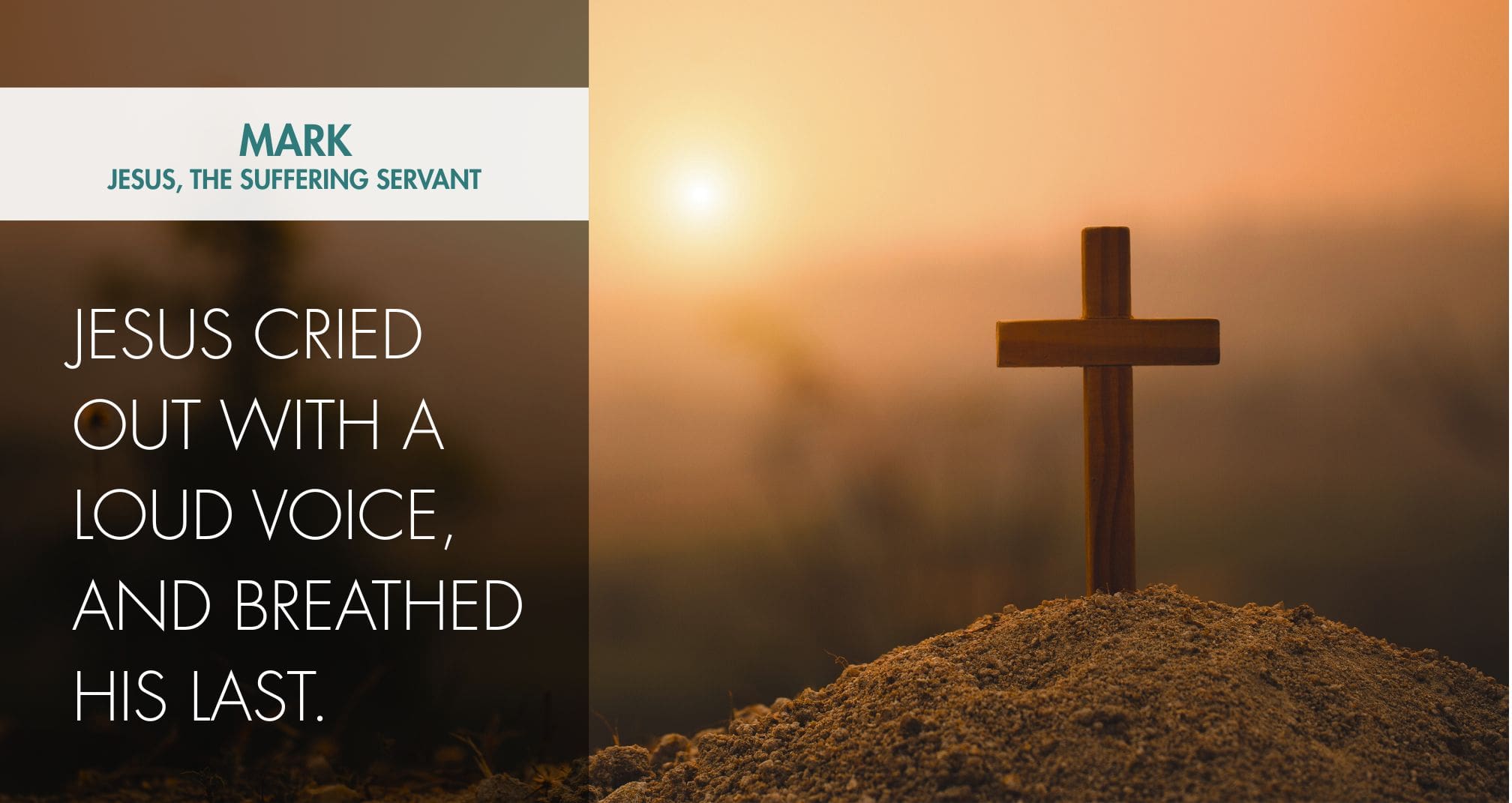
Most of us have heard of “the seven last words of Christ.” However, to glean those words, we must look at each of the four gospels. Mark, however, moves directly from Jesus’ exclamation of pain to this statement, “And Jesus cried out with a loud voice, and breathed His last.”
Luke records Jesus’ exclamation of triumph, “Father, into Your hands I commit My spirit.” Alfred Edersheim counsels us to “Notice, the ‘My God’ of the fourth Utterance had again passed into the ‘Father’ of conscious fellowship. And yet neither in the Hebrew original of this Psalm, nor in its Greek rendering by the Septuagint, does the word ‘Father’ occur. Again, in the translation of the Hebrew text, this word expressive of entrustment – the commending – is in the future tense; on the lips of our Lord, it is in the present tense.”
John records Jesus saying, “It is finished.” At that moment, our forgiveness was completed; there was nothing more to be done.
But some will ask, “Why did Jesus have to die? Why did the innocent God-Man have to die for sinful human beings?” The grounds and the necessity for Christ’s offering payment and satisfaction for our sins are to be found in the character of God Himself. The reason an atonement was necessary is that God is just, righteous, and holy.
In the words of R.C. Sproul, “We have lost sight of God’s character in our age. We conceive of God as some celestial grandfather, a cosmic bellhop who is on duty every hour of every day to give us all our needs. We allow the love of God to swallow up His justice and righteousness and obscure His holiness. We think that not only will God forgive all our sins without an atonement, but we also believe He must forgive us if He is going to be good and loving. Yet on the other side of that coin always stands His holy, righteous justice that must be satisfied.” That is the meaning of propitiation. It refers to the turning away of the wrath of God as the just judgment of our sin by the sacrifice of Jesus Christ on the cross.
The fact that Jesus’ exclamation of triumph completed our salvation was powerfully and graphically illustrated by the tearing of the veil in the Temple, separating the Holy Place from the Most Holy Place. The unseen hand of God tore that heavy veil. We’re told it was 60 feet long and 30 feet wide, the thickness of a man’s palm, or approximately 4 or 5 inches. Imagine how the sound of such a cloth tearing must have reverberated through the Temple courts.
With all the activity taking place in the Temple during Passover, many priests must have witnessed this striking event. Imagine the fear it struck into their hearts. It is perhaps why we read in Acts chapter 6 and verse 7 that “…the number of disciples increased daily, and a great number of priests were obedient to the faith.” This was a graphic, visual object lesson of what Jesus was accomplishing through His death. The way into the Holiest Place was now open to all who, by faith, accept the blood of Jesus as the only sufficient payment for their sin.
Jesus’ death was the exclamation point of the Old Testament Law. In His sinless perfection, He fulfilled all the Levitical requirements and now abrogated them.
The writer of Hebrews reminds us, “For the law, having a shadow of the good things to come, and not the very image of the things, can never with these same sacrifices, which they offer continually year by year, make those who approach perfect. For then would they not have ceased to be offered? For the worshipers, once purified, would have had no more consciousness of sins. But in those sacrifices, there is a reminder of sins every year. For it is not possible that the blood of bulls and goats could take away sins.”
He continues, “And every priest stands ministering daily and offering repeatedly the same sacrifices, which can never take away sins. But this Man, after He had offered one sacrifice for sins forever, sat down at the right hand of God, from that time waiting till His enemies are made His footstool. For by one offering He has perfected forever those who are being sanctified.” Hallelujah; He has perfected forever those who are being sanctified; that’s you and me!
The final cry of Jesus on the cross continues to echo down through the corridors of time. Every person who places their faith in Jesus alone for the forgiveness of their sin can echo that cry. Not in the same way Jesus did, because humans cannot save anyone. However, when we confess with our mouth the Lord Jesus and believe in our hearts that God has raised Him from the dead, our sinful past is finished; it is atoned for, it is nailed to His cross, and we are set free!
It is my prayer that you are resting in that exclamation of triumph.
The Final STATEMENT is,
An Exclamation of Testimony
After observing all that had taken place during those hours, including the darkness, the earthquake, the taunts and jeers of the Jewish leaders, the dialogue between Jesus and the criminals, and Jesus’ mostly silent suffering, the centurion concluded, “Truly, this man was the Son of God.” What irony! This pagan, Roman soldier, who most likely had witnessed many deaths by crucifixion, saw in Jesus a remarkable difference. He had never seen a condemned man die with such dignity, grace, and words of forgiveness! His words are a declaration set over against all that the mocking Jewish crowd thought or said about Jesus.
Mark draws a curtain over this heart-rending scene with the words, “There were also women looking on from afar, among whom were Mary Magdalene, Mary the mother of James the Less and of Joses, and Salome, who also followed Him and ministered to Him when He was in Galilee, and many other women who came up with Him to Jerusalem.”
While their testimony was nonverbal, they were looking on intently from a distance. They were deeply invested in what was happening. Unlike the other disciples, they hadn’t fled. Perhaps John had advised them to stay back to escape the insolence and mockery of the crowd.
Their presence is a powerful and courageous witness to their love for the Savior. He had elevated their status as women, graciously accepting their ministry to Him and the other disciples. Mary Magdalene, Mary the mother of James the Less, and Mary the mother of Jesus were among them. They served Jesus and the disciples as only godly women can. Their testimony lives on in the pages of Scripture for all time.
Jesus endured all the mockery, all the humiliation, all the pain for you. Yes, the physical pain must have been excruciating. But the emotional and spiritual pain was beyond our ability to comprehend. We know we are sinners by nature, and the Scripture tells us plainly that the wages of sin are death. That is what we deserve; they are what we have earned. But not Jesus. He was completely innocent. Yet, He willingly took our punishment upon Himself. “He was wounded for our transgressions, He was bruised for our iniquities; the chastisement for our peace was upon Him, and by His stripes we are healed.”
When He uttered that final cry from the cross, His followers must have concluded that this was the end. No one there understood that it was a cry of triumph. No one yet grasped that the old covenant, based on the blood of the animal sacrifices, was now complete, and His final cry opened the way for the new covenant through His blood. That would come later. However, the testimony of the centurion rings out across the millennia, “Truly, this was the Son of God.”
Yes, my friend, the sacrifice of Jesus is finished. It is complete. Nothing can be taken from it or added to it. It is sufficient to atone for all sin, for all people, for all time. His sacrifice alone has the power to make us righteous in the sight of Almighty God. Have you, by faith, claimed that righteousness as your own?
