
In this episode, J. Mark explores Revelation 5:1-7, where the sealed scroll is revealed by the Sovereign God. This scroll is God’s complete plan for history and redemption, and no one is worthy to open its seal. As John weeps over humanity’s hopelessness, Jesus—the Lamb who was slain—steps forward as the only One worthy to open the scroll. Join us as we see how Christ’s victory qualifies Him to unfold God’s plan, bringing judgment, redemption, and the promise of Eden restored.
Transcript
What would you give, or how much would you pay, to know the future, your future, or the future of humanity? A desire to see the future is almost as old as humanity. Obviously, we can’t pay someone to reveal the future to us, and even if we could, we may not like what we see!
In Daniel’s final vision of the end of the age, the angel told him, “But you, Daniel, shut up the words, and seal the book until the time of the end; many shall run to and fro, and knowledge shall increase.” While there is much we do not and cannot know, the future of human history is not entirely obscured to us, and the message to Daniel implies growing revelation.
The Holy Scriptures reveal what God has in store for humanity and the whole creation. For Believers, we’re promised, “For the Lord Himself will descend from heaven with a shout, with the voice of an archangel, and with the trumpet of God. And the dead in Christ will rise first,” 1 Thessalonians 4:16.
For unbelievers, “And I saw the dead, small and great, standing before God, and books were opened. And another book was opened, which is the Book of Life. And the dead were judged according to their works, by the things written in the books,” Revelation 20:12.
For the created world, “But the day of the Lord will come as a thief in the night, in which the heavens will pass away with a great noise, and the elements will melt with fervent heat; both the earth and the works that are in it will be burned up,” 2 Peter 3:10.
These are three scriptural passages among many that speak to future events. As we study God’s last book, we come to Revelation 5:1-7. In this text, we encounter a scroll or book that contains essential information, but it is sealed. Here is the Word of God from Revelation 5:1-7.
5 And I saw in the right hand of Him who sat on the throne a scroll written inside and on the back, sealed with seven seals.
2 Then I saw a strong angel proclaiming with a loud voice, “Who is worthy to open the scroll and to loose its seals?”
3 And no one in heaven or on the earth or under the earth was able to open the scroll, or to look at it.
4 So I wept much, because no one was found worthy to open and read the scroll, or to look at it.
5 But one of the elders said to me, “Do not weep. Behold, the Lion of the tribe of Judah, the Root of David, has prevailed to open the scroll and to loose its seven seals.”
6 And I looked, and behold, in the midst of the throne and of the four living creatures, and in the midst of the elders, stood a Lamb as though it had been slain, having seven horns and seven eyes, which are the seven Spirits of God sent out into all the earth.
7 Then He came and took the scroll out of the right hand of Him who sat on the throne.
We will aim to illuminate this text by examining the PARTICIPANTS in this scene and their interactions with the sealed book.
The First Participant is,
The Sovereign God
Our text opens with these words, “And I saw on the right hand of Him who sat on the throne…” As John observes the worship scene in heaven in chapter four, his attention is arrested by something new. He sees the Sovereign God sitting on His throne. On His outstretched, open hand, a scroll lies. This is a very similar picture to Ezekiel 2:9. “Now when I looked, there was a hand stretched out to me; and behold, a scroll of a book was on it.”
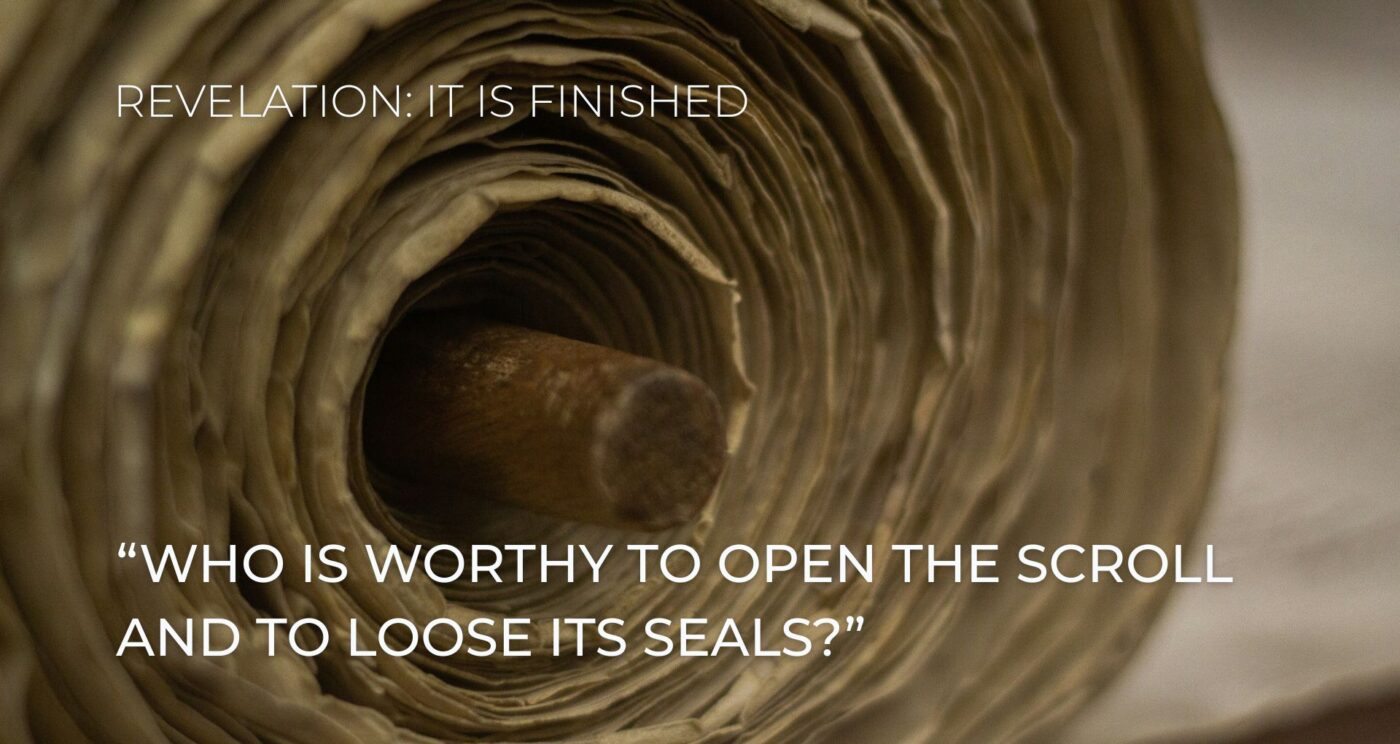
If we imagine a Torah scroll used in contemporary Jewish worship, we have a general idea of what this heavenly scroll looks like. One of the things John notices immediately is that the scroll has writing on both sides. This is unusual but not unheard of. Writing materials in that age were costly, so using both sides of the scroll would be the best use of the resource.
However, since this is a heavenly scroll, there must be more to it than economy. God doesn’t need to scrimp on materials! The writing on both sides may indicate the completeness of the divine counsels contained in the scroll. Ezekiel 2:10 tells us, “Then He spread it [the scroll] before me; and there was writing on the inside and on the outside, and written on it were lamentations and mourning and woe.” As we move further into the Book of Revelation, we will see that the contents of the scroll John saw are very much like what Ezekiel saw.
Another unusual detail John observed about this scroll, lying in the hand of the One on the throne, was its seal. The literal translation is “sealed down with seven seals.” The purpose of the seals was to safeguard the document’s contents. If the seals were broken, that meant the document may have been tampered with and was no longer trustworthy.
“This concern was valid and can be seen at the end of Revelation. The scribes who copied and those who translated, and anyone else, were warned about adding or deleting anything from John’s writings. ‘For I testify to everyone who hears the words of the prophecy of this book: If anyone adds to these things, God will add to him the plagues that are written in this book; and if anyone takes away from the words of the book of this prophecy, God shall take away his part from the Book of Life, from the holy city, and from the things which are written in this book.’”[1] The message in the scroll John saw was inviolable!
In my study, I learned that these seals were most likely successive. That is, opening one seal permitted access to one portion of the scroll. Then, as each one was broken, another portion of the scroll was revealed. We will see this exact scenario play out beginning in chapter six. Also, a will in Roman law bore the seven seals of seven witnesses. But this scroll John saw does not need any witnesses beyond God Himself. Some see the number seven, so common in Revelation, as indicating the completeness of God’s purposes. Given what follows, that seems logical to me.
As the Sovereign God holds this unusual scroll, the next participant enters.
The Next Participant is,
The Strong Angel
John sees and hears a mighty angel proclaiming with a loud voice, “Who is worthy to open the scroll and to break its seals?” This strong angel needed a voice that would reach the farthest corners of the universe, according to verse three.
However, the angel isn’t issuing a proclamation; he’s asking a question. “Who is worthy, capable, or qualified (by rank, character, or ability) to open the scroll and break its seals?” I notice a couple of interesting details here.
First, by asking the question, the angel confesses his inability to make disclosures about the future. Second, he mentions opening the scroll before he mentions breaking the seals. That seems backwards. I understand the Greeks had a rhetorical device they called “later-earlier.” It reverses the chronological order of words or ideas by placing the second element first. It was designed to catch the attention of the listener or reader. It is like us saying “shoes and socks” instead of “socks and shoes.”
Notice what happens next. “And no one in heaven or on the earth or under the earth was able to open the scroll, or to look at it.” Now we have a problem. We have a scroll that, on its face, contains critical information, and we have no one in heaven, on earth, or in Hades qualified to even look at it, let alone open it. John responds to this accordingly.
The Next Participant is,
The Weeping Seer
Upon realizing that no one is qualified or worthy to open this mysterious scroll, John is devastated and weeps aloud, uncontrollably. It seems the mysteries contained in this scroll will forever remain concealed from human understanding. In the context of the vision, the fate of the entire universe hangs on finding someone worthy to open the scroll. John was experiencing sensations and emotions associated with heavenly realities rather than ordinary human perceptions. He may have felt despair.
Perhaps, like us, John wondered why the One on the throne holding the scroll did not open it for Himself? God the Father didn’t open the scroll, not because He couldn’t, but because the scroll represented the Father’s unfolding plan of redemption and judgment. This plan required a uniquely qualified Redeemer to execute it through His sacrificial death and resurrection. No created being, not even angels or Satan, was worthy to break the seals, but Jesus, the Lamb who was slain, proved worthy by conquering sin and death, thus fulfilling the necessary conditions to implement God’s plan.
In some ways, we are like John. Without divine help, we can’t know anything about the future. If God chose not to reveal Himself to us, we, too, would weep in despair.
The Final Participant is,
The Slain Lamb
As John weeps, one of the 24 elders addresses him. “Stop weeping. Behold, the Lion of the tribe of Judah, the Root of David, has prevailed to open the scroll and to break its seven seals.” Before we examine these titles separately, note that descent from both Judah and David was a necessary qualification for the Messiah.
The elder’s first description of Jesus comes from Genesis 49:8-10. “Judah, you are he whom your brothers shall praise; your hand shall be on the neck of your enemies.
Your father’s children shall bow down before you. Judah is a lion’s whelp; from the prey, my son, you have gone up. He bows down, he lies down as a lion; and as a lion, who shall rouse him?The scepter shall not depart from Judah, nor a lawgiver from between his feet, until Shiloh comes; and to Him shall be the obedience of the people.”
Further, Jesus is identified as the Root of David in Isaiah 11:1 and 10. “There shall come forth a Rod from the stem of Jesse, and a Branch shall grow out of his roots.” And verse 10, “And in that day there shall be a Root of Jesse, who shall stand as a banner to the people; for the Gentiles shall seek Him, and His resting place shall be glorious.”
Both the Genesis and Isaiah texts present a unified picture of Christ, who is fully qualified to rule Israel and the nations because he has “overcome” both his enemies and God’s. The elder specifically informs John that this person, the Messiah, has won the victory, and He alone is worthy to break the seals and open the book. This theme of overcoming is prominent in the Book of Revelation and in John’s epistles.
With those words of comfort ringing in his ears, John looks, “and behold, in the midst of the throne and of the four living creatures, and in the midst of the elders, stood a Lamb as though it had been slain, having seven horns and seven eyes, which are the seven Spirits of God sent out into all the earth. Then He came and took the scroll out of the right hand of Him who sat on the throne.” What an incredible scene!
We think of the Redeemer as resembling a lamb in his moral attributes and in his sacrifice, but never as to form. For example, when John said, “Behold! The Lamb of God who takes away the sin of the world!” We don’t picture an animal, a literal lamb. John was speaking figuratively. This relieves the Revelation passage of all that is unsuitable and unpleasant, and may be all that John intended us to see. The Lord Jesus could not be the Lion of judgment, or the King of glory, unless He were first “the Lamb of God who takes away the sin of the world.”
This lamb John saw was standing, alive, on His feet, yet appeared to have been slain. The scars from the deadly wounds He received were clearly visible; yet He was alive. Though demons and wicked men conspired against Him and killed Him, He rose from the dead, thus defeating and triumphing over His enemies.
The word slain indicates violence and butchery, exactly what Jesus experienced in His brutal crucifixion. It is the same word used for Cain’s murder of Abel in 1 John 3:12 and for Moses’ instructions to kill the Passover lamb in Exodus 12:6. The imagery of the Lamb as the Crucified Christ occurs 29 times across 12 chapters in the Book of Revelation. This, in contrast with Him being described as the Lion of the Tribe of Judah.
Further, this Lamb is described as having seven horns and seven eyes. In the Bible, horns symbolize power. You may recall the scene in 1 Kings 22, where Ahab sought to persuade Jehoshaphat to join him in fighting the Syrians. A false prophet, Chenaanah, made a pair of iron horns and said, “Thus says the Lord: ‘With these you shall gore the Syrians until they are destroyed.’” His false prophecy cost him his life. Horns are also prominent in Daniel’s visions of the conquests of the kingdoms of the world, particularly in chapter seven. As we noted earlier, the eyes represent the discerning spirit, the omniscience and omnipresence of the Lamb.
As John observes all this, the Lamb steps forward and takes the scroll out of the hand of the One who sits on the throne. “The great God in resplendent glory is sitting on His throne, holding in His hand a mysterious scroll sealed with seven seals. All creation stands in solemn, silent awe as Jesus the Lamb steps forward to take the book from the hand of the One who sits on the throne. The perfect active indicative of “took” dramatically shows the completed action by the only One whose right it is.”[2] All that remains is for Him to open the seals.
If we accept the inspired outline of Revelation 1:19, it means that the messages to the seven churches are not included in the sealed scroll. Therefore, what follows in chapters 6-18 seems clearly to be the Lamb/Lion dealing with those on earth left after the rapture of the Church. It is a scroll of judgment!
“Verse 7 records the final, monumental act in the heavenly scene. Everything John has been describing since this vision began in 4:1 has been building toward this moment. This views the great, culminating act of history, the act that will signal the end of man’s day. The ultimate goal of redemption is about to be seen; paradise will be regained, Eden restored. Before John’s wondering eyes, the Lamb came and took the book out of the right hand of Him who sat on the throne.” [3]
This same scene is described by Daniel in Daniel 7:13–14, although he does not mention the scroll: “I kept looking in the night visions, and behold, with the clouds of heaven One like a Son of Man was coming, and He came up to the Ancient of Days and was presented before Him. And to Him was given dominion, glory, and a kingdom, that all the peoples, nations, and men of every language might serve Him. His dominion is an everlasting dominion which will not pass away; and His kingdom is one which will not be destroyed.” The worthy One has arrived to take back what is rightfully His. Hallelujah!
In our next episode, we will observe the events that happened after the Lamb stepped forward and took the scroll from the hand of the One who sits on the throne. I hope you can join me then.
[1] Lizorkin-Eyzenberg, Eli, and Shir, Pinchas, Hebrew Insights from Revelation, p. 157
[2] Smith and Yoder, A Revelation of Jesus Christ, p. 59
[3] MacArthur, New Testament Commentary on Revelation, p. 244
