What will remain when the world’s systems, wealth, and influence are gone? In this episode, J. Mark Horst studies Revelation 18:20-24, where John describes the final destruction of Babylon. J. Mark considers three insights into Babylon’s final overthrow: the storm of God’s vengeance, the enduring silence that follows its destruction, and the evidence that leads to its judgment. This sobering passage reminds us that worldly wealth, power, and status will not last, and calls us to live for the eternal city rather than the “NO MORE” city.
I spent the first 12 years of my life on a small dairy farm in southeastern Pennsylvania. It formed my work ethic and my sense of the importance of family. In many ways, it was a good life, but financially difficult. My parents subscribed to the concept of “Next year country.” Next year will be better! This idea has inspired at least one book, a documentary movie, and a folk song.
That phrase is a common folk and historical term for the American and Canadian plains—especially places like western Kansas or the prairie provinces—where farmers perpetually hope next year will bring more rain and better crops. However, it applies to anyone who relies on the Lord and nature to sustain their livelihood.
Contrast the hopeful concept of the next-year country with the fatalism of the “no-more city.” One historical example is the ancient city of Pompeii in southern Italy. When Mt. Vesuvius erupted in 79 AD, it buried the city under several meters of volcanic ash. For more than 1600 years, the city “was no more.” The thick layer of volcanic ash sealed the city from air and moisture. It froze the town in time, preserving its buildings, art, and everyday objects for centuries. Today, about 2/3rds of the city has been excavated.
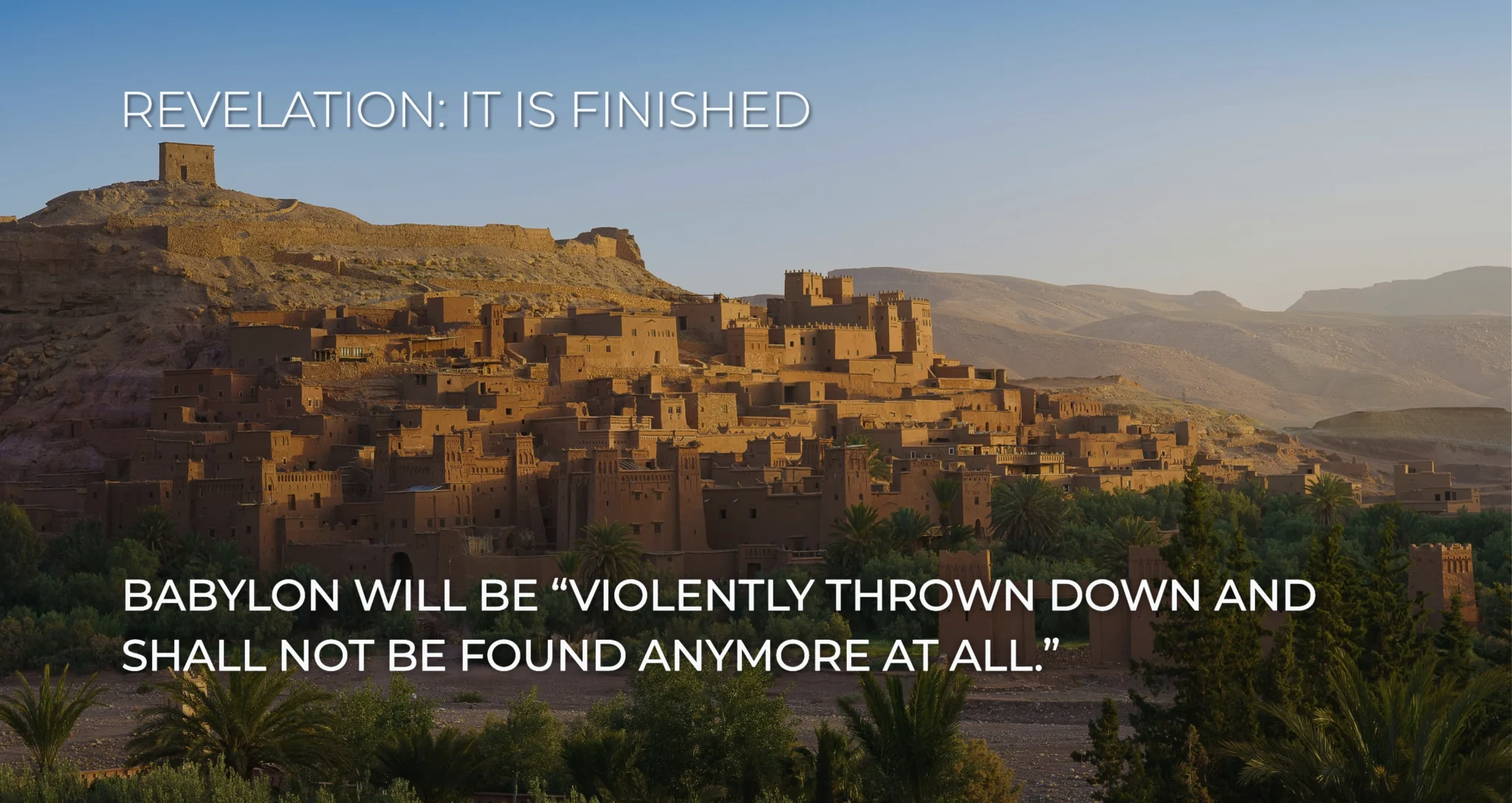
Pompeii vanished in 79 AD, but it still exists today; you can go and tour it. But that will not be the case with the future city of Babylon. According to Revelation 18:20-24, Babylon will be “violently thrown down and shall not be found anymore at all.” That’s the basis for our study this time, titled “The ‘No More’ City.”
20 “Rejoice over her, O heaven, and you holy apostles and prophets, for God has avenged you on her!”
21 Then a mighty angel took up a stone like a great millstone and threw it into the sea, saying, “Thus with violence the great city Babylon shall be thrown down, and shall not be found anymore.
22 The sound of harpists, musicians, flutists, and trumpeters shall not be heard in you anymore. No craftsman of any craft shall be found in you anymore, and the sound of a millstone shall not be heard in you anymore.
23 The light of a lamp shall not shine in you anymore, and the voice of bridegroom and bride shall not be heard in you anymore. For your merchants were the great men of the earth, for by your sorcery all the nations were deceived.
24 And in her was found the blood of prophets and saints, and of all who were slain on the earth.”
This text provides several INSIGHTS into Babylon’s final overthrow.
Before we begin discussing today’s text, remember the context. The previous verses of chapter 18 record Babylon’s destruction and the worldwide mourning that results. Her arrogance, pride, and luxurious, sensual living are brought to an end in one hour! The fire of God’s vengeance utterly destroys her. That sets the stage for our text.
The First Insight is,
The Storm of Vengeance
In Scripture, God’s wrath is often likened to a storm. Jeremiah announced God’s judgment on the false shepherds of Israel. “Behold, a whirlwind of the Lord has gone forth in fury— a violent whirlwind! It will fall violently on the head of the wicked. The anger of the Lord will not turn back until He has executed and performed the thoughts of His heart. In the latter days you will understand it perfectly” (Jeremiah 23:19-20).
The prophet Nahum pronounced God’s judgment on Assyria with similar language. “God is jealous, and the Lord avenges; the Lord avenges and is furious. The Lord will take vengeance on His adversaries, and He reserves wrath for His enemies; The Lord is slow to anger and great in power, and will not at all acquit the wicked” (Nahum 1:2-3)
All through the millennia, ever since the Tower of Babel, the storm of God’s judgment has been gathering in a dark cloud. In John’s vision, it is finally unleashed on that ancient seat of idolatry and all who followed her dark ways down through the ages of time.
Ever since Adam and Eve sinned in Eden, the great controversy has been between divine revelation and mankind’s sensual wisdom. Between these two there is an inherent, irreconcilable, and eternal antagonism (see James 3:13-18). As a result, those who follow God’s way are in continuing conflict with all that energizes the ways of the world. Consequently, the apostles, the saints, and the prophets have been the minority and suffered for it. But all that is about to change.
A voice (likely the angel of verse 4) commands, “Rejoice over her, O heaven, and the saints and the apostles and the prophets.” And why are these people commanded to rejoice? Because God has avenged her mistreatment of His saints. The expression “has avenged” is literally “God has judged your judgment on them.” God has approved the case of heaven. This is another example of the righteous ultimately triumphing, as victory follows suffering. Interestingly, this is the same verb used in Revelation 11:10 to describe the worldwide rejoicing at the death of the two witnesses. Now, the roles are reversed!
The long-awaited moment of vindication, retribution, and vengeance, for which the martyred Tribulation believers prayed (6:9–10) and for which all the redeemed hoped, will have arrived. Heaven rejoices, not over the damnation of sinners, but because of the triumph of righteousness, the exaltation of Jesus Christ, the elimination of His enemies, and the arrival of His kingdom on the earth.[1]
The truth contained in the previous sentence is so important. The righteous, including us, today, should never rejoice in the death of the wicked because that assures their destiny of eternal punishment. Sadly, I recall professing Christians rejoicing in 2011 when Osama bin Laden was executed in Pakistan by a US Navy SEAL team. Rather, we should look at the death of the wicked from God’s perspective: “‘As I live,’ says the Lord God, ‘I have no pleasure in the death of the wicked, but that the wicked turn from his way and live.” As long as a person, no matter how wicked, is living, there is a possibility of repentance.
Eventually, in His perfect timing, the storm of God’s vengeance will come, and the city of Babylon and all it represents will be no more!
The Next Insight is,
The Enduring Silence
As John watches, a mighty angel picks up a huge stone, like a great millstone, and hurls it into the sea. Some of the large millstones of John’s day were five feet in diameter, a foot thick, and weighed over a ton. I saw one of these on our trip to Israel in 2023.
The picture John saw reminds me of a scene from Greek mythology, from Homer’s Odyssey, after Ulysses and his men escaped the Cyclops. In response to their taunting of the giant, he broke off a huge mass of rock from the mountain and threw it into the sea. The resulting waves began to wash their ship back toward the shore and certain death. Only with the utmost effort were they able to steady the ship’s course. However, that is mythology; God’s judgment is reality!
The message that accompanied the angel’s violent action was “Thus with violence the great city Babylon shall be thrown down, and shall not be found anymore.” It isn’t apparent in our English translations, but the original text uses a double negative. Babylon will be thrown down and be found no more AT ALL!
This message of judgment is an echo of Jeremiah 51:60-64. “So Jeremiah wrote in a book all the evil that would come upon Babylon, all these words that are written against Babylon. And Jeremiah said to Seraiah, “When you arrive in Babylon and see it, and read all these words, then you shall say, ‘O Lord, You have spoken against this place to cut it off, so that none shall remain in it, neither man nor beast, but it shall be desolate forever.’ Now it shall be, when you have finished reading this book, that you shall tie a stone to it and throw it out into the Euphrates. Then you shall say, ‘Thus Babylon shall sink and not rise from the catastrophe that I will bring upon her.’”
As a result of this judgment, a deathly silence will descend on the ruined city. Six times the angel utters the words, “No more.” This great cosmopolitan city, filled with all the sights and sounds of entertainment, feasting, parties, manufacturing, domestic life, and bustling markets filled with all manner of luxury goods, comes to a screeching halt. Additionally, the light of the candle is now out, the city cold and dead, and no longer do its streets ring with the voices of the bridegroom and the bride. In contrast, chapter 19 details the joyous celebration in heaven at the marriage supper of the Lamb.
The very silence is a testimony to God’s devastating judgment on this wicked city. This judgment is similar to what Jeremiah pronounced on Judah in Jeremiah 25:10. And what is the stated reason for this complete destruction, this repetition of “no more”? That leads us to the final insight.
The Final Insight is,
The Damning Evidence
Three final reasons are given for Babylon’s judgment. “Because your merchants were the great men of the earth, for by your sorcery all the nations were deceived. And in her was found the blood of prophets and saints, and of all who were slain on the earth.” Let’s examine each of these individually.
First, her merchants were the great men of the earth, the ones held in highest esteem. It wasn’t the religious leaders, not the philosophers, not the politicians or the aged wise men. Rich merchants used their wealth to rise to positions of power, prominence, and influence. Today, such men use their wealth to gain the ear of the politicians, silence the voices of the godly, and lull the populace into an intellectual and moral stupor by the multitude of their digital gadgets.
The abuses of the proud, arrogant rich are well documented in Scripture. James asked, “Is it not the rich who oppress you and personally drag you into court?” (James 2:6). Later in his epistle, James further indicted the rich for their abuse of the poor: “Behold, the pay of the laborers who mowed your fields, and which has been withheld by you, cries out against you; and the outcry of those who did the harvesting has reached the ears of the Lord of Sabaoth. You have lived luxuriously on the earth and led a life of sensual, unrestrained pleasure; you have fattened your hearts in a day of slaughter. You have condemned and put to death the righteous man; he does not resist you” (James 5:4-6)
Next, their “sorceries” deceived the peoples of the world. In the original languages, the word for sorceries is pharmakia. We get our English word “pharmacy” from it. The New Testament uses the word to refer to magic and occult practices (Galatians 5:20). Babylon’s hold on the world will be due not only to her military and economic power, but also to her occult influence. Today, Satanic worship is moving into the open, into the mainstream more and more. Events like the annual Burning Man festival in Nevada and others show this deception.
Further, much of the world’s wealth and luxury today results from evil in all its forms. Think of the billions of dollars sloshing through the world’s economy from the international drug trade and sex trafficking of women and children. The activities that motivate and surround these evils are clearly demonic. Money blinds eyes, closes ears, and removes the milk of human kindness from men’s souls. It robs the innocent and protects the guilty.
The final reason for Babylon’s judgment was how she treated the righteous. “In her was found the blood of prophets and saints, and of all who were slain on the earth.” Not only was Babylon (both political and ecclesiastical) the “mother of harlots,” but also the mother of persecutions. Revelation 17:6 states that she was “intoxicated with the blood of the saints and with the blood of the martyrs of Jesus.” She will tolerate no dissent.
Scripture shows an obvious parallel in the rise and fall of Babylon throughout history. Introduced in Genesis 11:1-9, Babylon is symbolized by the tower reaching to heaven. It proposed maintaining the world’s unity through common worship and a common tongue. However, God defeated this purpose by confusing the language and scattering the people.
Babylon, religiously symbolized by the woman in Revelation 17, proposes common worship and a common religion by uniting a world church. The beast in Revelation 17:16 destroys this false religion, fulfilling God’s will. Babylon, politically symbolized by the great city of Revelation 18, attempts to dominate the world through a global marketplace and a world government. Both of these trends are present and evident today.
God’s triumph is witnessed historically in the scattering of the people and the unfinished tower of Genesis 11. In the future, God will triumph in the destruction of the world religion by the killing of the harlot of Revelation 17. He will destroy the political and commercial might of the city in Revelation 18. Christ destroys these at His second coming (Rev. 19:11-21).
While we do not know the timing of these final events, we can observe trends in our world today. Globalist organizations like the World Economic Forum, Council on Foreign Relations, World Council of Churches, and others tout their ability to bring together leaders from business, religion, government, international organizations, civil society, and academia to shape progress on the defining issues of our time. However, their documents show that their programs and plans leave no room for biblical Christianity.
The conditions described in the end-time Babylon closely resemble those in the developed world today. We must resist the constant messaging of our culture, both open and subliminal, that wealth and status mark true success. The pressure to compromise is strong, but we must heed the heavenly message of Revelation 18:4, “Come out of her, my people, lest you share in her sins, and lest you receive of her plagues.”
The words of Jesus in Luke 12:16–21 form a fitting conclusion to the message of judgment on commercial Babylon: “And He told them a parable, saying, ‘The land of a rich man was very productive. And he began reasoning to himself, saying, ‘What shall I do, since I have no place to store my crops?’ Then he said, ‘This is what I will do: I will tear down my barns and build larger ones, and there I will store all my grain and my goods. And I will say to my soul, “Soul, you have many goods laid up for many years to come; take your ease, eat, drink and be merry.”’ But God said to him, ‘You fool! This very night your soul is required of you; and now who will own what you have prepared?’ So is the man who stores up treasure for himself, and is not rich toward God.”
Make sure your choices lead to the eternal city rather than the “no more” city!
[1] MacArthur, New Testament Commentary on Revelation, p. 896