In Revelation 12:1-6, John is given a vision of three signs that reveal the unfolding cosmic conflict behind human history. In this episode, J. Mark explores the sign of the woman, the dragon, and the male child—symbols that point to Israel, Satan, and Christ. Their story traces the long battle between good and evil that began in Genesis. In this episode, we explore how this passage uncovers the spiritual reality behind the visible world and shows how God faithfully carries out His redemptive plan through every age.
In my youth, which was a long time ago (the 1970s), a singing group from Canada performed a song titled “Signs.” It was somewhat humorous, but it carried a message that still resonates today. The chorus was “Sign, sign, everywhere a sign, blocking out the scenery, breaking my mind, do this, don’t do that, can’t you read the sign?”
Don’t get me wrong; signs are important. Try to imagine a world without them! No matter where you travel, signs will be part of your experience. Airports, train stations, bus terminals, and highways all have them. They give us instructions, directions, and warnings, and on highways, they are designed to facilitate the smooth flow of traffic. They are also for our protection, and people who can’t read them or refuse to follow them often endanger others’ lives on the road.
Signs are significant in the Bible, too. Among the earliest signs is Genesis 3:15, sometimes called the protoevangelium (pro-toe-e’van-jell’-ee-um). That’s Latin for “the first gospel.” After Adam and Eve’s fall, God pronounces a curse on the serpent, declaring: “And I will put enmity between you and the woman, and between your offspring and hers; he will crush your head, and you will strike his heel.” This sign sets the stage for the Bible’s narrative arc: an ages-long conflict between the serpent, the woman, and their offspring. It charts the ongoing battle between good and evil until its final resolution.
And we are nearing that final resolution in our journey through the book of Revelation. Our study today takes us to Revelation 12:1-6, and I’ve titled it, “Signs of the Times.”
Before I read the text, let’s remember that chapter 11 ended with the sounding of the 7th trumpet. The details of the judgments to follow are unfolded in the seven bowls in chapter 16. In the interim, the divine revelation turns to other aspects of this period that precede the consummation of God’s plan for human history.
Apart from the outpourings of the bowls, which occur in rapid succession, there is little chronological movement from this point until chapter 19 and the second coming of Christ. The events and situations we will observe in these next chapters are occurring during the same time as the seals and the trumpets. These serve to emphasize the dramatic climax at the close of this period: the second coming of our Lord and Savior, Jesus Christ.
Now, let’s turn to our text, Revelation 12:1-6.
1Now a great sign appeared in heaven: a woman clothed with the sun, with the moon under her feet, and on her head a garland of twelve stars.
2 Then being with child, she cried out in labor and in pain to give birth.
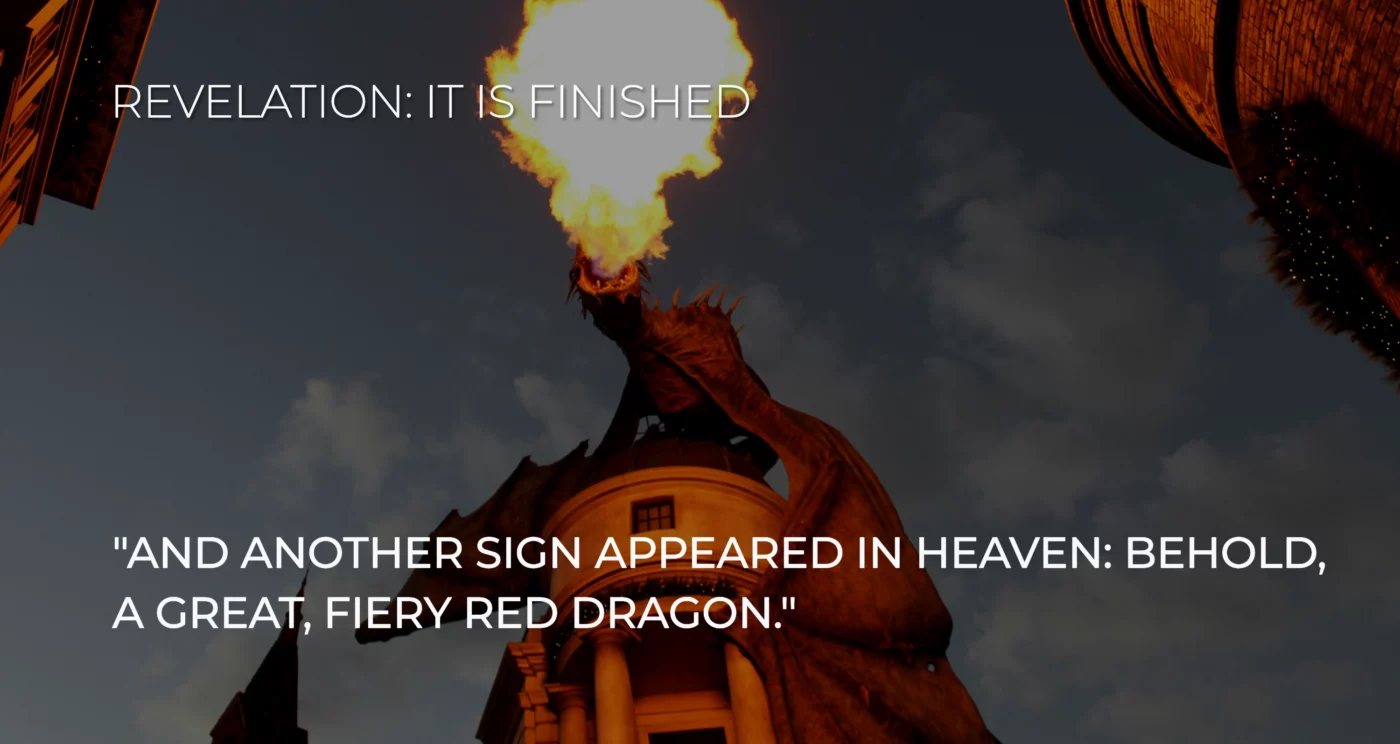
3 And another sign appeared in heaven: behold, a great, fiery red dragon having seven heads and ten horns, and seven diadems on his heads.
4 His tail drew a third of the stars of heaven and threw them to the earth. And the dragon stood before the woman who was ready to give birth, to devour her Child as soon as it was born.
5 She bore a male Child who was to rule all nations with a rod of iron. And her Child was caught up to God and His throne.
6 Then the woman fled into the wilderness, where she has a place prepared by God, that they should feed her there one thousand two hundred and sixty days.
This text reveals several specific SIGNS that highlight the great cosmic conflict spanning the ages of human history and reveal God’s faithfulness in bringing that history to a close.
The First SIGN is,
The Sign of the Woman
In the context of the book of Revelation, a sign or wonder is generally something that anticipates remarkable events soon to happen. However, as we will learn, the woman who initially appears in our text as a figure in heaven is a sign from the past. Notice her further description. She is clothed or enveloped by the sun, the moon is under her feet, and she wears a garland or crown of 12 stars. Clearly, this is a symbolic description, and we must ask, “Who is this woman, and why is she dressed this way?”
Before we attempt to answer that question, there is a more basic one we need to answer. How do we interpret the symbols used in the book of Revelation? First, there must be some level of consistency. We are not free to assign whatever meaning we want; that only leads to confusion. If a symbol is used in the Old and New Testaments, in the vast majority of cases, it will have the same meaning. My study of Revelation is based on the premise that all the symbols in the book are explained elsewhere, either in the book itself or elsewhere in Scripture. Either by direct statement or by comparison, the Scripture is the standard of interpretation.
With that in mind, let’s look more closely at this sign of the woman. As you look at the way she is described, do any other Scripture portions come to mind?
Upon reading verses one and two, we may quickly conclude that the woman represents Mary, the mother of Jesus. However, as we’ll see later in the chapter, those verses make that view untenable. Others have seen this vision as representing the church, but that makes no sense either, because it would mean the church gave birth to Christ, which is the exact opposite.
So, we must look further. For those who take the book of Revelation literally, this seems to be a clear reference to the nation of Israel, the “woman” who gave birth to the Messiah. Some may object to viewing the nation as a woman, but in the Old Testament, Israel is often depicted as such.
In the Old Testament, Israel and its capital, Jerusalem, are frequently personified as a woman. This feminine imagery is used in prophetic literature as an allegory for the nation’s covenant relationship with God. She is often depicted as His bride. The most prominent of these examples is Gomer, Hosea’s wife. She is representative of the unfaithfulness of the nation of Israel. In Isaiah 54, Israel is personified as a barren woman who will ultimately bear many children and experience restoration. So the nation described as a woman is not unusual at all.
The images of the sun, moon, and 12 stars should immediately take us back to Genesis 37 and the dreams of young Joseph. You may recall that his first dream was of him and his brothers binding sheaves of grain in the field. His sheaf stood upright, and all the other sheaves bowed down to him. That only increased the hatred they already had for their brother. But then he had a second dream and said, “Look, I have dreamed another dream. And this time, the sun, the moon, and the eleven stars bowed down to me. So he told it to his father and his brothers; and his father rebuked him and said to him, “What is this dream that you have dreamed? Shall your mother and I and your brothers indeed come to bow down to the earth before you?”
Now, we’re getting somewhere. Clearly, the sign John saw in heaven relates to Genesis 37. The sun is Jacob (later renamed Israel), the moon is Rachel, and the 12 stars are the sons of Jacob, who later became the tribes of the nation of Israel. Therefore, we can legitimately conclude that the nation of Israel, rather than Mary, is in view here.
Further, the woman is pregnant and cries out in the throes of labor. Like every mother, she longs for the birth pains to be over. Jesus acknowledged this in John 16:21 and likened it to the sorrow the disciples would have at His death. In Matthew 24, after describing some of the initial events leading to His coming, Jesus said in verse 8, “All these are the beginning of birth pangs.”
Here, the narrative is interrupted, and we are introduced to the next sign that highlights this cosmic conflict.
The Next SIGN is,
The Sign of the Dragon
This is a frightening sign indeed: “a great, fiery red dragon having seven heads and ten horns, and seven diadems on his heads!” This is the first of three such descriptions in the Apocalypse (12:3, 13:1, and 17:3). Again, we must ask, “Where does this imagery come from?” The dragon imagery is prominent in the Old Testament, where he is depicted as God’s chief enemy. He appears in the Bible as Rahab (Isaiah 51:9), Behemoth (Job 40:15-24), Leviathan (Isaiah 27:1), and the Serpent (Amos 9:2).
In addition, he has 7 heads and 10 horns. While the image is not exact, Daniel 7:7 and 7:24 refer to a “dreadful beast with 10 horns.” He shows up in Daniel’s 70th week, which I believe encompasses the 7-year Tribulation, the time we are looking at in this text. Chapter 13 will expand on this imagery. However, verse 9 of this chapter plainly identifies the dragon as Satan.
Notice, the dragon has seven diadems on his head. In chapter 13, this same dragon is seen with ten diadems on his head. These signify power and authority. Compare that with Revelation 19:12, where the Conquering Christ has many diadems on His head! As is his pattern, Satan tries to counterfeit God’s program but fails miserably.
Next, in John’s vision, the dragon is drawing the third part of the angels (stars) of heaven and hurling them to the earth. Verse 9 of this chapter identifies these “stars” as Satan’s angels. We don’t have time to trace this all out. Still, we do know that in Satan’s primeval rebellion against God, he was able to persuade a third of God’s “innumerable company of angels” (Hebrews 12:22; Revelation 5:11) to follow him. Isaiah 14:12-21 and Ezekiel 28:11-19 give us further insight into Satan’s rebellion and its consequences.
Some of those fallen angels were sent to the lowest hell, according to 2 Peter 2:4. Some were bound in the Euphrates River, Revelation 9:14. Others were confined to the abyss until the proper time for judgment, Revelation 9:2. There are still multitudes of demonic angels, however, freely roaming the world and serving “the prince of the power of the air” (Ephesians 2:2). These demonic spirits will be more active and dangerous than ever in these final days.
We now have the description of the dragon, but what is he up to? John sees the dragon standing before the woman (Israel), waiting to devour her child as soon as it is born. Ever since the promise of Genesis 3:15, Satan has been trying to prevent the promised seed from being born. He began his attack by having Cain kill his brother, Abel. Later, he attempted to corrupt the entire human race in the days of Noah. Still later, he used the Pharaohs and other world leaders to try to eliminate the nation of Israel in a variety of ways.
All of those efforts failed, and eventually, Christ was born. At His birth, Satan tried to destroy Him with Herod’s slaughter of the innocents at Bethlehem. When that failed, he tried to corrupt Christ with his temptation in the wilderness. The Gospels record several attempts to have him killed before He could go to the cross. So, after being thwarted all those times, it is not hard to imagine the seething rage that Satan has toward Christ and all His followers.
Satan’s failure to devour the child sets the stage for the next sign that highlights this cosmic conflict.
The Final SIGN is,
The Sign of the Male Child
The woman identified as Israel in verses 1 and 2 is said in verse 5 to bring forth a man-child who is destined to rule all nations with a rod of iron, but who, for the time being, is caught up to God to the throne. The phrase “ruling the nations with a rod of iron” comes directly from Psalm 2:9. Christ also promised the overcoming believers in the church at Thyatira that they would share in His rule of the nations with a rod of iron (Revelation 2:27).
The Gospels inform us of the details of Jesus’ earthly life. His birth, ministry, death, resurrection, and ascension are all part of verse 5. There is a span of 30+ years between Christ’s birth and ascension. So, again, the dragon’s vigilance was futile!
Some have contended that this child is the New Testament church, destined to reign with Christ, and that being caught up to God is the rapture. Earlier, I said the woman with child is identified with Israel collectively rather than with the Virgin Mary specifically. Further, the interpretation that the man-child is Christ Himself is implicit in the text. The Greek words for “man-child” with their emphasis upon his gender (male) favor identification of the child as Christ rather than as the church, which would be feminine. Not only that, but this man-child is specifically stated to have been caught up to God’s throne. He is there now interceding for us.
Frustrated again by the miraculous resurrection of Jesus and His ascension to the Father, Satan pursues the woman (Israel) into the wilderness. A moment ago, we were talking about the woman being Israel, and giving birth to the Messiah, who was Jesus. We can easily relate that to what we know happened 2000 years ago. Some see this as a reference to the flight into Egypt after Jesus’ birth, but the timing is off according to the previous sentence.
Not only that, we now see the woman fleeing to a place where God will take care of her for 1,260 days. Nothing like that happened 2000 years ago, nor has it happened since. This sudden leap across time (from the birth of Christ 2000 years ago to an unknown point in the future) may startle us, but it’s not unusual for the Bible to do this.
The reference to 1,260 days connects this account with the 1,260 days referenced in Revelation 11:3, which informs us that it refers to the time of great tribulation, which takes place during the trumpet period. Remember, this span of time is found repeatedly in Daniel and Revelation as 3.5 years, 1,260 days, and time, times, and a half time.
The “woman” at this time can only be Israel, and the “wilderness” into which she flees must be the desert-and-mountain regions east and southeast of the Dead Sea. This is the region occupied in ancient times by the peoples of Ammon, Moab, and Edom, and it is this area that Israel will flee to escape the armies of the Antichrist, also called the Beast (Daniel 11:36-45).
The idea that God would protect Israel during the great tribulation is supported by Old Testament prophecy. For example, Zechariah 14:1–5 describes the Day of the Lord, which refers to God’s wrath when Christ returns as king, but first, he promises to fight Israel’s enemies and give the Jews a place to flee. (Let me read it for you.)
Behold, the day of the Lord is coming, and your spoil will be divided in your midst. For I will gather all the nations to battle against Jerusalem; the city shall be taken, the houses rifled, and the women ravished. Half of the city shall go into captivity, but the remnant of the people shall not be cut off from the city.
Then the Lord will go forth and fight against those nations, as He fights in the day of battle. And in that day His feet will stand on the Mount of Olives, which faces Jerusalem to the east. And the Mount of Olives shall be split in two, from east to west, making a very large valley.
Half of the mountain shall move toward the north, and half of it toward the south.
Then you shall flee through My mountain valley, for the mountain valley shall reach to Azal. Yes, you shall flee, as you fled from the earthquake, in the days of Uzziah, king of Judah.”
These signs of the woman, the dragon, and the male child remind us of the great cosmic conflict that rages even today. They remind us that Satan never admits defeat and continues to deceive many and lead them to destruction. They remind us that the time of these events is drawing nearer with each passing day.
We can, however, take courage, knowing that our God is firmly in control and will ultimately bring human history to His predetermined conclusion. That conclusion includes His plans for His ancient, chosen, earthly people – the Jews. We Gentiles are eternally indebted to them for our Messiah! May the Lamb receive the reward of His suffering!