
“Not my will, but thine.” Five simple words so easily spoken, but so challenging to live. Have those words ever crossed your mind, your lips? If so, how have they affected your choices? Were they uttered in response to a specific decision you faced, or were you, as it were, writing a blank check to God, giving Him freedom to bring all of life under His authority?
Most Christ-followers are aware that Jesus spoke these words during His prayer in Gethsemane, before His arrest, trial, and crucifixion. But wasn’t Jesus always surrendered to the will of His Father? In John 8:29, Jesus said, “He who sent Me is with Me. The Father has not left Me alone, for I always do those things that please Him.” Surely, that seems like a declaration of obedience and trust.
Today’s study from Mark, chapter 14, focuses on verses 27-42. These verses are familiar and contain profound truths we need to be reminded of. The title of my teaching is taken directly from the words of Jesus, “Not my will but thine.” Listen carefully as I read the Word of God.
These verses show us several QUALITIES we must embrace as we follow Jesus’ example of surrendering to the will of the Father.
The First QUALITY is,
Confidence
In the opening sentence of our text, Jesus makes a painful yet confident prediction. “All of you will be made to stumble because of Me this night, for it is written…” Jesus expresses complete confidence in the reliability and accuracy of God’s Word. He quotes from the prophet Zechariah, who lived and wrote about 500 years before Jesus’ time on earth. “I will strike the Shepherd,
And the sheep will be scattered.” That’s Zechariah 13:7. He predicts that, without exception, all the disciples will desert Him. He speaks with divine authority.
He said, “You will all fall away, stumble, be offended because of Me.” The original word is sandalizo. It means seeing something in another person that hinders me from acknowledging their authority. It contains the idea of “shock by doing something improper, offended by some action considered very wrong or outrageous. “We get our English word scandalize from this. It must have been heartbreaking for Jesus to prophesy this, but it shows His confidence in the Word.
However, He wasn’t finished. He went on to say, “But after I have been raised, I will go before you to Galilee.” This wasn’t a statement of reproach, but a preliminary announcement of better things to come at their reunion. Jesus is contrasting the gloom of the immediate future with the hope of resurrection. He promised to meet them in Galilee after his resurrection.
He may have been thinking of the words of Psalm 16:9-10. “Therefore, my heart is glad, and my whole beingrejoices; my flesh also dwells securely. For you will not abandon my soul to Sheol, or let your holy one see corruption.” When we, like Jesus, embrace complete confidence in God’s Word, we will never be disappointed in the results.
Now, notice what happens immediately in response to Jesus’ statement. Peter, impetuous Peter, speaks: “Even if (as is likely) all the rest shall be offended, yet certainly not I.” In other words, Peter is adamantly confident in his ability to remain faithful to Jesus. As we know, it was misplaced confidence; it was boasting! He was implying that what Jesus just told them was inaccurate! He was putting more confidence in himself than in the words of Jesus.
Jesus’ response to Peter’s contradiction wasn’t anger, like ours might have been. I believe it was grief, because He knew what was coming. He said, “Truly I am saying to you that you (yourself) today, on this very night before a rooster crows twice, shall deny Me, not once, but again, and again, and again.” Peter’s boast was turned into a prophecy of greater downfall.
Amazingly, rather than back down in the face of Jesus’ knowledge of all things, Peter doubles down on his misplaced confidence. “He kept on saying with more vehemence and repetition, ‘If it should be necessary for me to die with you, I will positively not deny you.’ Moreover, in the same manner, all of them kept saying [the same].”
Let’s not be too hasty in our criticism of these men. We do well to take some time for personal reflection on our experiences. I can’t speak for you, but I know from my own experience that I have often placed unwarranted confidence in myself and my abilities. My actions have called into question the veracity of God’s Word, and typically, the results have been similar to what happened to Peter and the other disciples. I recall the words of Philippians 3:3, “For we are the circumcision, who worship God in the Spirit, rejoice in Christ Jesus, and have no confidence in the flesh…” Later in this text, Jesus specifically pointed out the struggle between the desires of our spirit and the weakness of our flesh.
Let’s shun Peter’s example of confidence in the flesh and follow the example of Jesus in exercising this quality of confidence in God’s Word.
Another QUALITY (we must embrace) is,
Consternation
Do you wonder why I chose this word? It means “amazement or dismay that hinders or throws into confusion.” That aptly describes Jesus’ experience in the following verses.
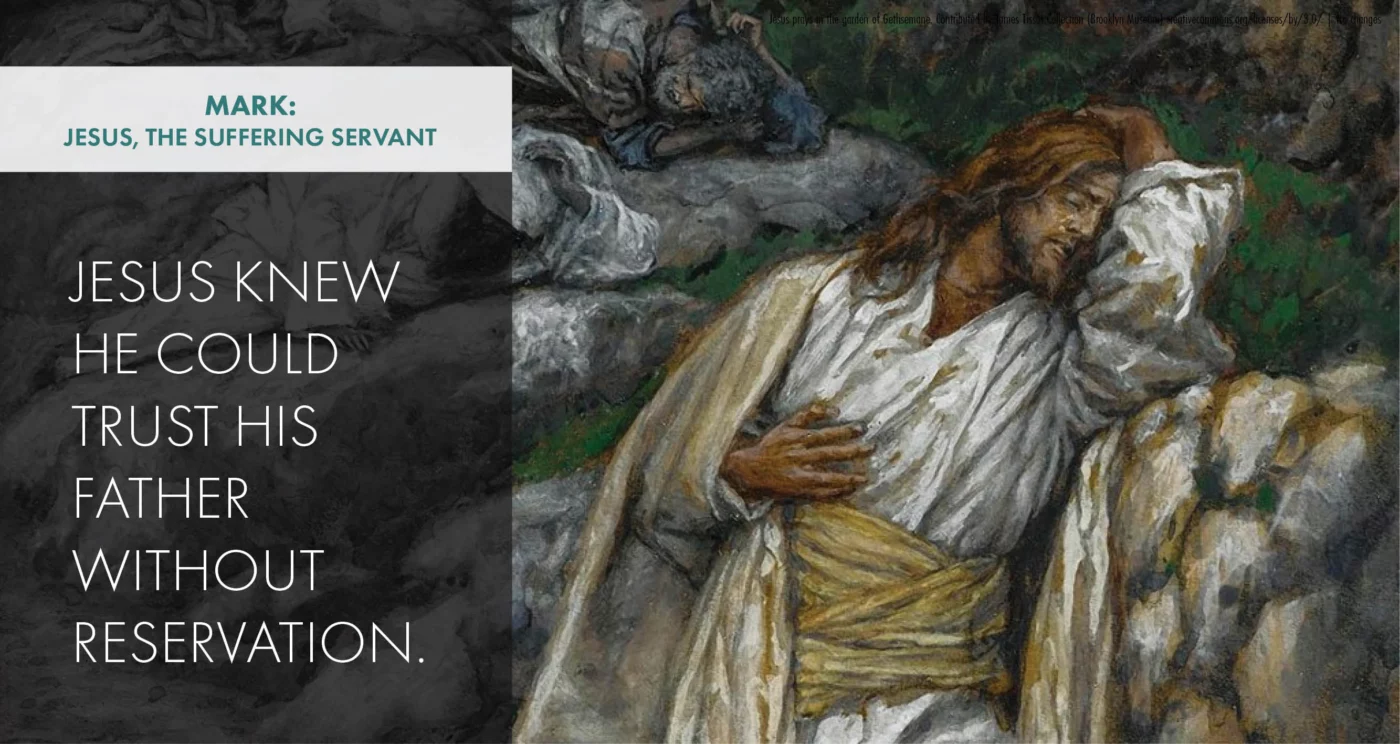
Recall that this prediction Jesus made is given while He and the Eleven are walking from the upper room in Jerusalem to their overnight lodging on the Mount of Olives. Our text informs us that they have now arrived at the Garden of Gethsemane, a familiar place to all of them. The name, Gethsemane, means “oil press.” If you have any knowledge of how olives are pressed for their oil, it surely is an appropriate metaphor for what Jesus is about to experience. The language that follows is very descriptive.
As they enter the place, Jesus takes Peter, James, and John and advances further into the garden. “There, He began to be troubled and deeply distressed, saying to them, My soul is exceedingly sorrowful, even to death. Stay here and watch.” In these phrases, we see the quality of consternation.
The KJV says that Jesus began to be “sore amazed.” The word in the original means “to throw into amazement or terror, to alarm thoroughly, to terrify, to be struck with terror.’ He was already overwhelmed with sorrow, but this feeling was one of terrifying surprise. It was no surprise that the long-promised sacrifice was near, but it was a surprise at the terrors that exceeded His expectations.
You might say, “Wait a minute! Jesus is God, He knows all things, how can you say that?” That God knows all things is beyond doubt. However, I remind you of the words of Hebrews 5:8, “Although he was a son, he learned obedience through what he suffered.” As the terrors of His passion came into view, His human soul received a new experience. What had been known before, only in theory, now became plainer, and with it a sense of dread and horror.
Mark’s description continues, “He was very heavy or deeply distressed.” These words speak of one who is not at home. He is uncomfortable in unfamiliar surroundings. We all have had similar feelings at one time or another. Sweaty palms, chest tightness, and shortness of breath are all common symptoms. Facing the cross, Jesus is experiencing something unfamiliar, and He is distressed by it. He pleads with His followers, “My soul is encompassed with grief even to the point of death. Abide here and be watching.”
With this anguished request, Jesus retreats farther into the garden. From a distance, the disciples saw Him “falling to the ground.” The verb is imperfect, which means that He repeatedly arose, only to fall again. It was a desperate struggle we cannot fathom! In that condition, He cried to His Father, “Abba, Father, all things are possible for You. Take this cup away from Me…” He prayed repeatedly that the hour (for which He had longed – John 12:27) might pass away from Him. Luke tells us that Jesus’ agony was so intense that mingled blood and sweat fell to the ground from His tremendous struggle. Once anticipated, Jesus now dreads the approaching hour, a trait we can all surely understand in a human being.
What did Jesus see when He looked into that cup? I believe He saw what is described in Revelation 14:9-10. “If anyone worships the beast and his image, and receives his mark on his forehead or his hand,he himself shall also drink of the wine of the wrath of God, which is poured out full strength into the cup of His indignation.”
I believe Jesus saw the unadulterated wrath of God against human sin, and He knew that cup was meant for Him to drink. And I further believe that when Jesus uttered that cry from the cross, “It is finished,” part of what He meant was that the cup of God’s wrath had been fully drunk, even to the dregs! Never again would you or I need to drink of that cup; Jesus drained it on our behalf. However, we only escape drinking it if we, by faith, accept His sacrifice.
In our sinfulness, you and I deserved to drink that cup, but Jesus, the sinless Son of God, drank the fullness of that cup for you and me. He recited His petition to the Father to remove the cup of suffering, but He was fully surrendered to obeying the Father’s will. We may look at the cross with all its pain and agony as the place where the victory was won, but I suggest to you that it was here, in the garden, where the victory was won.
If Jesus had not offered this petition, He would not have been who and what He was – fully human like us. There were at least two things in the cup from which our Lord shrank. One of them was to be made a sin offering, to be charged by the High Court of Heaven with the guilt of all human sin. From that, the holy Son of God drew back with all the infinite hatred of sin that was His.
The other was the agony of being temporarily deprived of the Father’s fellowship during the time of His crucifixion (Psalm 22:1-2). Since the fellowship between Father and Son had no beginning and had never been interrupted before, the loss of that fellowship meant infinite suffering. Jesus, in His humanity, shrank from these two things, dreading them with all His heart.
In His consternation, Jesus appeals to His “Abba, the Father.” Abba is Aramaic for ‘father,’ and as is his pattern, Mark interprets Aramaic words for his readers. Jesus identifies the Father explicitly as “the” Father—His Father. He affirms the sovereignty of God by saying, “All things are possible for You. Please, remove this cup from Me. Nevertheless, not what I (myself) desire, but what You (yourself) desire.” Even in His agony, He was committed to the will of the Father.
Jesus returned from His first season of prayer and found the disciples sleeping. Notice how He singles out Peter, the leader, the one who protested so vehemently against Jesus’ prophecy of his denial. I can only imagine the anguish in Jesus’ voice as He says, “Simon, are you sleeping? Could you not watch [with me] one hour?” Being deserted by your closest friends in your greatest hour of need is a blow to anyone’s morale.
Jesus used Peter’s pre-disciple name, Simon. He has reverted to his natural, hereditary character. The “Rock” is currently nowhere to be found. But let’s not be too hard on him. Even our best intentions fall prey to the weakness of the flesh. Don’t you think there was some consternation, some embarrassment on the part of Peter? Already, his boasted loyalty was failing in the hour of crisis. Though he promised to die with Jesus, he couldn’t even stay awake in response to the pleas of His Master.
Jesus is fully aware of our weakness. He said to Peter, “Be constantly watching and praying, so that you might not enter temptation. The spirit (vital, life force) indeed is willing, but the flesh (mortal and frail) is weak.” Their spirits, under the divine influence of Jesus, were willing and eager. But that willingness was no match for the frailty of the flesh. Two more times, this scene is repeated, with Jesus beseeching His Father and returning to find the disciples asleep. This leads us to the final quality we must embrace in our surrender to the will of the Father.
The Final QUALITY is,
Commitment
When Jesus returns to them the third time, He says, “Are you still sleeping and resting? It is enough! The hour has come; behold, the Son of Man is being betrayed into the hands of sinners. Rise, let us be going. See, My betrayer is at hand.” The time for watchfulness has passed; Jesus doesn’t repeat the command. He says, “Go on sleeping, rest if you can.”
Notice the short sentence, “It is enough!” It is generally used to mean “payment in full.” There are two possible meanings here. First, Jesus has exhausted all his appeals to the Father and is now fully committed to following the path laid out for him. He departed Gethsemane, having accepted the harsh reality that either he was to suffer and die, or humanity was lost.
The second possibility is that Jesus used the phrase in an ironic sense. “You’ve had enough sleep now.” There was no need for further reproof of the disciples for their failure to watch with him. One writer put it this way: “This is no time for a lengthened exposure of the faults of friends; the enemy is at the gate.” If this is the case, it seems His irony produced the desired effect, and the disciples were aroused from their slumber.
Jesus further stated, “The hour has come…” The appeals had been exhausted, the time for watchfulness and prayer had passed, the disciples had their sleep, and now, Judas was approaching. Several times in Scripture, Jesus referenced His passion as “this hour.” John 12:27, “Now My soul is troubled, and what shall I say? ‘Father, save me from this hour’? But for this purpose, I came to this hour.”
When Jesus said, “Rise, let us go,” He was not considering the possibility of escape. Instead, He is taking the initiative to go and meet Judas and those who were with him. He said to them, “When I was with you daily in the temple, you did not try to seize me. But this is your hour, and the power of darkness,” Luke 22:53. Truly, the hour of darkness had come, and Jesus faced the forces of evil with full commitment to His Father’s plan.
Have you ever surrendered your will completely to your Heavenly Father? I have, and it changed the trajectory of my life. I confess, I’ve had to repeat that prayer and act of surrender multiple times in my life. In some ways, it is a daily experience.
What about you? Have you ever personalized Jesus’ prayer? How has it changed your life? Do you have complete confidence in the authority and accuracy of God’s Word? Jesus did. He knew He could trust His Father without reservation.
And yet, when the time came to act on that confidence, He experienced consternation; “amazement or dismay that hinders or throws into confusion.” If you read the Scriptures, you know this quality is often expressed among godly people. Men like Abraham, Joseph, Job, David, Jeremiah, and others all experienced it. If you’ve walked with the Lord for any length of time, you’ve experienced it too.
Yet, in the end, despite the confusion and questioning, we remain fully committed to doing the will of our Father. What other choice do we have? Where else can we go? We, like Peter, say to Jesus, “Lord, to whom shall we go? You have the words of eternal life. Also, we have come to believe and know that You are the Christ, the Son of the living God.”
Based on that confession, we can say, “Not my will, but thine be done.”
