
Do you have memorials in your life? What are they? Why do you have them? How important are they? What is their purpose?
Memorials are designed to preserve the memory of a person, event, or other significant concept, often in the form of a marker, monument, holiday, or special commemoration. It can be a statue or another object built to commemorate a unique event or a famous person who has passed away. Most countries in the world observe a variety of “memorial” days. They commemorate events such as independence and other significant milestones in their history.
Memorials are almost as old as human history. The first mention of a memorial in Scripture is in Exodus 3:15. During Moses’ encounter with God at the burning bush, God said to him, “Thus you shall say to the children of Israel: The Lord God of your fathers, the God of Abraham, the God of Isaac, and the God of Jacob, has sent me to you. This is My name forever, and this is My memorial to all generations.” God’s name, connected to Abraham, Isaac, and Jacob, was to be an everlasting memorial.
Later, in Exodus 12:14, God gave Moses instructions regarding the Passover. “This day shall be to you a memorial; and you shall keep it as a feast to the Lord throughout your generations. You shall keep it as a feast by an everlasting ordinance.” Here, a special day was designated as the memorial of the Passover.
The root word of memorial is memory. Memories are things from the past. Is it possible to have a memorial for the future? That sounds like an oxymoron!
However, we’ll learn in our study today about a memorial that Jesus designed to help us look forward and remember, rather than looking back. The text for our consideration today is Mark 14:17-26. In this portion of Scripture, Jesus inaugurates what we call the “Communion Service” or “The Lord’s Table.” I’ve titled my teaching, “Let Us Keep the Feast.” Now, here is the reading of God’s Word.
In this text, Jesus highlights several critical ELEMENTS that are essential for us as we follow the biblical injunction, “…let us keep the feast.”
The title I’ve chosen for this teaching is based on Paul’s words in 1 Corinthians 5:6-8. “Do you not know that a little leaven leavens the whole lump? Therefore, purge out the old leaven, that you may be a new lump, since you truly are unleavened. For indeed Christ, our Passover, was sacrificed for us. Therefore, let us keep the feast, not with old leaven, nor with the leaven of malice and wickedness, but with the unleavened bread of sincerity and truth.”
The First ELEMENT (essential in keeping the feast) is,
Examination
Our text opens with Jesus and the Twelve reclining around the table in the Upper Room. There is some disagreement about whether this was a Passover meal, a Seder. Maybe that’s a subject to be explored at another time. At any rate, the assembled group was eating together. If, indeed, it was a Passover meal, that was a memorial for looking back in Israel’s history and remembering the deliverance from Egypt. Jesus changed it into a forward-looking memorial that anticipates the future – the fullness of the kingdom of God.
As they were eating, Jesus said, “Assuredly, I say to you, one of you who eats with Me will betray Me.” Even though this was a very general statement, imagine the impact it had on the atmosphere in the room. What a violation of culture and custom! In Eastern culture, the protection of a guest at your table is of paramount importance. How could this be?
What happens next isn’t at all surprising. The Twelve immediately become pensive, even sorrowful. One by one, they asked the question, most likely with some incredulity, “It’s not me, is it, Lord?” Matthew’s account includes Judas asking the question as well. What were they doing? Judas’ question was insincere, but the other 11 were examining their hearts. They were considering the almost unthinkable possibility that one of them would betray their Master. Jesus’ statement while they were eating prompted the Twelve to engage in some introspection.
According to Paul’s instructions in 1 Corinthians 11:28, this element of examination is essential before participating in the Lord’s Table. “[Let] a man examine himself and so let him eat of the bread and drink of the cup. For he who eats and drinks in an unworthy manner eats and drinks judgment to himself, not discerning the Lord’s body.”
This initial statement by Jesus and the response of the Twelve lead us to the next element.
The Next ELEMENT (essential in keeping the feast) is,
Explanation
In response to the queries of the Eleven whether or not they were the betrayers, Jesus said, “It is one of [you], he who dips in the same dish I am.” Notice, this is a more specific statement than the earlier one. I believe this was Jesus’ way of identifying Judas as the betrayer.
From the Gospel records, we can glean a partial picture of the seating arrangement at this Last Supper. It was customary for those reclining at the table to do so on their left side. We are also told in John’s Gospel that John, the Beloved disciple, reclined on Jesus’ bosom. That means he had to be to the right of Jesus and most likely at the end of the horseshoe-shaped table.
After this statement about betrayal, Peter made a gesture to John. He wanted him to ask Jesus about the identity of this betrayer. That meant Peter wasn’t close enough to quietly ask because he was across the table from John. It is also logical to assume that Judas was on Jesus’ left. This was the place of honor, next to the host.
According to Jewish historian Alfred Edersheim, it was customary for the host to dip the bread or morsel into the dish and give it to the guest of honor. When Jesus did this for Judas, the others didn’t understand that Jesus was singling him out as the betrayer. In addition, any conversation between Jesus and Judas may have been carried out in low enough tones as to exclude the others hearing what was said.
However, Jesus wasn’t finished with His explanation. He said, “The Son of Man indeed goes just as it is written of Him, but woe to that man by whom the Son of Man is betrayed! It would have been good for that man if he had never been born.” One writer said, the “woe” of this verse is not vindictive, as the nature of a curse, but reveals a misery which love itself could not prevent. It has the tone of a lament. Jesus took no delight in Judas’ destruction.
Jesus’ statement highlights the necessary tension between man’s free will and God’s sovereignty. My mentor, Dr. J. Otis Yoder, said, “God uses the free choices of men to accomplish His purposes, but holds them accountable for their choices.” Surely none of Jesus’ sayings are more fully charged with His claims to pre-existence, divinity, and judicial authority than this, which He spoke at the very moment when the traitor’s plot was on the verge of success.
The Son of Man must die as it was prophesied, but Judas made a conscious choice to betray his Master. He was not a pawn in this cosmic battle between good and evil. He was a free moral agent. Whether he fully understood the outcome of his choices, we do not know, but he was entirely responsible. He allowed Satan to enter his heart through his covetousness.
If, indeed, this was a Passover meal, Judas’ choices indicated that he had never left “Egypt.” He preferred the bondage he knew to the freedom he didn’t know. Jesus’ explanation of betrayal leads us to the next element in keeping the feast.
The Next ELEMENT (essential in keeping the feast) is,
Initiation
Immediately following Jesus’ revelation of His betrayer, He initiates the Last Supper. As they were eating, Jesus took one of the thin cakes of unleavened bread that was placed before him, as the host, and gave thanks. Then, He broke the bread and distributed it to them. “Take, eat: this is My body.” Luke adds, “This is My body which is given for you; do this in remembrance of Me.” This bread identified Him as the spiritual nourishment upon which a sinner may feed and have eternal life.
Following the distribution of the bread, Jesus “took the cup and when He had given thanks, He gave it to them, and they all drank from it. And He said to them, “This is My blood of the new covenant, which is being (present tense, durative action) shed for many.” The third cup of the Passover meal is traditionally called “the cup of blessing.” Perhaps this is what Paul is referencing in 1 Corinthians 10:16.
However, we must ask, “What is the significance of this initiation of the Feast? What does it mean to us, today?” Surely, it is more than a simple act of remembrance. It is an ordinance or sacrament. I use the word, sacrament, in the sense of a religious rite that is observed by those who follow Christ, not that participation bequeaths salvation on those who partake.
Interestingly, the word sacrament comes to us from the Latin sacramentum, which in turn originates from the Greek mysterion. Historically, the church recognized that something mysterious was involved in the liturgy and the administration of sacraments. In its most rudimentary form, the idea of the sacrament consists of an experience of something sacred—something that we regard as extraordinary or uncommon, something with a special meaning or significance attached to it.
Notice that Jesus did NOT say of the bread, “This represents My body,” nor of the cup, “This represents My blood.” He said of both things, “This IS…” This is not to espouse the belief in transubstantiation, the belief that the bread and the wine or juice become the body and blood of Christ. Nor is it an endorsement of consubstantiation, the belief that Jesus Christ is present in, with, and under the bread and the cup whenever the Lord’s Supper is celebrated.
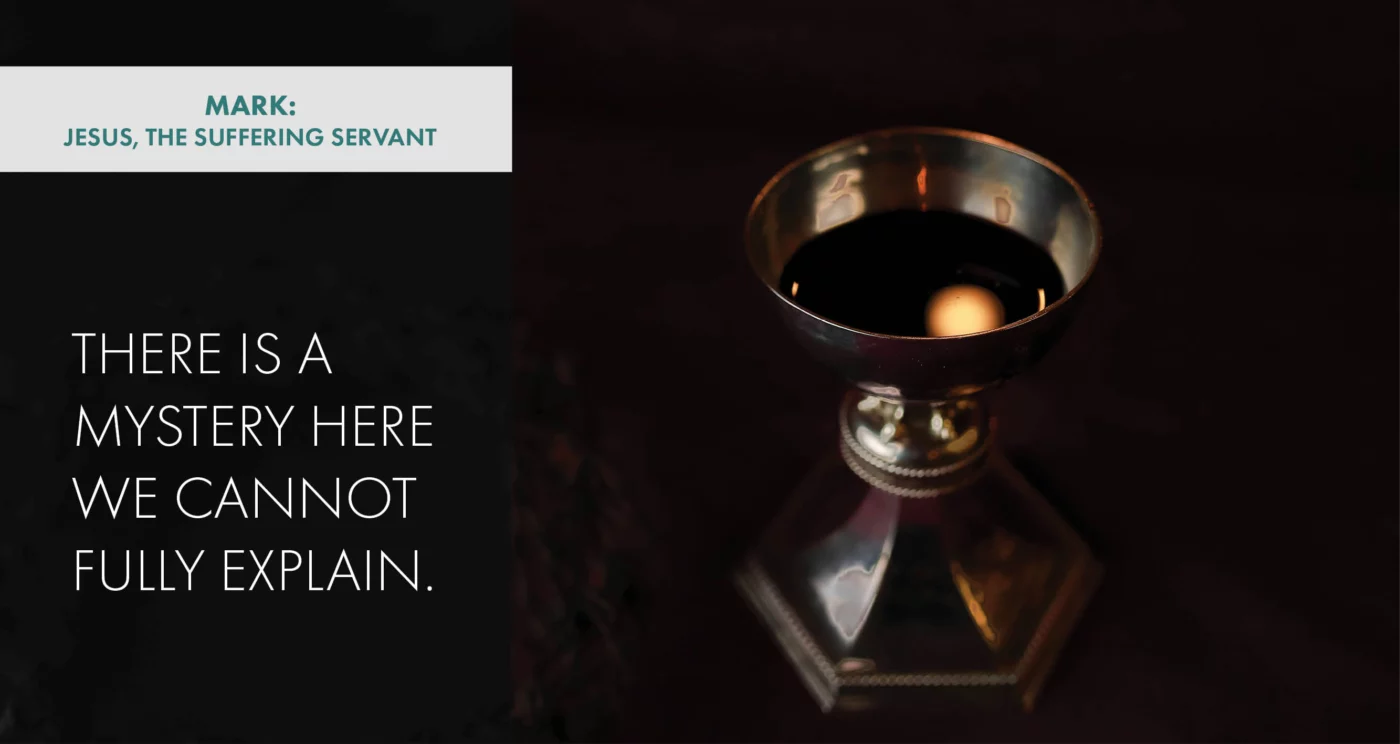
We must confess there is a mystery here we cannot fully explain. Just as there were mysteries that were revealed at the coming of Christ in human flesh, so too, there will be mysteries revealed in His coming again. Until that time, our limited understanding is bolstered by our unwavering faith in Him and His promises.
I found this quote from Alfred Edersheim that helps clarify the importance of this ordinance. “If we may venture an explanation, it would be that ‘this,’ [bread and cup] received in the Holy Eucharist, conveys to the soul as regards the Body and Blood of the Lord, the same effect as the Bread and the Wine to the body – receiving of the Bread and the Cup in the Holy Communion is, really, though spiritually, to the Soul what the outward elements are to the Body: that they are both the symbol and the vehicle of true, inward, spiritual feeding on the very Body and Blood of Christ. So is this Cup which we bless the fellowship of His Blood, and the Bread we break of His Body – fellowship with Him Who died for us, and in His dying; fellowship also in Him with one another, who are joined together in this, that for us this Body was given, and for the remission of our sins this precious Blood was shed.”[1] End quote.
We do well to spend time meditating on the tremendous truths contained in this simple service. The old Passover observance had fulfilled its purpose. It no longer would hold a place of prominence among the people of God. The new wine was being poured into new wineskins.
The Final ELEMENT (essential in keeping the feast) is,
Affirmation
An affirmation is a solemn declaration of the truth or existence of something. Jesus closes this section of the text with such a statement. It is a solemn promise we still embrace today.
In the observance of the Passover meal, there was this saying, “This is the bread of misery which our fathers ate in the land of Egypt. All that are hungry, come and eat; all that are needy, come, keep the Pascha.” It was a time of looking back. But Jesus was looking ahead. He told the Twelve, “I will [positively NOT] drink of the fruit of the vine until that day when I drink it new in the kingdom of God.” New is kainos, not new in terms of time, but rather in terms of quality. All the elements of festivity in the heavenly kingdom will be of a new and higher quality. This will be fulfilled, as I understand Scripture, in the Millennial Kingdom.
We have no record that Jesus partook of the bread and cup He offered to the Eleven; perhaps He did. However, according to Luke 12:35-37, a time is coming in the fullness of the kingdom when He will be both Host and participant. “Let your waist be girded and your lamps burning; and you yourselves be like men who wait for their master, when he will return from the wedding, that when he comes and knocks, they may open to him immediately. Blessed are those servants whom the master, when he comes, will find watching. Assuredly, I say to you that he will gird himself and have them sit down to eat and will come and serve them.”
In contrast to the Passover observance, with its bitter memories, this new meal is a blessing, as stated in 1 Corinthians 10:16-17. “The cup of blessing which we bless, is it not the communion of the blood of Christ? The bread which we break, is it not the communion of the body of Christ?For we, though many, are one bread and one body; for we all partake of that one bread.” Communion equals koinonia, participation, fellowship, and community. This is a blessing beyond our complete comprehension.
Are you ready for the fullness of the coming kingdom? Are you “keeping the feast,” the Lord’s Supper, in sincerity and truth? Are you willing to examine yourself to see whether you can participate worthily, according to 1 Corinthians 11:29? Failure to do so brings judgment and leads to spiritual weakness and even death.
Do you accept Jesus’ explanation of the necessity of His sacrifice and the realization that we humans are responsible for our choices? Have you experienced the results of Jesus’ initiation of the New Covenant, memorialized in the Communion service? Can you, by faith, affirm your place at that future meal when the kingdom comes in its fullness? I hope and pray you can answer each of those questions with a resounding, “Yes.”
“Ever since this blessed Institution has shone as the golden morning-light far out even in the Church’s darkest night – not only the seal of His Presence and its pledge, but also the promise of the bright Day at His Coming. ‘For as often as we eat this Bread and drink this Cup, we do show forth the Death of the Lord’ – for the life of the world, to be assuredly yet manifested – ‘till He come.’ ‘Even so, Lord Jesus, come quickly!’”[2]
[1] Alfred Edersheim, The Life and Times of Jesus the Messiah, p. 1344
[2] Ibid. pp. 1344, 1345
