The Continuing Acts of Jesus || Study the Book of Acts
The Voice of Hope
The Church Radiates the Spirit’s Power || Acts 3–4
Loading
/

In this episode, derived from Guide Through the Bible, Serge, our guest teacher, along with Anthony, study Acts 3–4 to see how the Holy Spirit’s power radiates through the early Church. The Holy Spirit shaped a community that learns to expect to see God at work, to speak about Jesus and His Kingdom, and to show up together in faithful, public witness. How can we be shaped by the Holy Spirit and learn to expect?

Transcript

Welcome: Hey everyone, Welcome to Guide through the Bible. A podcast guiding hearts to Jesus through scripture.

Today we’re looking at Acts 3 and 4. Acts 2 shows the Church being formed by the Spirit. Today’s question is not how the Church begins, but how the Church is empowered.  When you hear that God is at work, what do you expect to see?

  • Contrast:
    • Acts 2 = ignition
    • Acts 3–4 = traction

Most people know Acts 2 well. Why is it important that we slow down and pay attention to what comes after Pentecost?

  • Movement doesn’t just start with power; it survives pressure
  • Introduce theme:
    • The Church Radiates the Spirit’s Power

When you say “radiant witness,” what do you actually mean? What’s radiating — and how?

  • Spirit’s power embodied, not possessed
  • Example: Salt & light (Matthew 5:13-14)
    • Requires contact for effectiveness
  • Church moves from internal formation to public expression
    • Power + opposition show up together

  • Establish the episode direction:

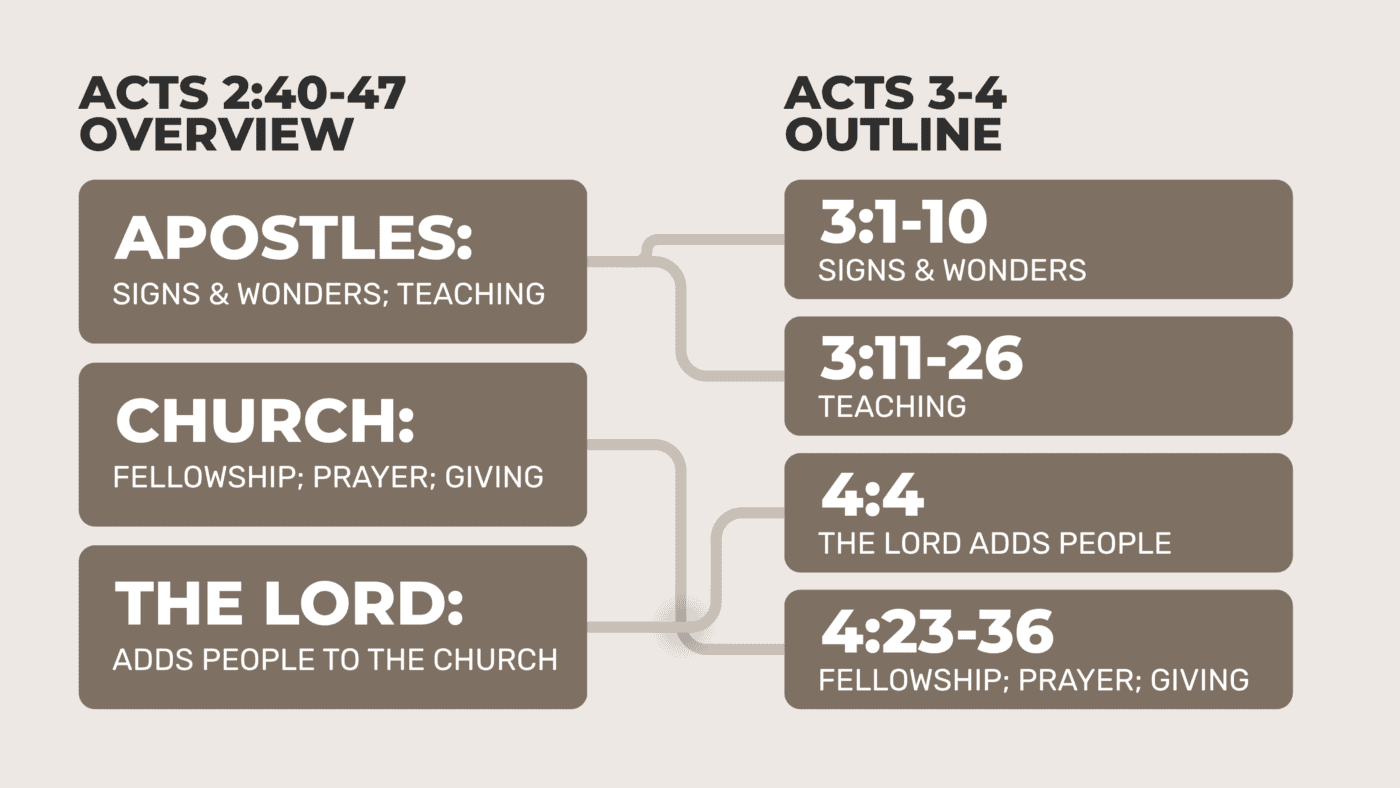
  • Analysing Acts 2:40-47 as a framework for Acts 3-4, I want to sit with three expectations for the Church
  • Expect to see
  • Expect to speak
  • Expect to show up

You describe Acts 2:40–47 as a kind of blueprint. What is Luke trying to show us before the story zooms in?

Let’s read Acts 2:40-47.

40 And with many other words he testified and exhorted them, saying, “Be saved from this perverse generation.” 

41 Then those who gladly received his word were baptized; and that day about three thousand souls were added to them. 

42 And they continued steadfastly in the apostles’ doctrine and fellowship, in the breaking of bread, and in prayers. 

43 Then fear came upon every soul, and many wonders and signs were done through the apostles. 

44 Now all who believed were together, and had all things in common, 

45 and sold their possessions and goods, and divided them among all, as anyone had need.

46 So continuing daily with one accord in the temple, and breaking bread from house to house, they ate their food with gladness and simplicity of heart, 

47 praising God and having favor with all the people. And the Lord added to the church daily those who were being saved.

The Three Actors

  1. The Apostles
    • Teaching + signs
    • Word and power together
  2. The Believers
    • Fellowship (koinonia)
    • Breaking bread
    • Prayer as shared dependence
  3. The Lord
    • God adds to their number
    • Growth is God’s work, not a formula

OUTLINE

Acts 3-4 Outline

BIG IDEA

When people are saved and Spirit descends,we see the Spirit’s Power in Church, shaping a community that learns to expect—to expect to see God at work, to expect opportunities to speak about Jesus, and to expect to show up together in faithful, public witness. 

A. Expect to See – Acts 3:1–10

What’s significant about how Acts 3 opens?

  • Peter and John did not set out to perform a miracle; they set out to pray. Yet Peter saw an opportunity that others may have overlooked. 
  • Acts 3:4 tells us that Peter “directed his gaze” at the lame man. This was not distraction, but attentiveness. Peter was spiritually alert to what God can do amid ordinary faithfulness. 
  • Importantly, the focus of the story is not the healing itself, but the Healer

  • Interruptions as Spirit moments
  • Seeing what others ignore

What does it mean to “expect to see” in ordinary life?

  • Attentiveness
  • Interruptions
  • Looking people in the eye
  • Acts 3–4 teaches the church to expect that God may work powerfully through ordinary obedience—and to be ready to recognize his activity when it appears. Faithfulness begins with spiritual attentiveness. 

B. Expect to Speak – Acts 3:11–26

The miracle draws a crowd — but Peter doesn’t stop with amazement. What does he do next?

  • Seeing God at work creates responsibility. For Peter, the miracle demanded explanation. Silence was not an option.
    • Redirects attention
    • Christ-centered sermon
    • Resurrection front and center
    • Miracle validates the message, not the messenger
  • Acts 3–4 calls the church to expect opportunities to speak—and to speak with clarity, faithfulness, and courage when those opportunities arise. 

Speaking is where most people freeze. What can we learn from how Peter spoke?

  • Contextual
  • Testimonial
  • Christ-centered
  • Spirit-empowered boldness


Acts tells us belief and opposition happen at the same time. Why do those two always seem to travel together?

  • When the gospel is proclaimed, it reveals hearts.
    • Hearts of belief & opposition
      • 5,000 believe
      • Intervention by Scribes and Pharisees
        • Arrest and warning
    • Our Hearts
      • Have we been with Jesus?
      • Can we speak of what we have seen and heard?
        • Why Peter Spoke: Peter spoke because he understood himself to be a witness. This flows directly from Jesus’ commission: “You will be my witnesses” (Acts 1:8). it was the gospel that needed to be proclaimed. 

C. Expect to Show up (Acts 4:23–31)

When Peter and John are released, they go straight back to the church. Why is that significant?

  • Community reflex
    • Example: Family debrief/huddle after an event
      • They retell the story together.
  • The Church interprets events together
    • Faith is sustained corporately

Their prayer is striking — especially what they don’t pray for. What stands out to you?

  • In Acts 4, the believers show up not by withdrawing in fear, but by leaning more deeply into life together before God.
  • Opposition does not scatter the church; it clarifies and strengthens it. 
  • No prayer for safety
  • Prayer for boldness
  • Prayer for continued signs
  • Mission over comfort

3. SHOW UP

This seems very communal. Why can’t this be lived out alone?

  • Routine faithfulness
  • Showing up together
  • Prayer as fuel
  • Shared life as witness


CONCLUSION

Summarize three points: See, Speak, and Show-up.

WHERE ARE YOU GIVING FROM?

To ensure you receive the correct charitable tax receipt, please select the country where you file taxes.

Bible Distribution

Heralds of Hope partners with in-culture believers to distribute Bibles. By collaborating closely with these partners around the world, we empower them to share God’s Word with their own communities.

Audio Content

Heralds of Hope offers two distinctive teaching programs: The Voice of Hope and Hope for Today, each centered on expository Bible teaching. The Voice of Hope is a weekly, thirty-minute program in English, while Hope for Today is a fifteen-minute international program offered in 26 languages. Both are available through radio and social media platforms.