

When I say father, what pictures form in your mind? Are they pleasant, or memories you wish you could forget? No human being, except Jesus, ever had a perfect father, and if you’re a father now, you may feel the weight of your imperfections. But don’t despair, the Bible has clear direction for you as a dad, and God’s grace is sufficient to cover your shortcomings.
We find so much in the Scriptures that will equip us to experience God’s best for us in our father role. On our program today, we honor faithful fathers and call them to a greater degree of faithfulness, to God, His Word, their families, and their churches. Returning to a biblical understanding of fatherhood is the surest path to reviving Christian belief and practice.
One of the great tragedies of our day is the rise in fatherlessness. The pressures of our modern society often make it challenging to be the kind of father we want to be. Because of this, our society is forced to deal with spiritual, emotional, and physical consequences. Let’s listen to a song that was written in the aftermath of the terrorist attack on the World Trade Center in New York on September 11, 2001. While it focuses on fathers who lost their lives in that tragedy, it reminds us of the importance of the role of fathers.
You’ve Got Another Chance SSAM 2:27
In thinking about the characteristics of a godly father, my mind went to Galatians 5:22-23, “the fruit of the Spirit.” Today, we’ll look at how they relate to being a godly father.
The fruit of the Spirit is LOVE. The love spoken of in the Bible is not natural to us. That’s why Ephesians 5:25 commands husbands to love their wives like Christ loved the church. Colossians 3:19 adds, “Don’t be bitter toward them.” Ephesians 6:4 commands us to love our children, and 1 John 4:21 commands us to love fellow Believers.
This love is not a feeling; it’s a choice and a commitment to the well-being of another person, even at significant personal cost. And no one can be an effective father without that kind of love. A father’s role is crucial; love is the foundation of your children’s lives.
Someone has said, “The greatest thing a father can do for his children is to love their mother.” Fathers can only love their wives and children to the degree they understand and accept God’s love for us through Jesus.
O The Deep, Deep Love of Jesus VOP 3:35
Thank you, men, for reminding us of the one who loves us and teaches us how to love.
The next fruit is JOY. Joy is cheerfulness or calm delight. As dads, we know the reality of a harsh and unforgiving world. We know life isn’t fair, and people take advantage of the powerless. In teaching this fact to our children, we can appear harsh, perhaps even uncaring. We want them to understand that you must learn to take your licks and keep going. You can’t wear your feelings on your sleeve. But amidst these challenges, there is joy in fatherhood; the joy of spending time with your children, seeing them grow and learn, and positively influencing their lives.
We need to model a cheerful countenance and calm spirit even in difficulty. Our children need to know that Dad enjoys spending time with them. When our children were young, our family enjoyed playing board games together. Now they’re grown and have children; we enjoy playing games with grandchildren.
How do you respond when you come home from work, plop down in your easy chair, and prop up your feet until suppertime, only to have one of your children come up to you and say, “Daddy, will you read a story to me?” Can you smile and say, OK, go pick out a book? Or do you frown at them and tell them you want to be left alone? Even if we must say NO, we can do it cheerfully. I’m now at that stage with grandchildren.
Next is the fruit, PEACE; the tranquil state of our soul assured of its salvation through Christ. We fear nothing from God and are content with whatever He sends us. We live in troubled times, and sometimes I ask, “What will my children (or grandchildren) face in their lifetime?” But I praise God, I can rest in His divine providence. I can be at peace. He has a plan mapped out for their lives. He has that all under control, and that knowledge, that assurance, provides peace. This peace is not just a personal state of mind; it’s a gift from God that can permeate your relationships and home, bringing harmony and tranquility.
I can also have peace in my relationships with my family. There’s no need for constant quarreling and bickering. When we follow God’s Word, we can have harmonious relationships. As dads, we set the tone in our homes. If we are at peace with God, our calling, and our fellow men, we will most likely have a peaceable home life too.
This song encourages us to be joyfully at rest, at peace.
Come, Come Ye Saints APC 2:18
Then there’s PATIENCE. Uh-oh, maybe I shouldn’t talk about this because I know so little about it. But it is in the list. Being a dad is a little like being a farmer. In James 5:7, we read, “…the farmer waits for the precious fruit of the earth, being patient about it, until it receives the early and the late rains.” You plant the crop, you tend to its growth, but mostly you wait.
That’s how it is with being a father. You plant the seeds of truth in a child’s life. You protect the tender young plant. You pull out the weeds of wrong attitudes and behavior. You do everything to ensure the child will become a productive member of society, and more importantly, the family of God. But most of what you do is wait. That requires patience.
As men, God made us problem solvers. When we see a problem or challenge, we formulate a plan to address it. But how do we respond when our plan doesn’t work? Are we willing to take more time to listen and learn, or do we become impatient and irritable?
That question leads us to the next fruit, GENTLENESS. The word, gentleness, carries the idea of integrity, or moral excellence. Men, you know that gentleness is not one of our natural characteristics. We tend to enforce the guidelines in our homes systematically and sternly. We want our children to understand the consequences of wrong choices. Sometimes our discipline can be overly harsh, and we risk breaking the child’s spirit instead of breaking the will. We need our wives to help balance us in this area.
Ephesians 6:4 warns us as fathers not to provoke or exasperate our children to the point of anger. We must learn that firm guidance can be coupled with gentleness. Children must know that Dad’s strong hands, which administer discipline, are also capable of a gentle touch. A smile, an arm around the shoulders, and an encouraging word all demonstrate a gentleness of spirit within. Fathers, we need to model the example of our gentle Shepherd, the Lord Jesus.
Gentle Shepherd VOP 1:25
The next fruit is GOODNESS. Goodness is moral excellence, which results in doing good deeds for others. We’re not looking for a payback; we want to bless others. In Galatians chapter six, we’re commanded to do good to all people, especially toward our fellow Believers. That would certainly include our families.
The righteousness of Christ is the only source of genuine goodness. Because Christ lives in us, we are empowered to do what is right and good. The fruit of goodness can only be present if we have learned how to die to our selfish desires.
Goodness also contains the idea of generosity. Romans chapter two tells us that God’s goodness leads men to repentance. God is generous with His gifts to unbelievers, hoping they will recognize Him and desire a relationship with Him. We should exercise that same kind of generosity in our families. Our lives should be characterized by goodness.
And what about FAITH? Faith is belief, a settled assurance in the truth. It is accepting the reality of something I cannot see. And biblical faith results in action. That’s the theme for the whole epistle of James.
Being a father takes faith. I accept the promises God has given and I act upon them. When I have a need and don’t have the resources to meet that need, I have confidence that God does. I can’t see all the results of investing in my children’s lives. But my children are old enough now that I can see, despite my failures and mistakes, that God is bringing to completion the good work He’s begun. He may not follow my timetable, but in my experience, I have found He’s faithful.
My Faith Has Found a Resting Place NHQ 1:56
MEEKNESS is the next fruit of the Spirit. Meekness is strength under control; the opposite of anger. The lion is known as the king of beasts; strong and fearless. Yet he can be trained to submit that great strength to a human master. That’s meekness.
Jesus described Himself this way in Matthew’s gospel. He said, “I am meek and lowly in heart…” Jesus wasn’t weak. He was God in the flesh, but He voluntarily limited Himself to functioning in the realm of human existence. He rebuked James and John for wanting to call down fire from heaven on the Samaritans. He reminded the disciples that he could have called legions of angels to deliver Him from death. But He surrendered His own will to the desires of His Father.
Dad, are you a meek person? Are you able to differentiate between your rights and responsibilities? If you get angry at your son for failing his chores, you focus on your right to expect his obedience. If you know your responsibilities, you will help him understand the consequences of not following through on his commitments, but there’s no need for anger.
Our final fruit is SELF-CONTROL. This one is closely related to meekness. Temperance is “the virtue of one who masters his desires and passions, especially his sensual appetites.” If you want a graphic example of how a father’s lack of self-control affects his children, read the story of Eli in the first book of Samuel. His experience warns us against thinking we can teach our children self-control while indulging our passions.
In our culture, we are constantly bombarded with sensual images. Electronic media, billboards, and all kinds of communication promote the idea that the path to happiness and fulfilment is to gratify your senses. In reality, it brings great suffering, spiritually, emotionally, and physically. It is, as Jesus said, “the wide road that leads to destruction!”
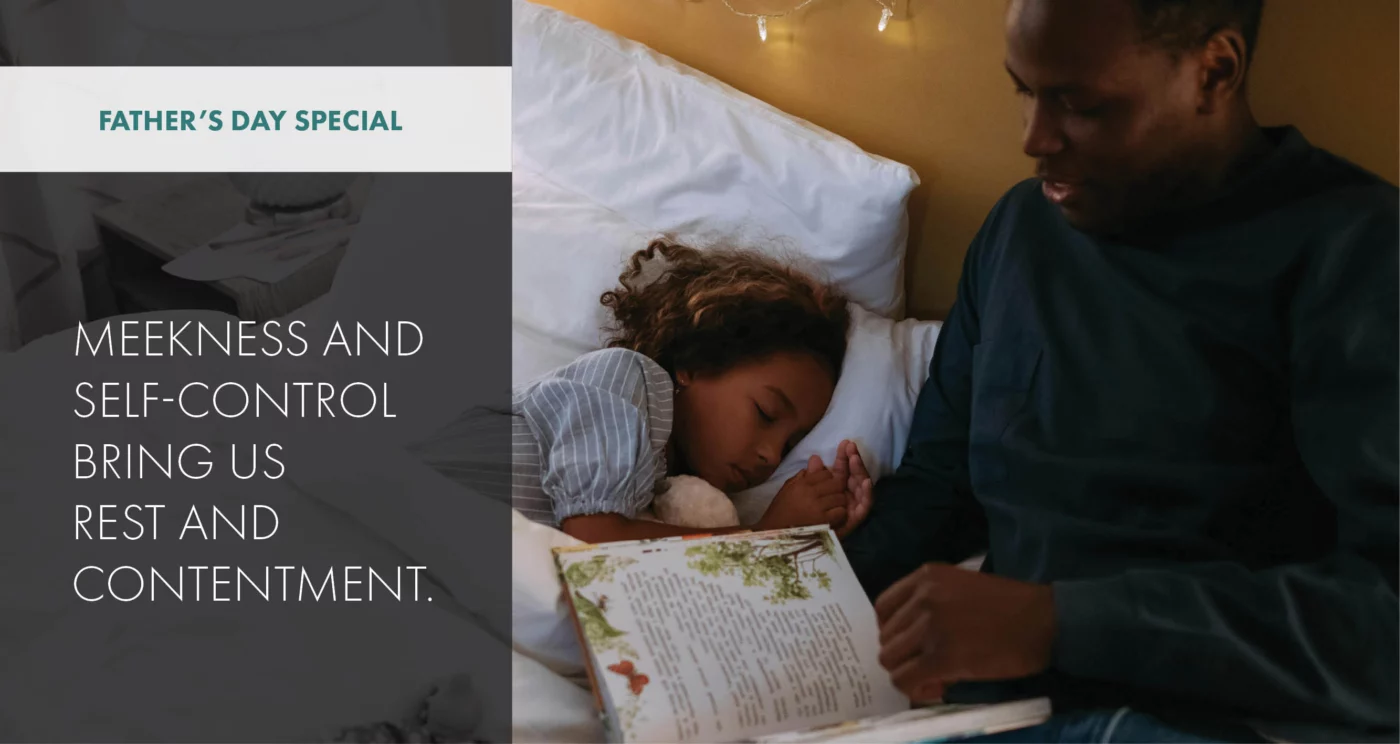
On the other hand, meekness and self-control bring us rest and contentment. We learn that happiness is not in having what we want but wanting what we have. God has given us “everything that pertains unto life and godliness.” He will not withhold from us any good thing if it will accomplish His purposes in our lives. We should be overwhelmed with His goodness, none of which we deserve.
Maybe our review of the fruits of the Spirit as they relate to fatherhood has discouraged you. Perhaps you’re thinking about all your failures as a dad. It’s good to acknowledge them and deal with them. But Satan is the only one who will use your failures to bring condemnation. My Father doesn’t do that. Instead, He convicts us and offers repentance and forgiveness. He wants us to strive to be more like Him and align our lives with His Word. I hope you’ll join me in pursuing that goal.
If you’re a dad listening today, let this song be your commitment.
Prince of Peace VOP 2:14
