

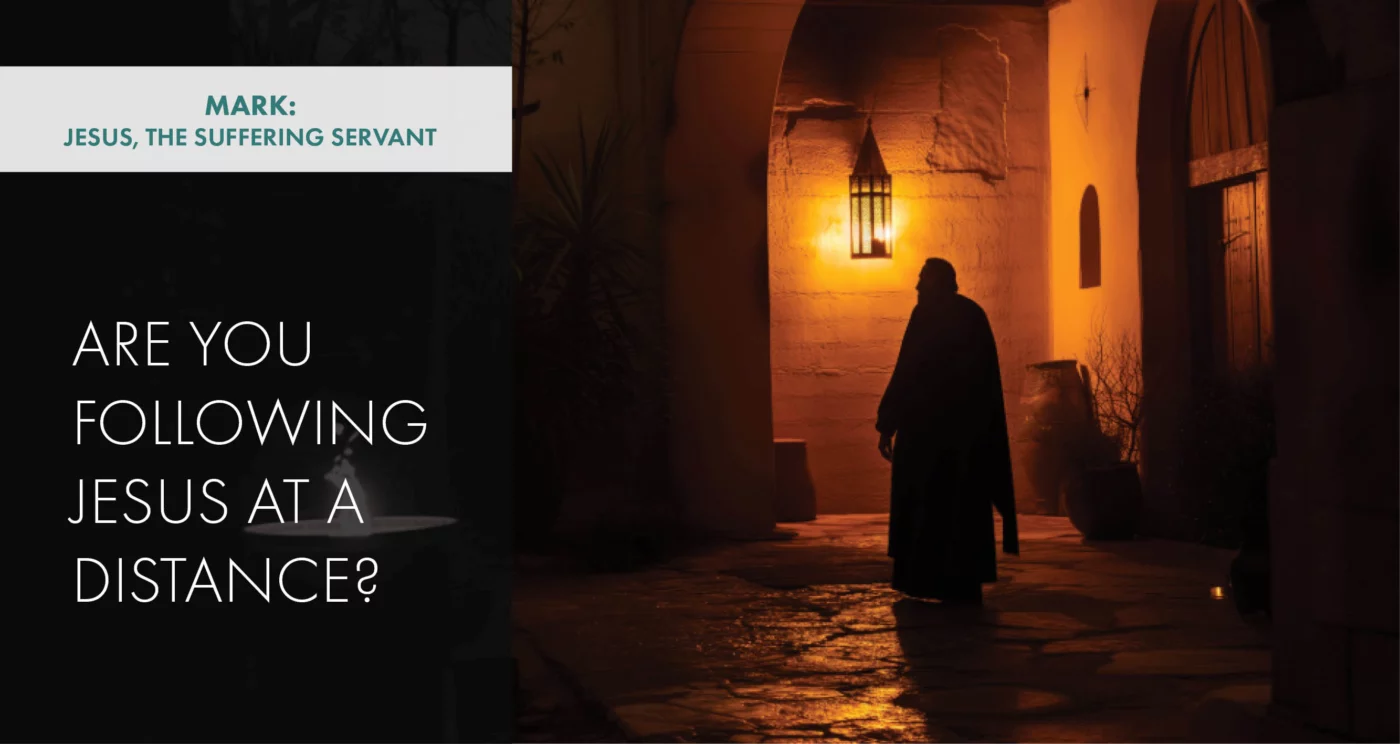
Have you ever had someone you considered a friend deny knowing you? I can’t say I’ve had that experience. Years ago, I met a man in another state. He looked familiar, but I had never met him before. I asked him if he was related to a person I knew. He acknowledged that he was. Later, I found out that he was not only a brother to the man I knew, but also a twin. He chose to omit both of those details in answer to my question. His silence, in a way, denied that connection.
When Jesus sent out the Twelve, He warned them that they would face opposition. He said, “Whatever I tell you in the dark, speak in the light; and what you hear in the ear, preach on the housetops. And do not fear those who kill the body but cannot kill the soul. But rather fear Him who can destroy both soul and body in hell. Are not two sparrows sold for a copper coin? And not one of them falls to the ground apart from your Father’s will. But the very hairs of your head are all numbered. Do not fear, therefore; you are of more value than many sparrows.
“Therefore, whoever confesses Me before men, him I will also confess before My Father who is in heaven. But whoever denies Me before men, him I will also deny before My Father who is in heaven.” That’s Matthew 10:27-33.
Jesus’ statement in verse 33 is a sobering one. If we deny that we know Jesus, verbally or by our actions, we renounce our connection to Him, we disown Him. And Jesus, as our judge, is wholly justified in applying that same standard to us. How thankful I am for His mercy; otherwise, I would have been disowned long ago!
Have there been times in your walk with Jesus that you’ve denied Him? How did that happen? What steps led you to that point?
As we continue working through the scenes of Jesus’ arrest, trial, and crucifixion, we come to Mark 14:66-72. I have read this passage of Scripture many times and seen it as simply a record of events. However, as I meditated on it in preparation for this teaching, its application for us today opened up in a new way. I’ve titled our study, “Denying Jesus.”
As I read the text, try to identify the steps Peter took in the process of denying Jesus. That’s Mark 14:66-72. This is God’s Word to us.
By studying Peter’s experience, we learn the STEPS that make us susceptible to denying Jesus and how to avoid them.
The First STEP (in denying Jesus) is,
Follow at a Distance
I have traveled across many states in the US and several countries overseas. One thing common in all these places is the use of large trucks to transport goods from one place to another. In every country, somewhere on the rear of the truck is a warning such as “stay back” or “don’t follow too closely.” These messages are put there for our well-being. Failure to heed these warnings can result in accidents, injuries, and even fatalities. Under those circumstances, following at a distance could save your life.
However, when it comes to following Jesus, following at a distance can result in tragedy, as seen in Peter’s example in our text. We must return to verses 53 and 54 to obtain this detail. “And they led Jesus away to the high priest; and with him were assembled all the chief priests, the elders, and the scribes. But Peter followed Him at a distance, right into the courtyard of the high priest. And he sat with the servants and warmed himself at the fire.”
What picture comes to mind when you hear the phrase “Peter followed Him at a distance”? There’s probably a whole sermon just in those words. Mark tells us that Peter came back from his flight into darkness to follow Jesus, at a distance. Why did Peter do that? Was he ashamed that, despite his earlier professed bravado, he, like the other 11, had fled into the anonymity of darkness? Did he hope Jesus would catch a glimpse of him in Caiaphas’ courtyard and that would atone for his glaring failure in the Garden? Matthew tells us that Peter went and sat with the servants “to see the end.” He wanted to see what would happen to Jesus.
Peter was concerned about his own safety. He followed at a distance so he could save his own life and not be executed along with Christ. He must have forgotten Jesus’ words at His arrest in John 18:8-9, “If you seek Me, let these go their way, that the saying might be fulfilled which He spoke, Of those whom You gave Me I have lost none.”
Many people claim to be followers of Jesus. They follow at a distance because to follow Him too closely in a fallen world is to invite persecution, and in some places, even death. That was what frightened Peter. This was the same Peter who had vehemently declared moments before, “I will follow You to the death.” But he followed Jesus as an observer at a safe distance. Other people keep a distance from Jesus because, in a hostile, secular culture, there is ridicule and shame that is often heaped upon followers of Christ.
Do you know people who follow Jesus at a distance? Have you ever been guilty of doing that? How can you tell if you are following Him at a distance? A few simple questions can determine the answer. Do your coworkers know you are a follower of Jesus? What about your friends, neighbors, or golfing buddies? You don’t need to wear your Christianity on your sleeve and make a pest of yourself, but do they know where your allegiance is? If they don’t, perhaps you’re following Jesus at a distance. As Peter discovered, that is the first step to denying Jesus.
Another STEP (in denying Jesus) is,
Prioritize Personal Comfort
So, Peter followed Jesus at a distance, but he followed Him right into the lion’s den – the lower courtyard of Caiaphas’ house! Remember, Caiaphas was a wealthy man, so this was probably a large area. Members of the mob that had helped arrest Jesus were most likely there recounting and embellishing their feats of bravery as such men are wont to do. Peter must have hoped to mingle with the crowd while retaining his anonymity. However, he made a fatal mistake. He prioritized his personal comfort.
It was late spring in Jerusalem, and the night air was chilly. Peter was cold, so he sat with the servants of the High Priest and warmed himself at their fire. If he had been content to stay in the shadows, he could most likely have remained unnoticed. However, the same flickering firelight that warmed his chilled body allowed the servant girl who had admitted him into the courtyard to examine him more closely. Her conclusion was boldly stated, though still in a questioning tone, “You also were with Jesus of Nazareth?”
Immediately, Peter disavowed Jesus by saying, “I neither know nor comprehend what you are saying.” We could rephrase it like this: “I am neither conscious of the fact, nor is the statement intelligible to me.” Or simpler yet, “I have no clue what you’re saying.” One writer said that if Peter had been called to accompany the Master to judgment and death, he probably would have gladly done so. The trial came in an unexpected form, and he discovered his lack of moral courage.”
Feeling nervous about his possible discovery, Peter leaves the fire and goes out to the porch (toward the gate). He is moving farther away from the crowd, but also from Jesus. It seems that a chill has entered Peter’s soul in addition to the chill to his body. The rooster crows, but Peter seems oblivious to the meaning of that sound.
How many of us have had a similar experience? No, not like Peter because his circumstances were unique. But how have our desires for personal comfort led to our denying Jesus? That comfort can be emotional or psychological; we don’t want to experience ridicule, rejection, or disdain. Or, it can be that we don’t want to experience physical pain inflicted on us by those who hate Jesus and those who follow Him. There may even be a warning given, but we’re too focused on avoiding pain that we never hear or see it until it’s too late.
Among Christians living in the West, our affluence and ease have led many of us to prioritize comfort above all else. It has made us “soft” in both body and spirit. Fasting is challenging or nonexistent because the variety and quantity of food have become almost an obsession. Some of us can spend hours in the hot sun at a ballgame, but we’re too tired near the end of the day for a one-hour prayer meeting in a climate-controlled room. Making our personal comfort a priority conditions us for easier denial of Jesus.
The Final STEP (in denying Jesus) is,
Reject Identifying with God’s People
Once again, Peter is confronted by the same servant girl. Peter overhears her saying to those gathered around the fire, “This is one of them.” Us is inclusive, them is exclusive, and generally not in a good way. What was the tone of the servant girl’s voice? Accusing, derogatory, or something else? To refer to others as “them” is a way to marginalize people, to make them somehow worth less, even to dehumanize them.
Immediately, Peter denies any connection to Jesus and His followers. He did not want to be identified with “them”! Matthew’s record tells us that an oath accompanied Peter’s second denial. According to Jesus’ denunciation of the Pharisees in Matthew 23, oaths were commonly used, even by religious people. Oaths are intended to add authenticity to a statement, but they are unnecessary for those who consistently tell the truth. Had Peter forgotten Jesus’ teaching about oaths in the Sermon on the Mount? Once again, Peter managed to silence, temporarily, the suspicions of those around him.
However, that silence didn’t last long, according to Luke’s record, only about an hour. Then, those who were standing nearby said, “Surely, you are one of them because your speech tells us you are a Galilean.”
This time, Peter began to curse and swear, “I DO NOT know this man you’re talking about.” The word is anathematizo from anathema. In Galatians 1:8-9, it is translated as accursed. In Acts 23:12, the Jews had bound themselves under a curse, refusing to eat or drink until they had assassinated Paul. Peter, thus, declares himself subject to the divine curse if he is not telling the truth when he disclaims all acquaintance with Jesus. “Oh, what a tangled web we weave, when first we practice to deceive.”
The word “swear” is the same word found in Heb. 3:11, where God is said to swear, that is, to put Himself under oath. According to Luke’s account of these events, Peter’s vehement denials had scarcely died out when Jesus, being led from His interrogation, “…turned and looked at him.” In all that crowd, Jesus’ eyes found Peter. I can only imagine what was communicated in the look Jesus gave him. The penetrating gaze of the Savior broke through the self-delusion, the fear, and the shame in the recesses of Peter’s darkened heart and broke open a fountain of conviction and repentance.
“Then Peter remembered the word of the Lord, how He had said to him, Before the rooster crows, you will deny Me three times.So, Peter went out and wept bitterly.” Later, after Jesus had risen from the dead, He confronted Peter by the Sea of Galilee, asking him three times whether he truly loved Him.
Donald Grey Barnhouse, the former beloved pastor of the Tenth Street Presbyterian Church in Philadelphia, Pennsylvania, once shared the story of a young man he had led to Christ during World War II. The young man was in military service, but he demonstrated the reality of his conversion by immediately professing Christ before the men in his unit.
The war ended. The day came when he was to return to his pre-war life in the wealthy suburb of a large American city. He spoke with Pastor Barnhouse about life with his family and expressed concern that he might soon slip back into his old habits. He was afraid that love for his parents, brothers, sisters, and friends might cause him to deny Christ. Barnhouse told him that if he were careful to make a public confession of his faith in Christ, he would not have to worry about it. He would not have to give up improper friends. They would give him up.
As a result of this conversation, the young man agreed to tell the first ten people of his old set of friends whom he encountered that he had become a Christian. So, he went home and, almost immediately, while still on the platform of the suburban station at the end of his return trip, he met a girl he had known. She was delighted to see him and asked how he was doing. He told her, “The greatest thing that could happen to me has happened.” “You’re engaged to be married,” she exclaimed. “No,” he told her. “It’s better than that. I’ve taken the Lord Jesus Christ as my Savior.” The girls’ expression froze. She mumbled a few polite words and went on her way.
A short time later, he met a young man whom he had known before going into the service. “It’s good to see you back,” he declared. “We’ll have some great parties now that you’ve returned.” “I’ve just become a Christian,” the soldier said. Again, it was a case of a frozen smile and a quick change of conversation. After this, the exact circumstances were repeated with a young couple and with more former friends.
By this time, word had gotten around, and soon some of his friends stopped seeing him. He had become peculiar, religious, and who knows, they may even have called him crazy! What had he done? Nothing but confess Christ. The same confession that had aligned him with Christ had separated him from those who did not want Jesus Christ as Savior and who did not even want to hear about Him.
What is your experience, my friend? Are you in danger of denying Jesus? Peter’s experience provides valuable lessons for us today.
Are you following Jesus at a distance? Are you embarrassed to be too closely identified with Him? Are you fearful about what your friends, family, or others may say about you? Will society shun you as a social misfit? Remember, Jesus told us not to fear those who can only kill the body. Instead, we must fear Him who can destroy both soul and body in Hell. If you’re following Jesus at a distance, it’s time to close the gap.
Are you prioritizing personal comfort? Are you trying to warm yourself at the same fire that the enemies of Christ surround? Has your emphasis on comfort caused you to neglect spiritual disciplines? Jesus and the apostles taught us that through much tribulation we enter the kingdom of God. If you prioritize personal comfort, it will eventually lead you to deny the Savior.
Finally, do you reject being identified with the people of God? Are you fearful of being recognized as “one of them”? Are you trying to fit in with those on the broad way to destruction? As Peter learned, being alone in a hostile crowd makes one very vulnerable. The pressure to deny Jesus is immense.
If you don’t want to deny Jesus, follow Him as closely as possible. Make your relationship with Him a priority, even if it means sacrificing some comfort. And make sure you identify with God’s people by plugging into a local church and committing yourself to the other believers there. Failure to do these things may lead you to deny Christ and weep bitter tears, even as Peter did.
