
Many of us have heard stories about someone buying something for a few dollars at a yard sale or flea market and then learning that what they purchased was worth much more than what they had paid. The seller did not know the value of the item they were offering for sale, or they would not have allowed it to slip through their fingers.
A few of you may be familiar with the 17th-century English poet John Milton. Some of you have heard of his epic poem, Paradise Lost. If you’re not familiar with it, it is a book-length poem about the fall of Satan and Adam and Eve’s ejection from the Garden of Eden. The poem consists of 10,565 blank verse lines written in 1667 when Milton was totally blind. (Blank verse means the poetry isn’t rhyming). He followed it up four years later with his poem, Paradise Regained.
In April 1667, John Milton sold the copyright of Paradise Lost to Samuel Simmons for five pounds, plus five pounds for the sale of each of three subsequent editions, an edition comprising 1,500 copies. The current value of five English pounds is about six US dollars. Milton received a second five pounds in April 1669, making a total of 10 pounds to the author of England’s greatest epic. After his death, Milton’s widow, Elizabeth, sold all remaining rights for eight pounds to Simmons, who became the perpetual copyright owner.
It’s hard to imagine someone selling something of such great value for so little!
Today, our study in Mark’s Gospel is in chapter ten and verses 13 through 16. In this text, Jesus confronts wrong ideas about children and their value in His kingdom. The title of my teaching is “Children of the Kingdom.” Please listen carefully as I read the text, Mark 10:13 to 16.
In this narrative, Jesus outlines essential IDEAS about the role of children and how they model the kingdom of God for us.
The First IDEA (about children of the kingdom) is,
The Views of Children
By the views of children, I mean the views about children. In the time of Jesus, there were differing views about children, just as there are today. If you listened as I read the Scripture, you couldn’t help but notice those differences between the disciples and Jesus.
This incident did not happen in a vacuum. In chapter nine, He deals with the disciples arguing about who will be the greatest in the kingdom of heaven. In the latter part of the chapter, Jesus made several significant statements about children. He clarified that offending a little one who believes in Him will have tragic consequences. Physical death would be preferable to the eternal death that awaits the offender.
The verses just before our text deal with divorce and remarriage, and we discussed the impact that has on children. Divorce often shows that children are valued less than personal autonomy. This broader context is critical for a proper understanding of Jesus’ teaching.
Remember, too, that Jesus is traveling with groups of pilgrims toward Jerusalem for His final Passover. The text finds Him in a house with His disciples, where He clarified His teaching on divorce and remarriage.
In this setting, members of the crowd brought their young children to Jesus so He could touch them. A touch shows caring, compassion, intimacy, and value. The mothers had reverence for Jesus and wanted Him to touch their children. Contrast their attitude with the attitude of the Pharisees and their testing Jesus on the divorce question earlier in the chapter. John’s attitude about who could “identify” with Jesus is also part of the context.
My wife and I have visited Nepal numerous times and observed some of its customs. One custom is for children, even youth, to approach their pastor and bow their heads. That signals the pastor to lay his hand on their head as a sign of blessing. Sometimes, they will take hold of the pastor’s hand and lay it on their heads. Of course, the pastor is not Jesus, but the custom shows respect for the pastor and his connection with them.
Alfred Edersheim informs us that for a Jewish Rabbi to spend time with children was totally out of character. It was contrary to all Jewish notions and incompatible with the supposed dignity of the Rabbi. This idea is supported by the disciples’ reaction toward those bringing the children to Jesus.
As these mothers brought their children to Jesus, the disciples reprimanded them severely. If Edersheim is correct in his assessment of the expectations for a Rabbi, the Twelve had indeed embraced that example. They mistakenly concluded that children have little value in the eyes of Jesus and that He had more important things to do. Jesus was too busy for children! We may want to criticize them immediately, but let’s not be too quick. After all, they were the product of their times, much like we are of ours. And children in our time are often neglected.
However, Jesus wasn’t impressed with their response to the children and their parents. He became indignant. The word is aganakteō. It is a strong word conveying deep negative emotion. He was angered because of the unjust treatment He witnessed. This is the only place in the New Testament where it is applied to Jesus. It is the same word used to describe the chief priests and scribes in Matthew 21:15 in their opposition to the children crying, “Hosanna to the Son of David!” Believe me, they were upset.
Jesus’ response was immediate and robust! The words let and permit don’t capture the strength of Jesus’ command. As I understand it, the idea is “Send the children to me, and DO NOT hinder them!” I would’ve liked to hear Jesus say this, wouldn’t you? I fear we have this mentality that Jesus was a milquetoast, a push-over. Much artwork depicts Him as effeminate. I don’t think He was like that. He wasn’t out of control, but He wasn’t namby-pamby either. He spoke with an authority that commanded a response.
Jesus’ response to the disciples shows us two different views of children. Does your view of children align more with the disciples or with Jesus? Are children a bother or a blessing to you? What do your actions prove?
The Next IDEA (about children of the kingdom) is,
The Virtues of Children
Virtues are commendable qualities or character traits that exist in a person. Jesus explains the rationale behind His command to bring the children to Him. He said, “The kingdom of God belongs to such as these.” What did Jesus mean?
This incident is recorded in all three Synoptic Gospels. Some commentators believe Jesus’ statement assures us of the eternal security of infants and young children who die before they understand their sin and the need for a Savior. I, too, think this is strong evidence of children’s “safety” before the age of accountability. They don’t know pretense like the Pharisees. They don’t know how to act self-righteously. Nor do they see the depth of their depravity. They are what they are with a simple faith and trust in those who guide them. They make no assumptions of goodness or badness. One of the virtues of children is their innocence.
As noted earlier, Jesus’ response contradicted the prevailing view of the apostate Judaism of His day. The Pharisees had a works-righteousness system that children could neither understand nor keep. Children could not perform righteous deeds to gain salvation. Hence, they could have no part in the kingdom. Jesus’ statement turned that idea on its head! He said the kingdom of God belongs to such as these. By this, Jesus included the whole class of children, not just Jewish children or the children who were present.
This reinforces the biblical teaching of salvation by grace through faith. No child or adult can perform enough works of righteousness to merit salvation. In the verses immediately following our text, Jesus offers further teaching on this subject – the experience with the rich, young ruler. He thought there was something he could DO to earn eternal life. He was wealthy and thoroughly self-righteous, but something told him he hadn’t yet found everlasting life.
Jesus said, “Assuredly, I say to you, whoever does not receive the kingdom of God as a little child will NEVER enter it.” That statement from the lips of Jesus is one we must understand. How does one receive the kingdom as a little child? Failure to understand will deny us entrance into the kingdom.
An infant is very dependent. They are unable to provide anything for themselves. As adults, most of us need to recapture the virtue of dependence. Each of us has been given gifts by God and entrusted with His work. We’re commanded to work hard, do our best, and refuse laziness. However, we must maintain our complete dependence on Him. He gives us physical strength to work. He gives us the power to get wealth. He keeps our hearts beating and our lungs operating. Without Him, we can do NOTHING. Dependence is a childlike virtue.
Children trust their parents implicitly. There is a unique bond between them. I remember when my children were small. I would stand them on a table or some other elevated surface and hold out my hands to them. They would walk right off the edge, fully trusting that I would catch them. I could tell them anything, and they would believe it. They trusted me! When I pick up my little grandson, he often snuggles his head on my shoulder and the curve of my neck. It is an act of trust and connection. Without the childlike virtue of trust, salvation is impossible.
Children learn to obey their parents simply and without complaint as they develop – at least, they should. Some psychologists and parents today argue against teaching children to obey, but the results are not encouraging. Children who obey their parents are prepared for the time when they will become Christ-followers. Obedience is necessary for salvation because one must acknowledge they are a lost sinner and heed God’s call to repent and believe the Gospel.
Jesus here presents the little child with trusting, simple, and loving obedience as the model for adults in coming into the kingdom. As adult children of the kingdom, are these virtues present in your life and mine?
The Final IDEA (about children of the kingdom) is,
The Value of Children
Jesus clearly demonstrated the value of children by His actions. “He took them up in His arms, laid His hands on them, and blessed them.” Mark is the only Gospel writer to include this meaningful gesture. What a difference from the attitudes and actions of the disciples!
Jesus didn’t just touch the little ones as their mothers had hoped. Instead, He enfolded them in His arms and blessed them repeatedly. Isn’t it like Jesus to give us more than we’re looking for and more than we deserve? The sense of the verb is that He blessed each one fervently, praying for each of them while laying His hands on them. What a wonderful picture for all the children of the kingdom!
Today, children are often not valued in the way that God intended. The blood of thousands of innocent children aborted every day around the world cries out for justice. I tremble for those who participate in these monstrous crimes because unless they repent, they will face the unmitigated wrath of Almighty God. Every one of these precious little ones is made in God’s image, and God will demand an accounting for the horrible treatment of His image-bearers.
Even for parents who would never consider abortion, there are other ways in which children are not adequately valued. Some children have adequate physical provisions, but their spiritual development and training are neglected. Others are neglected as parents pursue their careers, hobbies, financial, or ministry goals. I have seen children needing attention neglected by their parents because they were so absorbed in their smartphones that they were oblivious to the child’s needs. We can determine the value of something by the way we care for it!
Still others, professing to follow Christ, purposely prevent their marriage union from producing children. Their choice shows they don’t value children. Thankfully, I am not the judge of people’s salvation, but how can people who reject children claim to have entered Christ’s kingdom by becoming like little children? Asking for a friend.
I praise God for parents who value and love children. I know many of them and am blessed by their commitment to laying the foundations for many godly generations. May their number increase! I am also blessed by people who aren’t parents, but their actions demonstrate a love for children.
My wife and I haven’t been perfect parents, but we love each of our eight children and our eight grandchildren. Seeing our children embrace the Gospel we’ve taught and tried to live before them is our greatest blessing. Their salvation is a sovereign work of God, but as parents, we are the agents by which that divine work is begun.
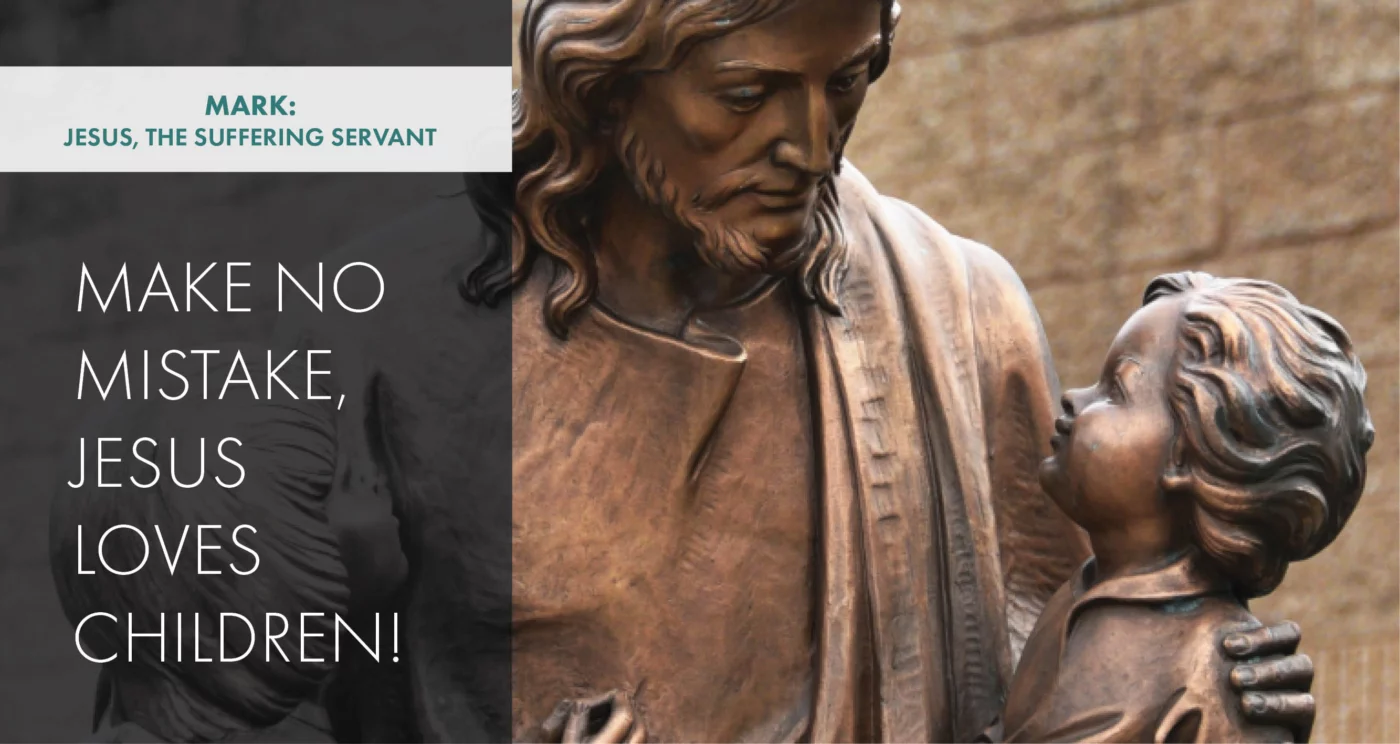
Make no mistake, Jesus loves children! Can we, as His followers, do less? Can we ignore, neglect, or refuse children and claim to be one of His? To ask the question is to answer it.
Let’s review the ideas about the role of children and how they model the kingdom of God for us. First, the views about children. Jesus had a different view of children than His disciples and the religious leaders. Jesus showed them that their view was incorrect.
Jesus then went on to teach them about the virtues of children: humility, trust, and obedience, to name a few. He taught that without these, no one can enter the kingdom of God.
Finally, He demonstrated the value of children by taking the time to hold them, pray over them, and bless them. I encourage you to take time for the children in your sphere of influence, whatever your position in life. To receive these little ones in Jesus’ name is the same as receiving Him and the Father!
May all of us be counted worthy to be called “Children of the Kingdom.”
