

“Check your privilege.” What comes to mind when you hear that phrase? It has its origins in the modern social justice movement. The co-founder of Black Lives Matter defined privilege as follows: “Privilege isn’t about what you’ve gone through; it’s about what you haven’t had to go through.” Supposedly, privilege can be based on skin color, gender, or economic status.
The phrase is often used to shut down discussion when the user asserts that you are hopelessly confused in your understanding and that your opinions amount to aggression. As a result, others argue that they don’t need to listen to you, much less respect your arguments. Unfortunately, there is no satisfactory remedy in the minds of people who think this way. For example, if you are white, you are guilty of white privilege, and no amount of remorse or self-flagellation can correct it.
However, there is another aspect of the phrase. It could be an invitation to discuss the issues at hand. In that sense, “check your privilege” essentially amounts to “check your premises” behind your views. In other words, what is the basis or foundation of your argument or point of view? Reviewing these can be beneficial for all of us.
Our text for study today is Mark 12:1-12. While these verses comprise the opening of a new chapter, they are directly connected to the previous chapter. That’s why it is helpful when you study Scripture to sometimes ignore the chapter and verse divisions.
Our study last week was titled “The Question of Authority.” We noted how the religious leaders refused to acknowledge or accept the authority of John the Baptist and Jesus. The parable that Jesus tells in the opening verses of chapter twelve continues this theme. However, Jesus approaches the subject from a different vantage point, the vantage point of privilege. Thus, the title of my teaching is “Check Your Privilege.”
I invite you to listen carefully as I read Mark 12:1-12.
In this parable, Jesus reveals various ASPECTS of privilege and how our response to them determines our future.
The First ASPECT of Privilege is,
The Diligence of the Planter
Before I begin to unpack this, I note that a parable is rare in Mark’s Gospel. Remember, Mark records more of what Jesus did than what He taught. So, why a parable, and why now?
In Matthew 13, when Jesus was asked why He used parables, He said, “Because it has been given to you to know the mysteries of the kingdom of heaven, but to them it has not been given. Therefore, I speak to them in parables because seeing, they do not see, and hearing, they do not hear, nor do they understand.” So, parables were designed to obscure the truth from those who refused to believe.
However, this parable wasn’t designed to obscure the truth. It is very plain, and I believe Jesus intentionally provoked the religious leaders because of their obstinate unbelief. So, let’s take a closer look.
The diligence of the planter is the first aspect of privilege. There is no question about who the planter of the vineyard is. It is God. We learn that from Isaiah 5:1 and 2. “Now let me sing to my well-beloved. A song from my beloved regarding His vineyard: My well-beloved has a vineyard on a very fruitful hill. He dug it up, cleared out its stones, And planted it with the choicest vine. He built a tower in its midst and made a winepress in it; so, He expected it to bring forth good grapes, But it brought forth wild grapes.”
Later, in verse 7, God spells it out unmistakably. “For the vineyard of the Lord of hosts is the house of Israel, and the men of Judah are His pleasant plant. He looked for justice, but behold oppression; for righteousness, but behold, a cry for help.”
Jesus’ audience was familiar with the prophet’s writings, and Jesus’ words may be a loose translation of those verses from Isaiah. In Mark’s telling of the parable, Jesus adds that the vineyard owner “set a hedge around it.” This was likely a hedge of thorns to protect against thieves and predators. The owner wanted to protect what was his.
In addition, he dug a pit under the winepress to catch the juice of the trampled grapes. Joyce and I saw this type of winepress in our visit to Israel in 2023. It was hollowed out of solid rock. He also built a watchtower for security, leased the vineyard to tenant farmers, and entered a distant country. The details of the owner leaving the area tell us that the tenants had complete control of what happened in the vineyard. He gave the vineyard every possible privilege so it would thrive and produce good fruit.
The structure of the parable shows that God is the landowner and that the vinedressers are Israel as a nation, although they are addressed and dealt with in the person of their representatives and leaders. Luke tells us that this parable was spoken to the people, yet says that the Pharisees and chief priests “perceived that He spoke about them.”
Yes, God gave the nation of Israel every possible advantage to bring forth fruit for His glory. I think of Paul’s words in Romans 3:1 and 2. “What advantage then has the Jew, or what is the profit of circumcision?Much in every way! Chiefly because the oracles of God were committed to them.”
Further, in Romans 9:3 to 5 he wrote, “For I could wish that I myself were accursed from Christ for my brethren, my countrymen according to the flesh, who are Israelites, to whom pertain the adoption, the glory, the covenants, the giving of the law, the service of God, and the promises; of whom are the fathers and from whom, according to the flesh, Christ came, who is over all, the eternally blessed God. Amen.” Wow, what a list of privileges!
God, in person, gave Israel the Law at Mount Sinai, including all the statutes and commandments they needed to fulfill His plan for them as a people. He set them apart as a special people for Himself. Then, He stepped back (went into a distant country) and left them to live out His commands.
What privileges have you received because of the diligence of God, the heavenly planter? It is easy for us to criticize the Jews of Jesus’ day, but hasn’t He given us many privileges, too? We enjoy easy access to the Word of God and many resources to help deepen our understanding of it. We gather freely for corporate worship, while many of our brothers and sisters worldwide cannot. We are blessed to see and hear things that prophets, kings, and saints of old desired to see and hear and could not. Materially, we are blessed above 90% of the world’s population. Yet, how, I ask, have we treated the giver of all these privileges? How have we responded to His messengers?
That question leads me to the next aspect of privilege.
The Next ASPECT of Privilege is,
The Disrespect of the Tenants
Tenant vineyards operated in several ways during Jesus’ time. One common way, and the way this vineyard appears to have been operated, was that the owner received a portion of the fruits. Generally, these leases were given by the year or occasionally for life. Sometimes, the leases were hereditary, passed down from father to son. This parable assumes that it is a generational lease.
So, when the harvest time drew near, the vineyard’s owner sent one of his slaves (doulon) to the tenant farmers to receive the portion they owed him. They caught the slave, beat him severely, and sent him back to his master empty-handed.
That’s not how this was supposed to work! We would think that the vineyard owner would now take severe measures to acquire what was rightfully his. But no, instead, he sends another slave to collect what was due. The tenants treated him disgracefully, threw stones at him, wounded him in the head, and sent him away empty-handed.
Despite the rejection of his overtures, the vineyard’s owner sent more of his slaves. Some of these were severely beaten, others were killed. Luke’s account of this parable indicates that the authority or rank of those sent increased as time passed. That makes sense as we reach the climax of disrespect these tenants show.
Two things stand out to me in this—first, the determined rebellion and wickedness of the tenant farmers. Their guilt increased dramatically with each servant they abused and rejected. Second, the patience and forbearance of the vineyard’s owner is astonishing. He was patient, long-suffering, slow to believe that his tenants were so thoroughly evil.
Finally, the owner, yet having a beloved son, sent him to collect the debt. He believed that the tenants would honor and reverence his son. The word picture of reverence is “turning with respect when one worthy of it appears.” And did you notice the son was sent to them “last?” The word is eschaton. We get our English word eschatology from it. Jesus’ coming to His vineyard ushered in “the last days,” the final age of redemption.
However, the tenants said to each other, “This is the heir of the vineyard; here’s our chance. Let’s kill him, and the vineyard will become ours.” So, they took him, cast him out of the vineyard, and killed him. Alfred Edersheim suggests that the words “taking him” indicate that by violence, they thrust him out of his possession before they wickedly killed him. That fits Hebrews 13:12. “Therefore Jesus also, that He might sanctify the people with His own blood, suffered outside the gate.”
Since the vineyard owner had not descended on them with judgment for their ill-treatment of the earlier emissaries, these wicked men assumed that by killing the heir, they would have sole possession of the vineyard. They mistook the patience of the vineyard owner for disinterest in its affairs. It was a grievous mistake.
Have you and I disrespected our Master, the Lord Jesus? Have we taken His patience and grace as a sign of weakness or disinterest? How have we treated His messengers, His Word, His Holy Spirit, our parents, our spiritual leaders, and our brothers and sisters in the Lord? If we find this kind of disrespect in our lives, we must repent.
Listen to Jesus’ indictment of these tenants in Luke 11:47 to 51. “Woe to you! For you build the tombs of the prophets, and your fathers killed them. In fact, you bear witness that you approve the deeds of your fathers, for they indeed killed them, and you build their tombs. Therefore, the wisdom of God also said, ‘I will send them prophets and apostles, and some of them they will kill and persecute,’ that the blood of all the prophets which was shed from the foundation of the world may be required of this generation, from the blood of Abel to the blood of Zechariah who perished between the altar and the temple. Yes, I say to you, it shall be required of this generation.”
That pronouncement of accountability leads us to the final aspect of privilege.
The Final ASPECT of Privilege is,
The Displacement of the Tenants
What is the proper response of the vineyard owner in light of this flagrant abuse of His servants and rejection of His authority? He will come and destroy those wicked tenants and give His vineyard to others. This pronouncement was graphically fulfilled in the total destruction of Jerusalem in AD 70 and the opening of the door of faith to the Gentiles. The vineyard has been “rented” to other tenants. Let us be careful lest we face the same fate.
Jesus knew that the religious leaders were familiar with Scripture. So, He asked them, “Haven’t you read this passage? The stone that the builders rejected Has become the chief cornerstone. This was the Lord’s doing, And it is marvelous in our eyes?” He quoted Psalm 118:22. Incidentally, the children in the Temple also quoted this Psalm in their ecstatic praise during the Triumphal Entry.
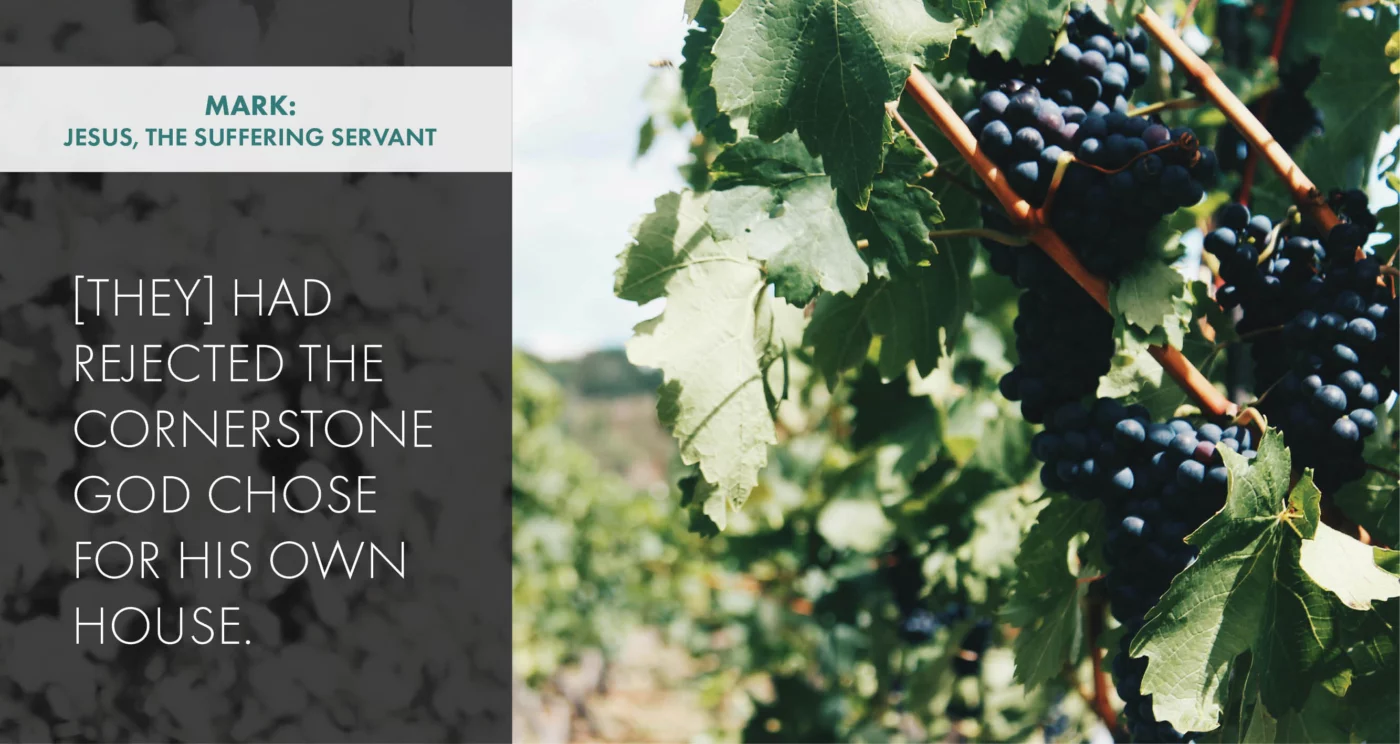
These so-called experts in building God’s temple had rejected the cornerstone God chose for his own house. But God had the last word, set aside the building experts, and put his Son as the Head of the corner. It was a withering indictment.
After graphically describing the trajectory of those who reject God in Romans chapter one, Paul writes the following, “And do you think this, O man, you who judge those practicing such things and doing the same, that you will escape the judgment of God? Or do you despise the riches of His goodness, forbearance, and longsuffering, not knowing that the goodness of God leads you to repentance? But by your hardness and your impenitent heart, you are treasuring up for yourself wrath in the day of wrath and revelation of the righteous judgment of God, who ‘will render to each one according to his deeds’…”
Immediately, the elders understood the meaning of Jesus’ words in the parable and the Psalm’s quote and wanted to arrest Him. However, they feared the people, knowing Jesus had spoken the parable against them. So, they left Him and went away. As we’ll see shortly, the reprieve was only temporary.
Lest you and I be tempted to gloat over the displacement of the original tenants, God has a word of warning for us in Romans chapter 11.“You will say then, “Branches were broken off that I might be grafted in.” Well said. Because of unbelief, they were broken off, and you stand by faith. Do not be haughty, but fear. For if God did not spare the natural branches, He may not spare you either. Therefore, consider the goodness and severity of God: on those who fell, severity; but toward you, goodness, if you continue in His goodness. Otherwise, you also will be cut off.”
If we are unfaithful and disrespectful to the vineyard master, we, too, will be displaced. The writer of Hebrews warns us, “For if we sin willfully after we have received the knowledge of the truth, there no longer remains a sacrifice for sins,but a certain fearful expectation of judgment, and fiery indignation which will devour the adversaries.”
As Christ-followers, you and I have been blessed with many privileges, including “every spiritual blessing in the heavenly places in Christ, just as He chose us in Him before the foundation of the world, that we should be holy and without blame before Him in love…” God did not spare His own Son but delivered Him to death because of our offenses. Christ died for us while we were still sinners. The diligence of our planter is unmatched!
Are we guilty of disrespecting our Master? Have we taken His patience and grace as a sign of weakness or disinterest? Have we mistreated His messengers to us, His Word, His Holy Spirit, our parents, our spiritual leaders, our brothers and sisters in the Lord? Have we spurned His calls for humble, selfless service in the pattern Jesus gave us?
If we encounter this kind of disrespect in our lives, we must repent. Otherwise, we may be displaced in favor of those who honor and respect God and obey His commands. Each of us needs to “check our privilege.” What is the basis of our relationship with Jesus, and are we walking with Him in loving obedience?
