

There are numerous expressions we use in the English language that, unbeknownst to many, come from the pages of Scripture. Some are quotes like, he’s a “salt of the earth” kind of guy, or “a three-strand cord isn’t easily broken.” Others are implied, like “don’t be a Judas,” or “don’t judge a book by its cover.” Speaking of Judas, his betrayal of Jesus gave us the idiom, “the kiss of death.” It is used to describe something (such as an act or association) that ultimately causes harm or ruin.
No treachery is worse than betrayal by a family member or friend. Among the conspirators who assassinated the Roman emperor, Julius Caesar, was Marcus Junius Brutus. Caesar not only trusted Brutus but had favored him as a son. When he saw Brutus among the attackers with his dagger in his hand, Caesar stopped struggling. He pulled the top part of his robe over his face and asked the famous question, “Even you, Brutus?”
Shakespeare’s well-known line is still used today to express shock at a friend’s betrayal. If you’ve ever experienced such betrayal, it’s heartbreaking. The one you thought loved and supported you turns against you in your time of greatest need.
As we continue our study of the Gospel of Mark, we come to the scenes of Jesus’ betrayal and arrest. He has just concluded His agonized wrestling with drinking the cup of God’s wrath against our sin. It has been a physically, spiritually, and emotionally draining experience, but He is committed to doing His Father’s will. What happens next, though not unexpected or unknown, must have hurt very deeply.
Let’s read about those events from Mark 14:43-52.
In this section of Scripture, we see several EXAMPLES of “Betrayal.” We will learn there is more than one way to betray our Savior.
The First EXAMPLE (of betrayal) is
Judas
Our text begins by telling us that Judas, at the head of a large group of people, enters the garden and approaches where Jesus and the eleven disciples are gathered. Jesus is still urging the disciples to pray against temptation even as Judas arrives. Notice how the text mentions explicitly that Judas was one of the Twelve. The double reference emphasizes the horror of this act; first, it marks Judas’ intention to betray Jesus, and now it marks the act being carried out.
This “multitude” consisted of a hastily gathered group armed with short swords and stout sticks. These were not the crowds of ordinary people from the Temple, but rather some members of the Temple police and some regular Roman soldiers. There were also some personal servants of the High Priest and members of the Sanhedrin.
The token was a prearranged sign between Judas and the authorities. He said, “Whomever I kiss, He is the One; seize Him and lead Him away safely.” Do you see the dichotomy in that statement? Seize and safely don’t seem to belong together in the same sentence. Judas must have feared Jesus could “give him the slip.” He had often demonstrated His supernatural ability to elude His enemies. There must be no risk of failure.
Judas, arriving at the spot, wasted no time. He immediately approached Jesus, greeted Him as “Rabbi,” and kissed Him affectionately. It was customary to greet a Rabbi with this sign of respect. The verb “kissed” is kataphileo. The prefix kata intensifies the verb phileo. It was a fervent kiss, but of course, hypocritical. Judas kissed Jesus, not just once on each cheek, as is the typical Eastern greeting, but with profuse kisses. Most likely, Judas wanted no mistakes about who the target of this arrest was.
In Luke’s record, Jesus confronts Judas with the words “…with a kiss do you betray?” The very act of love, friendship, and mutual trust is turned into treachery by Judas. It seems Jesus is making one last appeal to Judas’ conscience, but sadly, his conscience is seared beyond feeling. His disillusionment and greed have hardened his heart. His kiss was a kiss of death.
Judas’ problem was not his intimacy with Jesus; it was his intimacy with swords and clubs. Though he should have known better, he must have expected resistance. Why else would he come in the way he did? He displayed his misunderstanding of what Jesus had been teaching for the past three years. Jesus was not leading an armed revolution; perhaps that’s what Judas had been hoping for. Jesus’ kingdom operated on different principles from the kingdoms of the world.
Judas’ betrayal of Jesus was a very open act. It signified a conscious choice he made at some point in the past, at least by the time he agreed with the religious leaders and received the payment for his services. Although we don’t know all the events that brought Judas to this point of action, he was certainly conscious of the insincerity of the affection he now lavished on Jesus.
But what about you and me; are we ever guilty of openly betraying Jesus like this? Most of us would deny it. Have you ever remained silent when the name of Jesus was being denigrated or blasphemed? Were you ever too embarrassed to be identified as one of His followers?
I know we can’t recreate the circumstances. He’s not here physically, but what about betraying those who are part of His body, the church? If you injure my body, you injure me, right? Have we ever offered someone a handshake and a smile, only to detest them inside and be eager to share their failures with someone?
1 John 4:20 and 21 tell us, “If someone says, ‘I love God,’ and hates his brother, he is a liar; for he who does not love his brother whom he has seen, how can he love God whom he has not seen? And this commandment we have from Him: that he who loves God must love his brother also.” Have you ever stood silently while a brother or sister’s reputation was being maligned or their character denigrated? Is that not a betrayal?
Our ability to love our brothers and sisters proves the genuineness of our love for Jesus. If our expressions of love for our brothers and sisters are as hypocritical as Judas’ expressions of love for Jesus were, we are betraying them and Him. The results may not be fatal immediately, but unless we repent, ruin and harm will ultimately be the consequence.
The Next EXAMPLE (of betrayal) is
Peter
Peter betrayed Jesus, too. We don’t usually see it that way, do we? We see Peter’s denial of Jesus, but in our minds, ‘betrayal’ may be too strong a word to use.
As the mob seizes Jesus, Peter reacts instinctively. He drew his sword and cut off the ear of the High Priest’s servant. It takes little imagination to understand that Peter’s intent was NOT the surgical removal of this man’s ear. He was aiming to cleave his skull!
Peter’s action is a betrayal of Jesus. For more than three years, Jesus had been teaching His disciples that His kingdom operates in ways opposite to the kingdoms of this world. He taught them that love is a greater power than force, that service is the way to greatness, that poverty brings true riches, and much more. However, we can conclude from his actions in this scene that Peter rejected this teaching.
Jesus’ earlier warning to Peter must have been forgotten. Remember, Jesus said, “The spirit is willing, but the flesh is weak.” Because the response of the flesh is natural, it often predominates. That is part of its inherent weakness; it reacts rather than responds. Peter’s failure to “watch and pray,” to fortify his spirit, earlier led to failure in the moment of crisis. How many times have you and I had similar failures?
Maybe you wonder how an impulsive reaction can betray Jesus. Wasn’t Peter trying to defend Jesus? One of the definitions of betray is “to fail or desert, especially in time of need.” Peter lashes out and strikes at the first available victim. He intended to kill the man, but only slashed off his ear. John tells us the man’s name was Malchus, a servant of the High Priest.
Did Peter’s hasty action support what Jesus had taught them? No, of course not! Here was Peter, a disciple of one who taught the way of forgiving love, even to enemies, and he was trying to kill the one who came against his Master. His actions were a betrayal of the very things Jesus had taught in the Sermon on the Mount and on other occasions during His ministry. In Luke’s record, Jesus rebuked him by saying, “Those who live by the sword will die by the sword.”
As Tim Keller points out, we’re kind of like Peter. He was fine with justice, peace, and fairness. But when a challenge arose, he felt for the sword hilt. Like him, we merge the kingdom of this world – force, money, power, success, and recognition into our philosophy, whether it’s Christian or something else. And just like Peter, we settle for the kiss of death.
I’m a follower of Jesus, but I’d be embarrassed to tell you how many times my impulsive reactions have betrayed Him. When I respond in anger to that rude driver on the highway, I betray my Lord. When I snap at the restaurant waiter for messing up my order multiple times, I betray my Lord and His teaching. Maybe you have some examples of your own.
Perhaps you think those things aren’t as serious as what Peter did. Well, anything that hinders Jesus’ message is a big deal. If someone rejects Christ and His message because of my impulsive reactions, I am betraying the Lord’s trust in me. I believe that’s serious!
While Mark doesn’t record this, I love Jesus’ response. He asks the soldiers for permission to postpone His arrest until He can heal the injured servant. So, He touches the servant’s ear and heals him. Incredible! He’s not thinking about Himself, He’s thinking about His purpose: to save life, not destroy it. Only God, in His amazing grace, can transform our failures into something beautiful. That doesn’t excuse our poor choices; it just shows His power.
Another EXAMPLE (of betrayal) is
The Religious Leaders
In verse 48, Jesus confronts the religious leaders with their cowardice. He asks why they have come to apprehend Him with swords and clubs as though He were a violent criminal? Highway robbers like Barabbas were common and were often regarded as heroes. Why didn’t they arrest Him as He taught each day in the Temple? The Lord had visited the Temple on three consecutive days during that week.
But then, as He did earlier in verse 27 of this chapter, He acknowledges that this must happen so the Scriptures will be fulfilled. In Luke’s version of these events, Jesus addresses the spiritual powers involved in this event. He says, “This is YOUR hour and the power of THE darkness.” The treachery of Judas and the secrecy of the arrest were fulfillments of prophecy.
The religious leaders knew the Scriptures. However, their position, power, wealth, and prestige had blinded them to the truth. Jesus’ ability to attract the multitudes filled them with envy and blind hatred. In John 15:22-25, Jesus told His disciples, “If I had not come and spoken to them, they would have no sin, but now they have no excuse for their sin. He who hates Me hates My Father also. If I had not done among them the works which no one else did, they would have no sin; but now they have seen and also hated both Me and My Father. But this happened that the word might be fulfilled which is written in their law, they hated Me without a cause.”
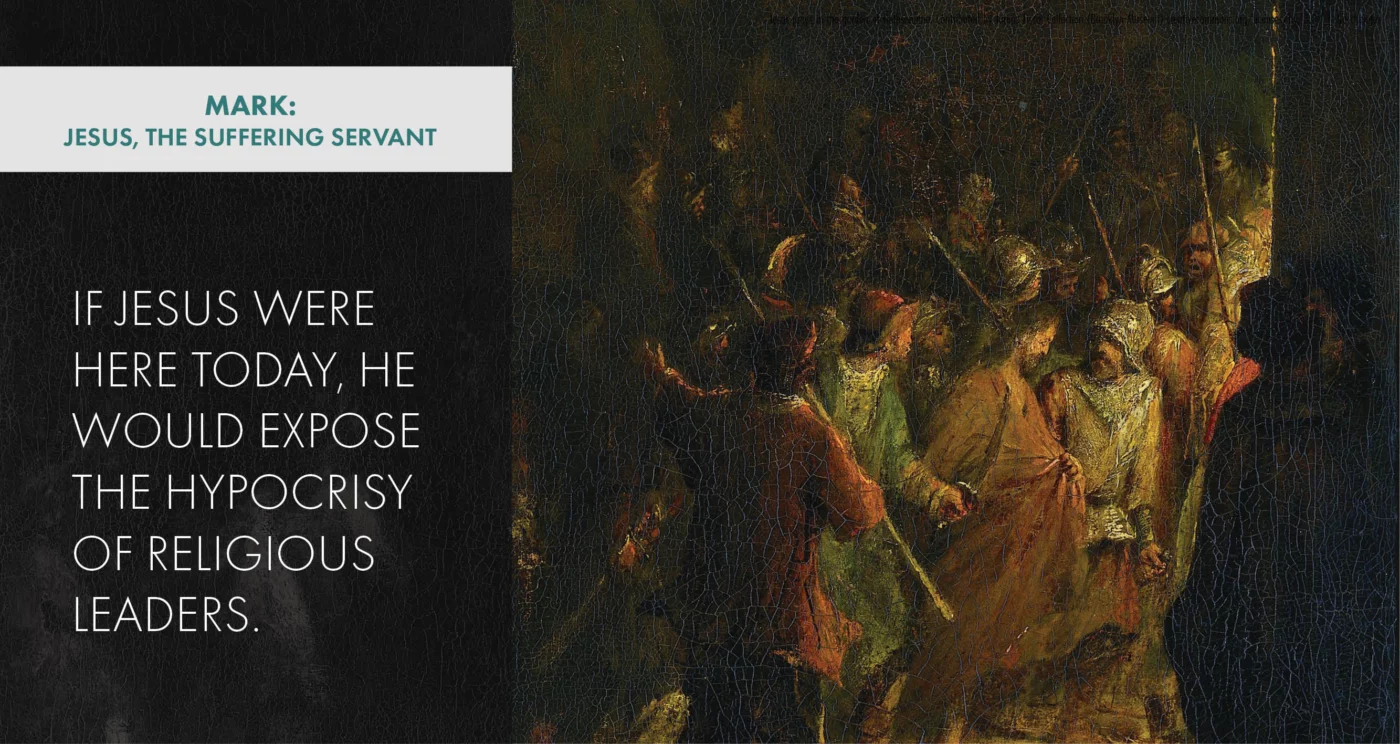
Unfortunately, there are religious leaders today who follow this same path. They appear outwardly righteous, but power, wealth, and prestige have caused them to protect their position at the expense of the truth. If Jesus were here today, His exposure of their hypocrisy would place them among those calling for His death.
It’s true; all these things needed to happen just the way they did to fulfill prophecy. But those who committed these acts of betrayal were personally responsible for their choices.
The Final EXAMPLE (of betrayal) is
The Remaining Disciples
The final verses in this text are equally tragic. “And having forsaken Him, they fled, all of them. And a certain young man was following with Him, who had thrown a linen cloth around his nakedness. And they seized him. And having left the linen cloth, he fled unclothed.”
In the Bible, nakedness is a sign of shame and disgrace. It is undoubtedly an appropriate metaphor of what is happening in our text. It reminds me of the nakedness and shame described in another garden, the Garden of Eden. Just as Adam and Eve chose to listen to the serpent’s lies, Jesus’ disciples decided to listen to the lies of their world.
Even though Jesus had assured them that He would rise again, all they could see was the end of their dream of the kingdom restored to Israel. We know from Acts 1:6 that even after His resurrection, they still harbored hopes of the renewal of that physical kingdom. Now, in this moment of crisis, all that seemed like a broken dream, so they forsook Him and ran away.
Lest we be too quick to condemn these men, we’d best look in the mirror. Unlike them, at this point in the narrative, we have the Holy Spirit living in us. Yet, how often do we “run away” when our dreams crash or the situation looks impossible? How frequently do we let outward circumstances determine our actions rather than a calm confidence and trust in our Lord?
Fortunately, for these men and us, the story doesn’t end here. Pentecost, the coming of the Holy Spirit, made the difference. In Acts 17, in the city of Thessalonica, the Jewish opposition to the Gospel appealed to the leaders of the city, saying, “These who have turned the world upside down have come here too. Jason has harbored them, and these are all acting contrary to the decrees of Caesar, saying there is another king—Jesus.” They may not have realized it, but they were the first to recognize that Jesus’ kingdom was an “upside-down kingdom.”
Where do you see yourself in this account? A Judas, a Peter, the mob, or a fearful runaway? We have ALL betrayed Jesus in some way at one time or another. One thing is sure: no matter where you find yourself in this text, it’s not the end. Repentance and restoration are still available. Judas was given opportunities to course-correct, but he refused them. Peter found forgiveness and restoration. Some in the mob that arrested Him most likely later came to embrace His kingdom. And the Eleven eventually were restored to Him.
Jesus, today, knows that “the spirit is willing, but the flesh is weak.” If the Holy Spirit is showing you ways in which you have betrayed your Lord, fall before Him in repentance and have that sin erased. Jesus went to the cross to pay the penalty for all your sins, past, present, and future.
