
A History Lesson : HOH Celebrates 65 Years!
Can you tell me a bit about Dr. Yoder?
1. J. Otis Yoder was born on the plains of Colorado in 1914. At two years of age, he was stricken with double pneumonia. His parents were given little hope for his survival, so they told God that if He would spare their son, they would dedicate him to the ministry of the Gospel. His mother then applied an old-fashioned mustard plaster to his chest and God answered their prayers.
2. J. Otis grew up in the Mennonite community in Midland, Michigan. At age 11, he surrendered his life to Jesus Christ. Two years later, his father died. He became “the man of the house” and he felt that responsibility keenly. Later, in 1938, he was ordained to the ministry at the Midland Mennonite Church. (He was 24)
HISTORY/EDUCATION
3. Everyone who knew J. Otis back then agreed that he had a “hunger for learning.” His education had been interrupted by the early death of his father. After his ordination he pursued Bible training, earning a doctorate in theology and N.T. language. He was on the faculty at Eastern Mennonite College and Seminary for 21 years.
Why? What was J. Otis’s vision in those early years?
4. As J. Otis was teaching at Eastern Mennonite College and Seminary, he had a close-up view of the future of the Mennonite church. He was, after all, training leaders. He had some very serious concerns about the inroads of modernist thought into the church and her institutions. One of the evidences of modernist thought at EMC was in the geology department where they basically rejected a literal 6-day Creation.
I’m not sure how deep into the theological weeds you want to go with this, but basically, it denied the verbal, plenary inspiration of Scripture. Higher criticism and situational ethics were also part of that philosophy. The reaction was the rise of fundamentalism. Fundamentalist was, and still is, used by some as pejorative term, but the goal of fundamentalism was to call people back to the fundamentals of Scripture.
5. J. Otis saw radio as a tool to reach a greater number of people with sound, biblical exegesis to shore up those beliefs that were being marginalized in the culture and in the church. That was the vision for Heralds of Hope. So, originally, there was no vision for international ministry. That would come later.
Our office is currently located in south central Pennsylvania but that’s not where it all began. The first office was located on Route 222, south of Lancaster, Pennsylvania near the small town of Buck. When was the original office built and how long did the ministry use it?
WHERE
6. The original office building was constructed in 1968 and dedicated on May 5th of that year. That facility was used for almost 10 years. It housed the offices, studio and print shop of the organization.
7. The move to our present location was precipitated by a couple things. There was some internal conflict between the recording studio as a for-profit venture and the non-profit ministry side of the organization. At the same time, Sharon Mennonite Bible Institute was begun in Fulton County, Pennsylvania. J. Otis was asked to teach there, so the move made sense from that perspective. J. Otis taught a class at SMBI on Homiletics when I was a student there in 1979.
Along the way, there were several other projects to share the Word through radio and print. Uncle Jay, as he referred to himself, produced a Children’s Hour program where he read children’s books on the air. Do you know when this ended?
There were also several printing projects in the early years. Glenn Sell, an early board member, spent some time writing a small column for a few local newspapers called the Hope-o-gram. Somewhere during these years, a Bible Study booklet was printed called the Hope Herald which we continued to print for our international readers until just recently.
Another aspect of Dr. Yoder’s work was taking folks on tours to Israel. Did you go along on any of these trips?
There was a change of direction during the late 1970’s when Heralds of Hope began broadcasting internationally. How did this come about?
INTERNATIONAL MINISTRY
8. HOH became a member organization of the National Religious Broadcasters. NRB was founded in 1944 to advocate for evangelical ministries access to the airwaves. In 1943 the major networks removed all programming from organizations that were not approved by the Federal Council of Churches, the forerunner of the National Council of Churches.
9. At NRB, Dr. Yoder met Dr. Paul Freed, the founder of Trans World Radio. Dr. Freed told Dr. Yoder, “the world needs your Bible teaching.” In 1974, the English “Hope for Today” began airing internationally from a 600K watt station in Monte Carlo (southern France). Arabic was the first additional language and was added in 1978.
One of the things I noticed when looking through old photographs was correspondence and travel to Nigeria. How did Dr. Yoder get involved there?
10. Lots of letter responses from Nigeria in response to the English broadcasts from Monte Carlo and later from Southern Africa. Many listeners requested Bibles and Bible distribution began in 1975. Correspondence with Nigerians motivated the Yoders to travel to Nigeria and establish what was called “Hope for Today Fellowships.” These were organizations of local church leaders formed to assist in disseminating our teaching material and help with Bible distribution.
Through the years a number of people worked in this office and assisted J. Otis and Isabel. When did you come on board?
11. I joined the staff in July of 1994. We had been living in the city of Reading, PA and I was serving on the Board of HOH. Joyce and I were active in our local church, and I was working in a local cabinet shop which I thoroughly enjoyed.
What was your role?
12. I came to fill the role of Administrative Assistant to Dr. Yoder with the understanding that I was to be trained as the next president of HOH.
When J. Otis began Heralds of Hope, he wasn’t exactly young, but he was able to continue for 30+ years, correct? How did the transition come about?
13. J. Otis would have been 54 in 1968 when our first radio program aired on WDAC in Lancaster, PA. He served until March of 2000.
14. In March of 2000, J. Otis had a stroke. He partially recovered from that but never regained his full speaking ability. I was appointed as President by the Board of Directors in September of that same year.
In May 2001 J. Otis had the 2nd stroke that took all of his speech and his mobility. Just two days after his second stroke, I was ordained for the Bible teaching responsibilities on our radio programs.
Next month you celebrate your 30th anniversary at Heralds of Hope. How does that make you feel?
15. Old? Yes, 65 has seemed to come rather quickly. But I have a deep sense of gratitude for the privilege of serving in this ministry. It has been a blessing to me and to Joyce and to our family. We have met so many godly, committed people who have impacted us and hopefully we have been able to bless them, too.
I never dreamed that my childhood sense of call to ministry would involve serving at HOH. I’ve never seen this work as mine, and I wanted to be sure to make the transition to the next generation of leadership as easy and as seamless as possible.
So, I feel really good about where God is taking HOH under your leadership and the guidance of the Board of Directors.
What significant events stand out to you during your tenure?
16. Oh wow! How much time do you have?
You ask about significant events, but I first of all think about people. My first thanks is to my dear wife of 43 years, Joyce. She has been a jewel. I couldn’t have done this without her on my team. She is such a giver, such a servant. When all ten of us traveled together in PR programs she was the glue that held us together!
Much like the Yoders, the late Mark Atkinson served for 30+ years as our printer. I don’t know that I’ve ever met or worked with a more humble and patient man than him.
We had some really good secretaries through the years, ladies from the community. Rose, Ellie, Barbara, Audrey, Donna, and more.
Bob Kauffman came in 2007 as my Assistant and served for 13 years. He was a huge blessing to me and to the ministry.
The restructuring of our Board was a very significant process. I thank John Sensenig for the huge role he played in that. And now under the leadership of Tony Hollinger, I really like the seriousness the Board is showing in their development and governance of the organization.
Adding new languages to our broadcast schedule was always a highlight. My giftings motivated me to serve more as a maintainer than a visionary.
Thank you for joining us today for “A History Lesson.” Come back next week for a special episode for Father’s Day! Anthony and J. Mark host a discussion on fatherhood.
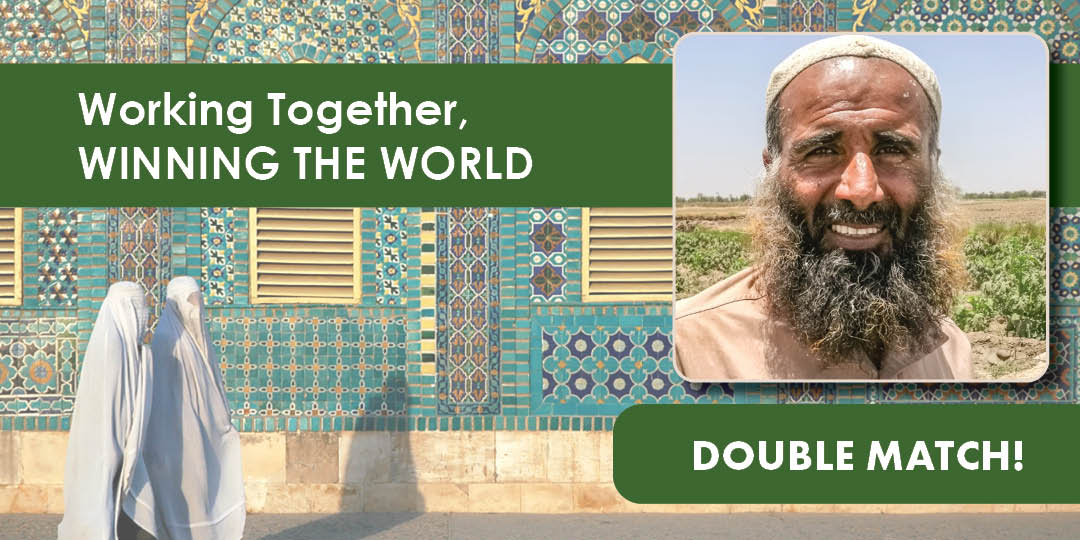
Want to double your impact? We currently have a DOUBLE MATCH opportunity as we are “Working Together, Winning the World.” More details here. Help us broadcast the Gospel into the Dari, Hindi, and more languages! Your gift will be matched, up to 80k, from the Double Matching Fund.