In this week’s Voice of Hope episode, J. Mark Horst teaches from Revelation 19:11-21, exploring how Christ the glorious conqueror will return to judge the nations and establish His righteous rule. In this passage, John uses names for Christ that reveal His character, and Christ’s appearance reveals aspects of His rule. As we look forward to the Great Day of God Almighty, we are reminded of the hope we have in Christ’s return.
You’ve probably heard the saying, “Anticipation is half the fun.” Whether we’re planning a vacation, moving to a new location, getting a different car, or shelling out money for the latest iPhone, excitement builds as we head to the airport, pack the U-Haul, savor that “new car” smell, or track the UPS shipment, eagerly waiting for our order to arrive.
If your experiences have been like many of mine, sans the iPhone, I’d say anticipation is more than half the fun. Somehow, when the anticipated time arrives, or your purchase is delivered, there’s often a bit of a letdown.
One writer explained waiting for the delivery of his new iPhone: I know by the time you read [my] weekly letter next week I’ll already have adapted to the new phone. It won’t feel special, or new, or like my life is any different. This is a total bummer. Not in like a “that cost me twelve hundred bucks” way, but more a “what is the point of life if my favorite product on Earth gives me fewer than 7 days of joy” kind of way.
To which I can already hear some of you thinking, “Come on, it’s just a dumb phone. Obviously you can’t expect it to change your life.”[1] And yet we often think this way, don’t we? And as long as we live on this earth, we’ll need to deal with this reality.
However, every genuine follower of Christ can anticipate a singular future event; I guarantee you the reality will far exceed the anticipation. It is the Second Coming of our Lord and Savior Jesus Christ as KING OF KINGS AND LORD OF LORDS on the great day of God almighty! Indeed, as Paul writes in 1 Corinthians 2:9, paraphrasing the prophet Isaiah, “Eye has not seen, nor ear heard, nor have entered into the heart of man the things which God has prepared for those who love Him.”
As we continue our study in Revelation, we have arrived at the day spoken of in chapter 16, verses13-14, recording the sixth bowl judgment: “And I saw three unclean spirits like frogs coming out of the mouth of the dragon, out of the mouth of the beast, and out of the mouth of the false prophet. They are spirits of demons, performing signs, which go out to the kings of the earth and of the whole world, to gather them to the battle of that great day of God Almighty.” Our text is Revelation 19:11-21, and I’ve titled our study “The Great Day of God Almighty.”
11 Now I saw heaven opened, and behold, a white horse. And He who sat on him was called Faithful and True, and in righteousness He judges and makes war.
12 His eyes were like a flame of fire, and on His head were many crowns. He had a name written that no one knew except Himself.
13 He was clothed with a robe dipped in blood, and His name is called The Word of God.
14 And the armies in heaven, clothed in fine linen, white and clean, followed Him on white horses.
15 Now out of His mouth goes a sharp sword, that with it He should strike the nations. And He Himself will rule them with a rod of iron. He Himself treads the winepress of the fierceness and wrath of Almighty God.
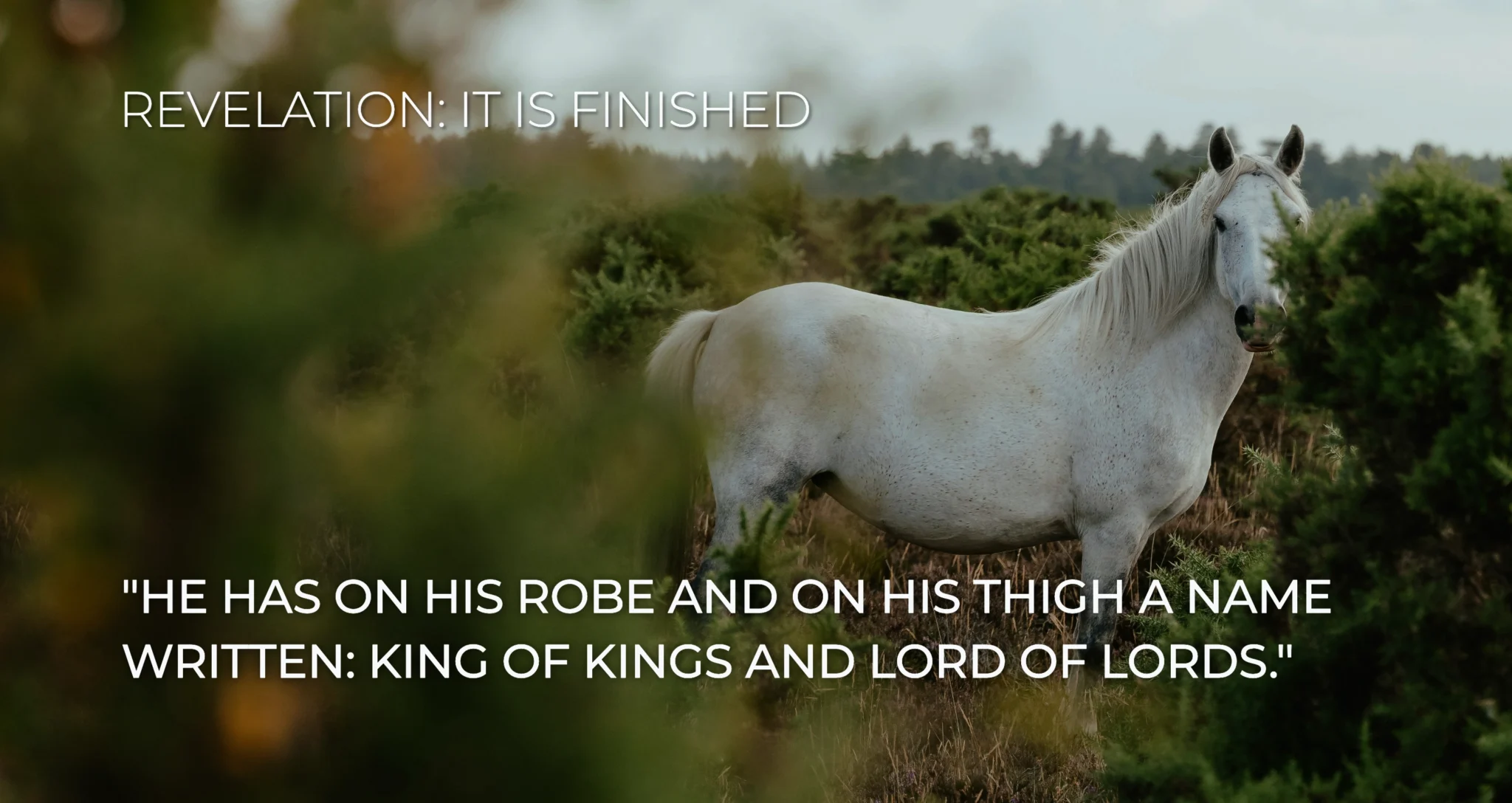
16 And He has on His robe and on His thigh a name written:
KING OF KINGS AND
LORD OF LORDS.
17 Then I saw an angel standing in the sun; and he cried with a loud voice, saying to all the birds that fly in the midst of heaven, “Come and gather together for the supper of the great God,
18 that you may eat the flesh of kings, the flesh of captains, the flesh of mighty men, the flesh of horses and of those who sit on them, and the flesh of all people, free and slave, both small and great.”
19 And I saw the beast, the kings of the earth, and their armies, gathered together to make war against Him who sat on the horse and against His army.
20 Then the beast was captured, and with him the false prophet who worked signs in his presence, by which he deceived those who received the mark of the beast and those who worshiped his image. These two were cast alive into the lake of fire burning with brimstone.
21 And the rest were killed with the sword which proceeded from the mouth of Him who sat on the horse. And all the birds were filled with their flesh.
This text reveals several DETAILS that should fuel our anticipation as we await the Great Day of God Almighty.
The First DETAIL is,
The Glorious Conqueror
John wrote, “I saw heaven opened…” Think of other times recorded in Scripture when the heavens opened: at Jesus’ baptism (Matthew 3:16); Jesus promising the disciples they would see this phenomenon (John 1:51); and when Stephen was martyred (Acts 7:55).
But this opening of heaven is different from any that has occurred or will occur till then. This one is for the glorious appearance of Christ with his saints. Just as we believe that “he ascended into heaven, and sits on the right hand of God the Father,” so we believe that from there “he will come to judge the living and the dead.” The Lamb, now married, leaves the Father’s house and comes to take possession of what is his own.
Even a casual study should make the contrast between this event and the church’s “catching-up” clear. At the Rapture, Christ meets His own in the air, and there is no evidence of immediate judgment upon the earth (1 Thessalonians 4:13-18). At the Second Coming, Christ comes to earth with His saints to bring divine judgment and establish His righteous rule for 1,000 years (Revelation 20:4).
As the heavens opened, John saw “a white horse.” For John’s readers, picturing the white horse and rider, followed by the armies of heaven, gave a clear message. They were very familiar with the pageantry, worship, and rewards of Roman generals returning victoriously from conquering their enemies. John’s glimpse into the open heavens revealed a victory parade unlike anything the world had ever seen or ever would.
Interestingly, we encountered a rider on a white horse in Revelation 6:2 at the opening of the first of the ‘seal judgments.’ “And I looked, and behold, a white horse. He who sat on it had a bow; and a crown was given to him, and he went out conquering and to conquer.” The rider is not named in either text, but they cannot be the same. From chapter six, I conclude that this is the beginning of the Antichrist’s reign, which he will consolidate through negotiation and persuasion rather than force. Later, he reveals his true character as a ruthless tyrant! This usurper blasphemously assumed control over the world, aiming to displace God and His plan.
In our text, the description and everything said of the rider on the white horse unmistakably identifies him as the same Jesus who ascended to heaven from the Mount of Olives before the watching eyes of His disciples. At His Second Coming, His holy feet will stand again on those same sacred heights (Zechariah 14:4). His appearing in this scene stands in stark contrast to His first coming, when He rode meekly into Jerusalem on a donkey colt. Now, in His majesty, He rides prosperously because of His truth, meekness, and righteousness (Psalm 45:4).
Notice how the rider on the white horse in our text is identified. “He who sat on him was called Faithful and True, and in righteousness He judges and makes war.” The description of Jesus as Faithful and True echoes Revelation 3:14 and clearly distinguishes Him from those He is coming to judge. The Dragon, the Antichrist, and the false prophet are all deceivers through and through; it is their character and their modus operandi.
But their deception will not stand! Christ will judge with righteous judgment. He judges the beast (Antichrist), the false prophet, and their followers, and makes war on them. When sin becomes irredeemable and incurable by corrective measures, it must be put down by force of arms. Mercy slighted and abused brings the executioner. The world banded together in arms against its true Sovereign; now He brings the sword of insulted majesty against it.
The depiction of Christ’s appearance reminds us of the initial picture we’re given in Revelation 1:13-16. His eyes, like a flame of fire, see through and through, search all the depths, look beneath all the masks, penetrate all darkness, and test everything, even to the smallest fragment. This flaming vision speaks of the fierceness of His wrath against His enemies. If there were ever a time when looks could literally kill, this would be it!
Further, to demonstrate His kingship, many diadems rest on His head. Many indicates that He has collected all the rulers’ crowns, signifying that He alone is the sovereign ruler of the earth. Collecting a vanquished king’s crown was customary in the ancient world (2 Samuel 12:30). The Dragon has seven diadems on his seven heads, as the possessor of the seven great world powers (chap. 12:3). The Beast has ten diadems on his ten horns, as combining ten sovereignties. (Chap. 13:1). The collection of crowns expresses accumulated victory and dominion. Christ comes as the One anointed and endowed by heaven to bring an end to Satanic rule and deception finally.
He bears a name no one knows except Himself. Since this is stated as a fact, all speculation is useless. Jesus may have been thinking of this when He said, “All things have been delivered to Me by My Father, and no one knows the Son except the Father. Nor does anyone know the Father except the Son, and the one to whom the Son wills to reveal Him” (Matthew 11:27).
In addition, He wears a garment sprinkled with blood. This is not the blood of redemption; this is the blood of His enemies. The prophet wrote, “I have trodden the winepress alone, and from the peoples no one was with Me. For I have trodden them in My anger, and trampled them in My fury; their blood is sprinkled upon My garments, and I have stained all My robes. For the day of vengeance is in My heart, and the year of My redeemed has come” (Isaiah 63:3-4).
Some have wondered how His garments can be stained with blood before the battle begins. However, this is certainly not the first battle that Christ has fought against His enemies. Who but He “cut Rahab and wounded the Dragon?” Who but He fought for Israel “in the days of Joshua, when opposing kings were put to the sword and all their armies?” Who but He “fought from heaven” against the kings of Canaan in Taanach by the waters of Megiddo, when “the stars in their courses fought against Sisera?”[2] Truly, He has many victories to His credit!
Another description of the glorious conqueror, who appears in this great day of God Almighty, is His name – The Word of God. This name belongs originally and essentially to Him. This is consistent with John’s other writings. “In the beginning was the Word, and the Word was with God, and the Word was God” (John 1:1).
H. A. Ironside points out the significance of the three names given to Christ in this text: “A Name written that no man knew but He Himself” speaks of His essential glory as the Eternal Son, concerning which He declared that “no man knows the Son but the Father.” The second name is “The Word of God.” [The third title is] “KING OF KINGS AND LORD OF LORDS.” In these three names we have set forth, first, our Lord’s dignity as the Eternal Son. Second, His incarnation—the Word became flesh. And, lastly, His second advent to reign as King of kings and Lord of lords.”[3]
Verses 15 and 16 give us further details of our glorious conqueror. “Out of His mouth goes a sharp sword, that with it He should strike the nations. And He Himself will [shepherd] them with a rod of iron. He Himself treads the winepress of the fierceness and wrath of Almighty God. And He has on His robe and on His thigh a name written: KING OF KINGS AND LORD OF LORDS.”
The word for “sword” refers to a long Thracian sword, unusually large and longer than most swords. Its size demanded both hands, so the fighter relied on the sword’s momentum rather than a shield for defense. By New Testament times, the term evoked an image of overwhelming, almost unstoppable force—an ideal metaphor for decisive judgment. Here the word is used symbolically to represent a sharp instrument of war with which Christ will smite the nations and establish His absolute rule. His word will slay His enemies!
This shows how easily He accomplishes His purpose. He speaks, and it is done. He commands, and it is accomplished. He demonstrated this when the armed mob came to arrest Him in Gethsemane. “When He said to them, ‘I am He,’ they went backward, and fell to the ground.” (John. 18:5.) If such a mild statement caused his enemies to fall back then, what will it be when He crowns himself for the “battle of the great day of God Almighty”—when He comes with the armies of heaven to tread the winepress of the fierceness of Jehovah’s anger? Resistance will be absolutely futile!
His rule over the nations with a rod of iron is prophesied in Psalm 2:8-9, “Ask of Me, and I will give You the nations for Your inheritance, and the ends of the earth for Your possession. You shall break them with a rod of iron; You shall dash them to pieces like a potter’s vessel.’”
Christ will swiftly judge all sin and instantly put down any rebellion. All people will be required to conform to His law or face immediate judgment. Using the same imagery of ruling with a rod of iron, Jesus promised that believers would rule under Him in the kingdom: “He who overcomes, and he who keeps My deeds until the end, to him I will give authority over the nations; and he shall rule them with a rod of iron, as the vessels of the potter are broken to pieces, as I also have received authority from My Father” (2:26–27).[4]
Another image of the completeness of judgment is His trampling of His enemies in “the winepress of the wine of the wrath of the anger of God Almighty.” This vivid symbol of God’s wrath comes from the ancient practice of stomping on grapes as part of the wine-making process. The splattering of the grape juice pictures the pouring out of the blood of Christ’s enemies. Together, these passages (Isaiah 63 and Revelation 14:19-20) reinforce the sad conclusion that, on the day of judgment, God’s mercy is unavailable. Nothing is more inflexible than divine judgment when grace has been spurned. These scenes of awful judgment flatly contradict the modern view that God is dominated entirely by His attribute of love.
The concluding description of Christ reveals that on His robe, previously described as dipped in blood, and also on His thigh, a name is written, “KING OF KINGS, AND LORD OF LORDS.” The Psalmist sang in anticipation, “Gird thy sword upon thy thigh, O most Mighty” (Psalm 45:3). Normally, the warrior carries his sword on his thigh; but here the sword proceeds from Christ’s mouth, and in its place is a name representing it; for the Psalmist defines the sword in this case as his glory and majesty. The sword stands for authority and the right to punish evildoers. It tells of the majesty and dominion of him who bears it. And the authority, majesty, and dominion of Christ are this: that he is “King of kings and Lord of lords,” now no longer mere theory or appointment, but present assertion, armed to enforce his rights.[5]
John’s vision presents the victorious Christ astride a white war-horse (19:11-16). The title appears twice: “on His robe” and “on His thigh.” This double location is unique in Scripture and deliberately conspicuous, emphasizing total, public, and permanent authority as Christ rides to judgment and redemption. From a mounted perspective, the outer thigh sits at observers’ eye level. Graeco-Roman cavalry often branded or emblazoned insignia on the thigh-guard (fascia) for quick identification in combat. John’s detail captures that wartime realism: everyone, angelic and human, can read His supremacy.
Further, swearing “under the thigh” (Genesis 24:2-3) invoked the covenant-marker of circumcision. Displaying Christ’s title on His thigh signals the unbreakable covenant He fulfilled and now enforces. Ancient Near Eastern idiom placed “power” or “offspring” in the thigh (Genesis 46:26). It proclaims that the fullness of divine potency rides with Him. A final detail: Hebrew legal practice reinforced agreements with duplicate witnesses (Deuteronomy 19:15). By engraving the same royal title in two places, John shows that Christ’s kingship is doubly attested—irrefutable in heaven and on earth, in priestly garment and warrior thigh, in covenant and in conquest.
What an awesome description of this Glorious Conqueror. Join me next time as we look at 3 additional details that will fuel our anticipation of the Great Day of God Almighty!
[1] McKendrick, Trevor, Anticipation is Half the Fun, Online Essays
[2] Seiss, Joseph, Lectures on Revelation, p. 437
[3] Ironside, H. A. Lectures on the Book of Revelation, p. 330
[4] MacArthur, John, New Testament Commentary on Revelation, p. 938
[5] Seiss, Joseph, Lectures on Revelation, p. 437