What does the marriage supper of the Lamb reveal about Christ and His Church? In this episode, J. Mark introduces us to Revelation 19:6-10, examining the preparation of the bride, the blessing of those invited to the marriage supper, and the angel’s command to worship God alone. He also explores how Jewish wedding traditions shed light on this passage, and how the church, the bride of Christ, must remain spiritually alert as we await His return.
In most cultures, weddings are happy, festive occasions. Most include music, feasting, dancing, revelry, and other activities or traditions. However, only weddings centered on Christ contain true joy because participants know that God designed marriage to illustrate Christ’s relationship with His church. They realize they are entering a binding covenant relationship for life and need Jesus as the third strand of the threefold cord (Ecclesiastes 4:12) to ensure the relationship endures.
Recently, I had the privilege of attending a wedding in my extended family. Because it united two committed Christians, it was a joyous celebration. It began with worship and praise to God. That was appropriate – marriage was God’s idea, and He is worthy of praise. The pastor who delivered the wedding sermon emphasized the solemnity and permanence of this biblical covenant, as well as the joy that comes when husband and wife fill their biblical roles. The guests’ presence (whether they realized it or not) signified that they had a role in holding this newlywed couple accountable for the vows they made to each other before God.
The New Testament makes it undeniably clear that the church is the Bride of Christ. However, it is also clear that the marriage has not yet been consummated.
Paul’s teachings support this conclusion. In 2 Corinthians 11:2, Paul wrote, “For I am jealous for you with godly jealousy. For I have betrothed you to one husband, that I may present you as a chaste virgin to Christ.” Further, in Ephesians 5:25-27, “Husbands, love your wives, just as Christ also loved the church and gave Himself for her, that He might sanctify and cleanse her with the washing of water by the word, that He might present her to Himself a glorious church, not having spot or wrinkle or any such thing, but that she should be holy and without blemish.”
Our text is Revelation 19:6-10, which records the marriage supper of the Lamb. The scenes John saw included worship, the bride’s readiness, the blessing on the guests, and a final reminder of Jesus’ preeminence. Please follow carefully as I read this portion of Holy Scripture.
6 And I heard, as it were, the voice of a great multitude, as the sound of many waters and as the sound of mighty thunderings, saying, “Alleluia! For the Lord God Omnipotent reigns!
7 Let us be glad and rejoice and give Him glory, for the marriage of the Lamb has come, and His wife has made herself ready.”
8 And to her it was granted to be arrayed in fine linen, clean and bright, for the fine linen is the righteous acts of the saints.
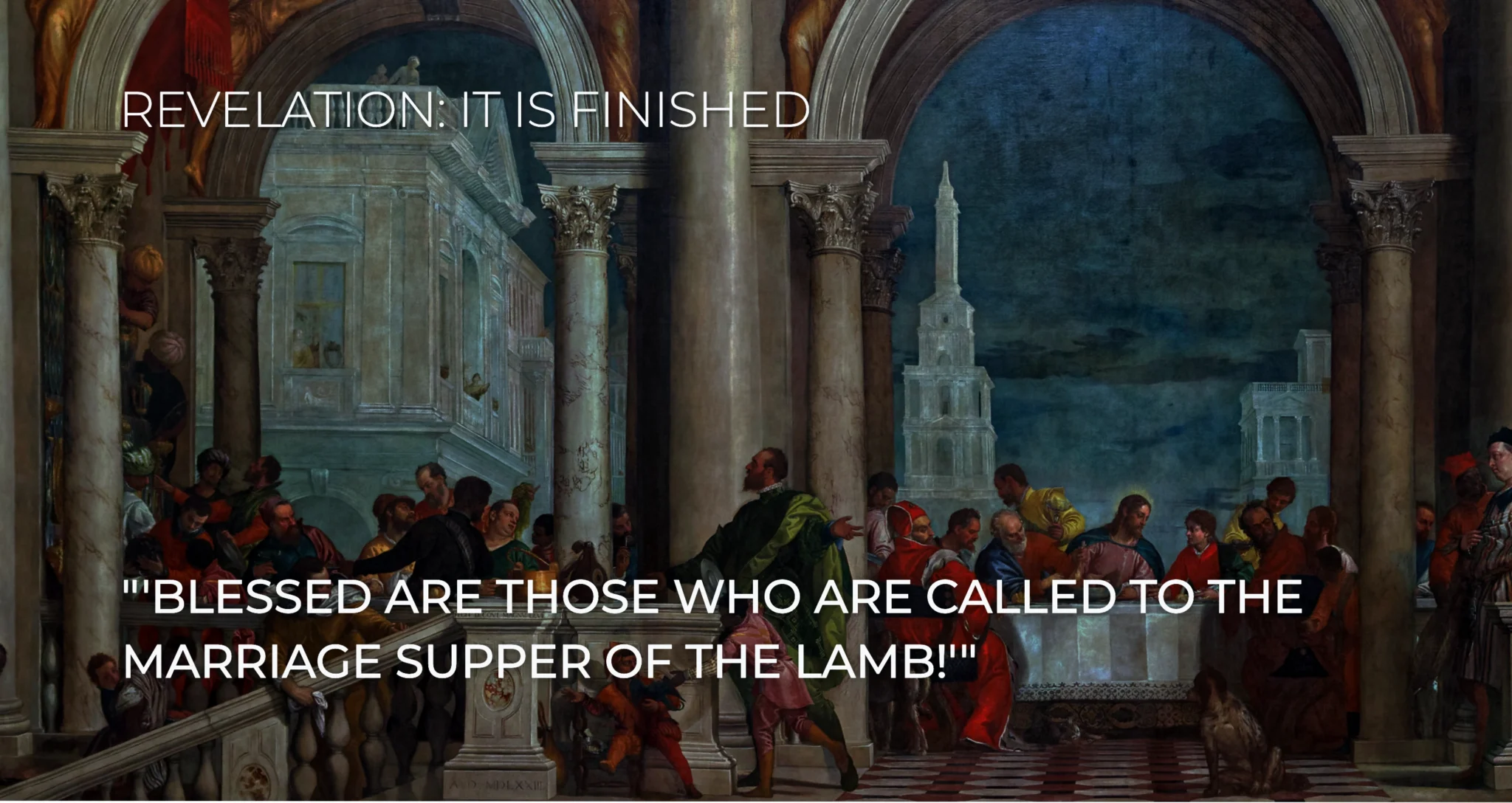
9 Then he said to me, “Write: ‘Blessed are those who are called to the marriage supper of the Lamb!’ ” And he said to me, “These are the true sayings of God.”
10 And I fell at his feet to worship him. But he said to me, “See that you do not do that! I am your fellow servant, and of your brethren who have the testimony of Jesus. Worship God! For the testimony of Jesus is the spirit of prophecy.”
This text invites us to view the awesome SCENES of the marriage of the Lamb so we can anticipate this blessed event!
The First SCENE is,
The Preparation of the Bride
To understand the opening phrase of verse seven, we must know what preceded it. That’s why I included verse six in my reading, although we covered it in the previous episode. Verse six records the great multitude proclaiming, “Alleluia! For the Lord God Omnipotent reigns!” Because God reigns, the multitude is exhorted to “keep on being glad and rejoicing and give Him glory.”
The first three alleluias in this chapter rejoiced in God’s righteous judgment on Babylon and her wickedness. Righteousness has finally triumphed once and for all! The Harlot (false religion) has been swept away, and the faithful True Woman is about to receive her rightful honors. The betrothed, who has waited so long through persecution, contempt, and sacrifice, now becomes the Bride. The final alleluia rejoices in the anticipation of the Lamb’s marriage. Heaven rejoices because “the marriage feast of the Lamb has come at last.”
The bride has prepared herself for this moment! How does the bride prepare herself? “Beloved, now we are children of God; and it has not yet been revealed what we shall be, but we know that when He is revealed, we shall be like Him, for we shall see Him as He is. And everyone who has this hope in Him purifies himself, just as He is pure” (1 John 3:2-3). Other Scriptures regarding the bride’s preparation include Jude 1:21 and 2 Corinthians 7:1. However, Ephesians 5:25-27 shows that Christ’s act is the primary preparation. He sanctifies and cleanses His bride.
As I said in my introduction, the Lamb’s bride is indisputably the church. A pretribulational rapture is consistent with the great multitude of tribulation saints, who see the Lamb’s wife as an entity other than themselves. In the Old Testament, Israel is called the “wife” of Jehovah, while the New Testament church is called “the bride of Christ.”
To understand what is happening in our text, we must understand Jewish wedding practices when John wrote Revelation. A Jewish wedding had four stages. The “arrangement” came first. In this stage, the groom’s father met with the bride’s father and paid the bride price. This often occurred when the bride and groom were children. In some arrangements, the couple never saw each other until their wedding day! This was Arnold Fruchtenbaum’s grandparents’ experience. He is a Jewish believer in Yeshua, and I have deeply appreciated his book, “The Footsteps of the Messiah,” in my study of Revelation.
The next stage was called “the fetching of the bride.” After at least a year (often much longer), the groom would go to the bride’s home and bring her back to his hometown. Following her ritual cleansing, or mikvah, the wedding would take place, marking the third stage. A small group of family and close friends usually attended. The final stage was the wedding feast, which traditionally lasted seven days. Many more people were invited to the feast than to the wedding.
In reference to Jesus and His bride, the church, the first stage was fulfilled when God, the Father of the groom, made the arrangement and paid the bride price, the blood of His Son (Ephesians 5:22-23). Stage two, the fetching of the bride, will occur at the Rapture when Jesus comes to bring His bride home. Just as a long time could pass between these first two stages of a Jewish wedding, so it has been with the church. Only the Father knows the timing of this event, but in the interim, Jesus is preparing the place for His bride (John 14:1-3).
The third stage, the marriage ceremony, will take place in heaven just before Christ’s Second Coming, as our text describes. The wedding announcement will be made (v. 6), and the bride will be fully prepared (v. 7); she will be wearing her finished bridal gown. Notice that Christ gives her the bridal dress as a gift. It is described as “fine linen, clean and bright, because the fine linen is the righteousnesses [position and acts] of the saints.”
This must mean that the bema judgment of 2 Corinthians 5:10 is completed. In 2 Corinthians 3:11-15, Paul wrote, “For no other foundation can anyone lay than that which is laid, which is Jesus Christ. Now if anyone builds on this foundation with gold, silver, precious stones, wood, hay, straw, each one’s work will become clear; for the Day [of judgment] will declare it, because it will be revealed by fire; and the fire will test each one’s work, of what sort it is. If anyone’s work which he has built on it endures, he will receive a reward. If anyone’s work is burned, he will suffer loss; but he himself will be saved, yet so as through fire.”
This is not a judgment of sin for salvation, but a judgment of works, the basis of rewards, i.e., the fine linen of the robe of righteousnesses. This corresponds to the ritual cleansing of the Jewish wedding practices. Christ will reward us according to our faithfulness, and the rewards we receive will make up the “wedding gown.” Dr. Lehman Strauss wrote, “Has it ever occurred to you…that at the marriage of the Bride to the Lamb, each of us will be wearing the wedding garment [at least partly] of our own making?” What a solemn thought!
The final stage of the Jewish wedding is the marriage feast, and that leads us to the next scene in the marriage of the Lamb. Remember that, for the marriage ceremony, the guests are few, but many are invited to the marriage feast.
The Next SCENE is,
The Blessing of the Guests
In verse 9, the angel commands John to write the 4th beatitude of this letter. “Blessed are those who are invited to the marriage supper of the Lamb!” So who are the guests, those invited to the marriage feast? As we explore this question, I will share my conclusions, and I hope to do so humbly and with a teachable spirit. I urge you to remember that the goal of the book of Revelation is to unveil God’s plan, not obscure it. That said, some things are hard to understand, and some will likely be understood only by those who live in this end time.
I think we can agree that those invited to the marriage supper are guests, not part of the Bride of Christ, the church. The Bride has a relationship with the Bridegroom that belongs to her alone! However, the guests are her companions and associates. If all saved persons were actually the Bride, then it would be enough to say, “Blessed are those who are called to be the Wife of the Lamb.” Joseph Seiss, Arnold Fruchtenbaum (whom I mentioned earlier), and others believe the guests are the saints of the Old Testament and the Tribulation, who will soon (in that setting) be resurrected. That resonates with me because the blessedness of the marriage supper extends beyond the Bride, even though she has a special place of honor that belongs to her alone.
However, we should keep in mind that while this feast is held in honor of the bride and groom and will be glorious beyond imagination, they will not celebrate alone. Whoever, in any language, tribe, or people, down through the ages, has trusted in the promised seed of the woman and embraced God’s call and promises will also be there. Whether bride or guest, the whole assembly of the firstborn from Adam down to the last martyr of the Tribulation will be there! They will be glad and rejoicing and giving Him glory, for the marriage of the Lamb has come, and His wife has prepared herself.
Further, “What is the marriage feast?” Even in our culture, the marriage ceremony and the wedding reception are not the same. Scripture speaks of this feast many times. Immediately after God’s pronouncement of judgment on the wicked in chapter 24, Isaiah 25:6-8 says, “And in this mountain [Zion] the Lord of hosts will make for all people a feast of choice pieces, a feast of wines on the lees, of fat things full of marrow, of well-refined wines on the lees. And He will destroy on this mountain the surface of the covering cast over all people, and the veil that is spread over all nations. He will swallow up death forever, and the Lord God will wipe away tears from all faces; the rebuke of His people He will take away from all the earth; for the Lord has spoken.”
Of this marriage feast, Joseph Seiss writes, “As Melchisedek, king of righteousness, and king of peace, brought forth bread and wine to Abraham returning from the scenes of judgment upon the marauding kings (Genesis 14), so will he whom Melchisedek typified spread before his victorious people the precious [delicacies] of a heavenly banquet, of which our holy Lord’s supper is the constant prophecy and foretaste.”[1]
Jesus spoke to His disciples about this feast in Matthew 26:28-29 in the context of the final paschal meal. “For this is My blood of the new covenant, which is shed for many for the remission of sins. But I say to you, I will not drink of this fruit of the vine from now on until that day when I drink it new with you in My Father’s kingdom.” While we do not know what kind of food we will eat, we can be sure it will be of the finest quality, and we are awaiting that day with anticipation.
And what confidence is there in this blessedness we live and die for? The angel’s words: “These are the true words of God.” No, these things are not just in our imagination. Yes, there is a Lamb, once slain, now risen and glorified. He is moving serene and mighty amid the principalities of eternity. He himself is the highest of them all, to whom all believers stand betrothed and pledged. They are preparing and waiting for a wedding day to come, when they shall be joined to him in fellowship, glory, and dominion forever.
A city of gold, light, and jewels is being built for God’s people for many ages, and is now nearing readiness for their everlasting habitation. A banquet awaits when the honored Bride sets foot upon its golden streets; the call, if heeded, is man’s superlative blessedness. No room remains for doubt, for “these are the true words of God.”[2]
As the overpowering reality of these promises impresses itself on John’s consciousness, we observe the final scene in the marriage of the Lamb.
The Final SCENE is,
The Command of the Angel
Try to put yourself in John’s shoes. Remember, he has been banished to the desolate isle of Patmos for his commitment to Jesus. His flock of believers in Ephesus has lost their senior shepherd and is facing severe persecution. His letters reveal how deeply he cared for them.
This amazing vision and the angel’s message so thrilled John’s soul, and stimulated his sense of wonder and worship, that he fell prostrate before the angel. The entrancing magnificence of the final portion of the saints—the overwhelming majesty of the glory to come when the Bridegroom appears — bent John’s soul in awe, even toward the messenger who told him. He either felt that the angel represented God, or he was beside himself with excitement at this glorious vision of the consummation.
Immediately, the angel prevents him from acting on his impulse. “Do not do that, because I am your fellow servant…” Instead, “Worship God! Because the testimony of Jesus is the spirit of prophecy.” This means that prophecy is designed to unfold the beauty and loveliness of our Lord and Savior Jesus Christ. In the present age, the Spirit of God is not only to glorify Christ but to show believers things to come as they relate to His person and majesty (John 16:13).
Jesus is the source of all prophecy, and all prophecy moves toward its fulfillment by Him with a view toward his glory. Thus, a true prophet, inspired by the Holy Spirit, will testify that God was indeed incarnate in the man Jesus (1 John 2:22; 4:1-3). Therefore, Jesus is God and is to be worshipped, but He alone.
After viewing these scenes from the marriage supper of the Lamb, how do you respond? What is the condition of your heart? You’ve been invited to the marriage supper of the Lamb; how have you responded?
The cry has long been ringing in your ears, “Behold, the Bridegroom comes!” Are you spiritually alert, with your lights burning like unto those who wait for their Lord? Or are you like the evil servant in Matthew 24:45-51 who is partying and abusing others to get what you want? “Even so, Christ will come on a day when you are not looking for him and at an hour that you are not aware of, and will cut you in two and appoint you a portion with the hypocrites. There shall be weeping and gnashing of teeth.” God forbid that this should be your experience!
[1] Seiss, Joseph, Lectures on Revelation, p. 431
[2] Ibid, p. 433